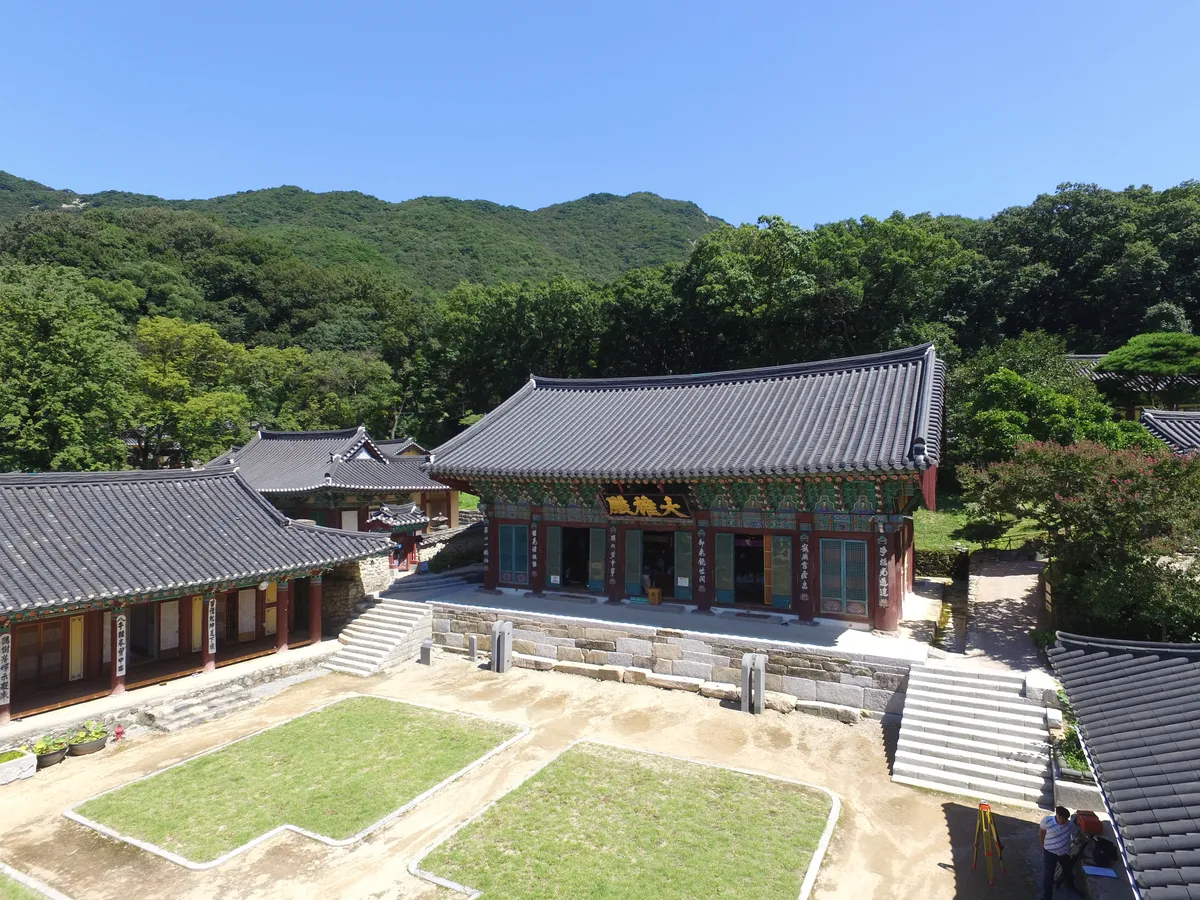
Gapsa Daeungjeon Hall, Gongju
公州 甲寺 大雄殿
충청남도 공주시
Basic information
- Designation
- Treasure No.2120
- Category
- Architecture
- Era
- 조선시대
- Designated year
- 2021
- Location
- 공주시, 충청남도— 충청남도 공주시 갑사로 567-3 (계룡면)
- Coordinates
- 36.365376, 127.187662
AI Docent
Coming soonAn AI-generated, friendly retelling of this heritage site is available in Korean. An English version is on our roadmap — for now, please see the official description below.
Description
Machine-translatedThis English description was machine-translated and may contain inaccuracies. Refer to the original Korean text for details.
Gapsa Temple's earliest founding tradition traces to the Silla Jinheung era in the sixth century, with Gapsa recognized as one of the Nine Buddhist Temples of Huayan teaching and confirmed in the 'Memorabilia of the Three Kingdoms' as established by at least the ninth century. Gapsa's Great Treasure Hall was rebuilt immediately after the Imjin War and underwent multiple repairs continuing to the present. Seventh-century records mention a separate 'gold hall site,' indicating the temple's original Silla-era location differs from the Great Treasure Hall's current position, though it likely represents one of the earliest post-Jeongyu reconstruction structures and maintained its formal characteristics thereafter. Considering the 1617 creation date of 'Gapsa Colored Clay Tripartite Buddha' (Treasure) housed in the Great Treasure Hall interior and the 1650 painting date of 'Gapsa Triple Divine Hanging Scroll' (National Treasure), along with the 'Gapsa Historical Monument' erected in 1659, the Great Treasure Hall's construction is confirmed as early-seventeenth-century. As seventeenth-century architecture, Gapsa Great Treasure Hall exhibits transitional-period characteristics. The five-bays front, three-bays-side configuration appears infrequently; dimensions employing simple eight and twelve-cubit proportions, identical front and rear bracket styles on gable roofs with equal-spacing arrangements represent pre-late-Joseon architectural conventions. The minimally processed curved timber creating new aesthetics in wood construction represents emerging period trends. Such characteristics evidence Gapsa Great Treasure Hall's significance in sharing expanded multi-bracket gable roof forms of the seventeenth century while proposing late-Joseon architectural tendencies with considerable historical building value. Gapsa Great Treasure Hall preserves well-documented chronology and related relics, retains mid-seventeenth-century multi-bracket gable construction characteristics in floor planning, bracket composition techniques, upper framework and baldachin structures, and houses treasured Buddha statues and paintings alongside the building's history. As the five-bay-front relatively large-scale Great Treasure Hall of Unified Silla's preeminent ancient temple representing South Chungcheong Province, possessing significant architectural dating and historical value.
Location
지도를 불러오는 중…
Have you visited this place?
Log in and verify your visit on-site via GPS to record a stamp in My Journey. (QR verification coming later.)
Images: KOGL (khs.go.kr) · Data source: Korea Heritage Service Open API (khs.go.kr)