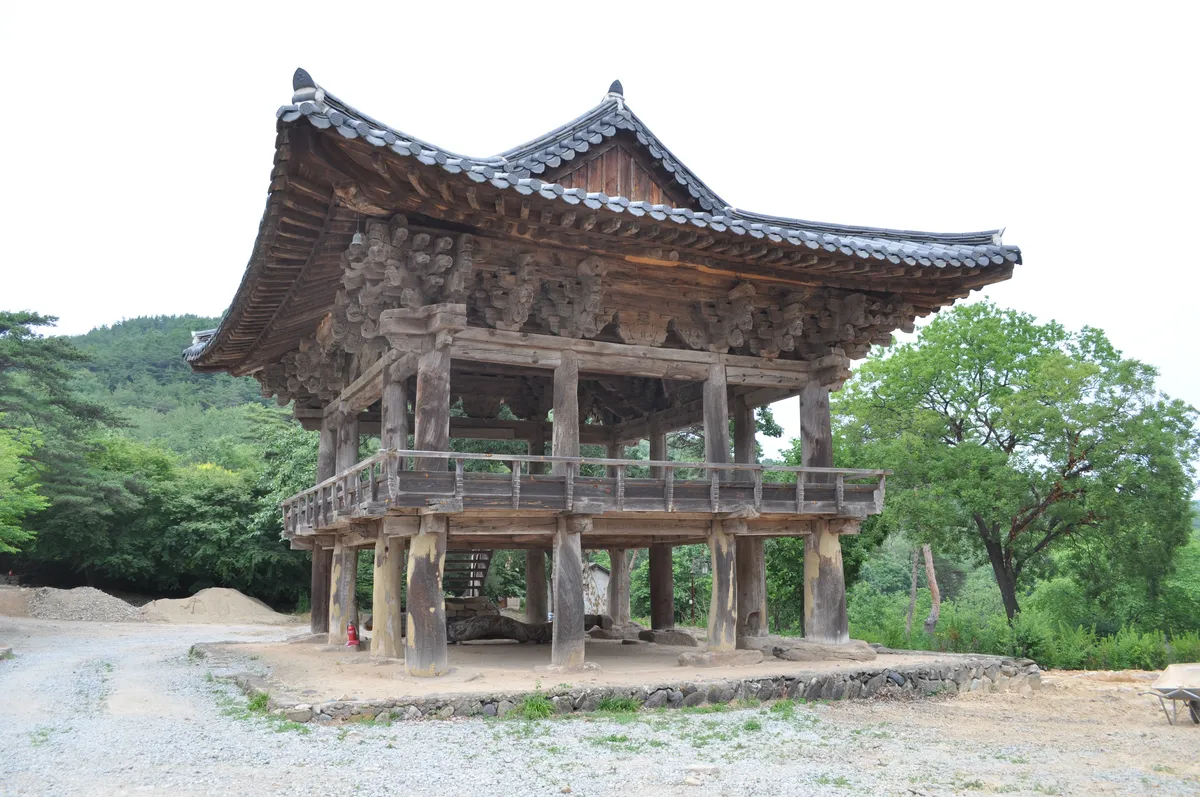
Daegoksa Beomjong Pavilion, Uiseong
義城 大谷寺 梵鐘樓
경상북도 의성군
Basic information
- Designation
- Treasure No.2121
- Category
- Architecture
- Era
- 조선시대
- Designated year
- 2021
- Location
- 의성군, 경상북도— 경상북도 의성군 대곡사길 80 (다인면)
- Coordinates
- 36.490174, 128.377647
AI Docent
Coming soonAn AI-generated, friendly retelling of this heritage site is available in Korean. An English version is on our roadmap — for now, please see the official description below.
Description
Machine-translatedThis English description was machine-translated and may contain inaccuracies. Refer to the original Korean text for details.
Based on Daegoksa's temple reconstruction records and historical documents, construction occurred under Royal Preceptor Jigong during King Gongmin's era of late Goryeo, though unearthed bronze Buddha statuary of Unified Silla late-period style (discovered 1960) suggests founding during the Silla late-period, with minimum dating to pre-mid-Goryeo. The Daegoksa Bell Pavilion underwent total destruction during the Imjin War and Jeongyu Rebellion and underwent reconstruction between 1644 and 1683 during the mid-to-late-seventeenth century. The Bell Pavilion features a three-bays front, three-bays-side two-story pavilion design. Among existing pavilion buildings, seventeenth-century early examples largely maintain three-bay floor plans, with subsequent pavilion configurations expanding from three bays to five or seven bays. Examining this expansion trajectory, the Bell Pavilion represents relatively early seventeenth-century characteristics among surviving pavilion structures. Lower-level pillars feature natural-curved timber posts and finished cylindrical columns, while upper-level pillars are entirely finished cylindrical columns. Curved posts employed in lower-level structures reflect post-Imjin War material shortages and Joseon late-period naturalism philosophy, appearing frequently in temples and residential structures, representing characteristic carving techniques of the reconstruction era. Main beams typically consist of single elements, yet this pavilion employs two-stage identical-sized beams, an uncommon arrangement where upper beams function as primary supports and lower beams as support pedestals. This configuration is difficult to locate in other pavilion or temple structures, meriting specific notation as characteristic. Even placing brackets within bays employs multi-bracket styling with ornamental brackets in each center bay—predominantly multi-bracket and column-header bracket style configurations representing eclectic architectural design. Ornamental brackets rest on center-bay frames supporting upper structures through intentional design, with front and rear facades appearing larger and more elaborate than side facades. Bracket first- and second-offset shapes, decorative elements of window frames and numerous components retain mid-to-late-Joseon architectural characteristics. Particularly notable is the center-bay bracket omission on front and rear facades substituting ornamental brackets, representing hybrid-style differentiation from existing hybrid multi-bracket structures, with distinctive positioning warrants attention. Contemporary records verify construction and reconstruction foundations with original form preservation. Mid-seventeenth-century architectural style preservation demonstrating regional Buddhist temple flourishing characteristics merits sufficient value for architectural transformation examination.
Location
지도를 불러오는 중…
Have you visited this place?
Log in and verify your visit on-site via GPS to record a stamp in My Journey. (QR verification coming later.)
Images: KOGL (khs.go.kr) · Data source: Korea Heritage Service Open API (khs.go.kr)