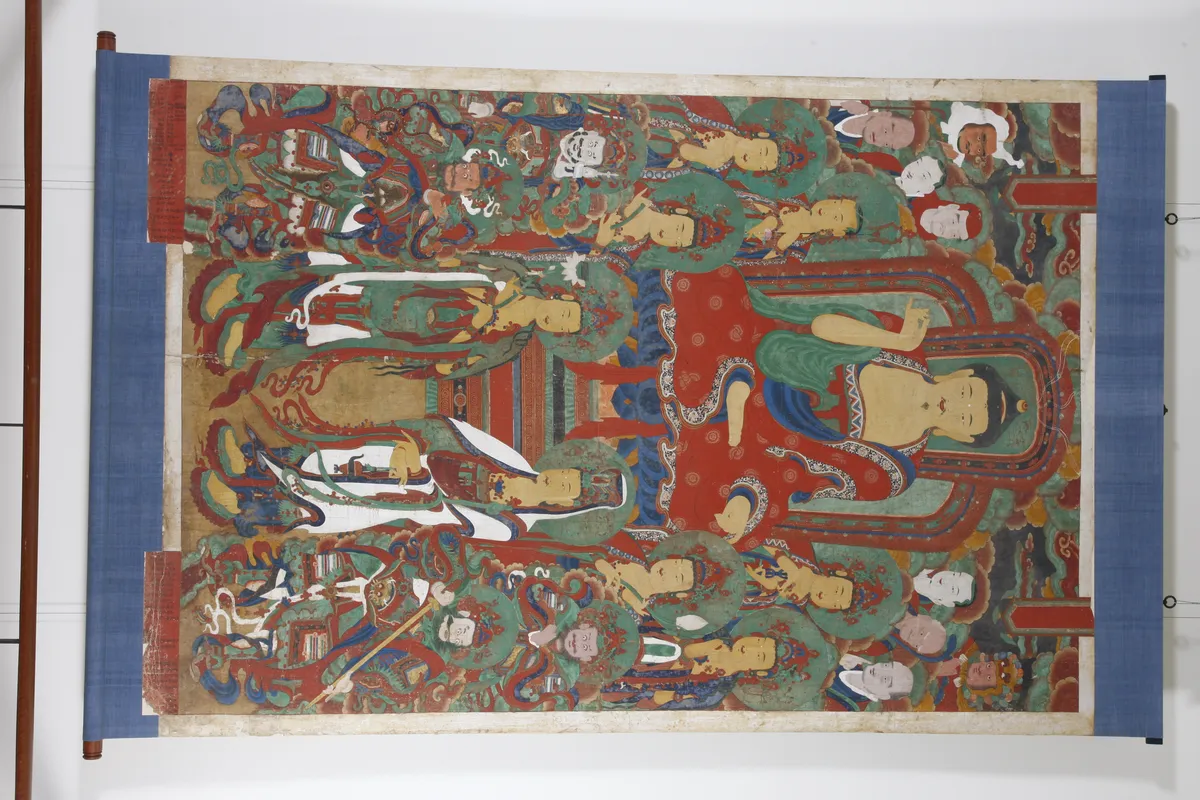
Baegyangsa Amitayeoraeseolbeopdo Mit Reliquary Objects, Jangseong
長城 白羊寺 阿彌陀如來說法圖 및 腹藏遺物
전라남도 장성군
Basic information
- Designation
- Treasure No.2123
- Category
- Painting
- Era
- 1775년(영조 51)
- Designated year
- 2021
- Location
- 장성군, 전라남도— 전라남도 장성군 백양로 1239(북하면, 백양사)
- Coordinates
- 35.461400, 126.755800Museum-based location
AI Docent
Coming soonAn AI-generated, friendly retelling of this heritage site is available in Korean. An English version is on our roadmap — for now, please see the official description below.
Description
Machine-translatedThis English description was machine-translated and may contain inaccuracies. Refer to the original Korean text for details.
The Amitabha Buddha Preaching Discourse Painting from Baekyang Temple in Jangseong was created in 1775 (fifty-first year of King Yeongjo) by eleven painters under the direction of master painter Saekmin. Newly created during the 1775 restoration of Amitabha Buddha statue in the Paradise Hall, though stolen in September 1994, this work was recovered in September 2006. The great chief patron and dharma-master Hwanwoldang Min Suk initiated the project to pray for the Pure Land rebirth of his maternal grandmother, the Yussi family couple, and his mother, the Bonggssi family couple. The consecration dedication text records 'Buddha statue gilding, Baekwoldang master gilding, Saekmin novice, upper platform painting canvas director painter, Gyeheon novice,' indicating Saekmin bore overall responsibility for Buddha statue gilding and painting creation, with Gyeheon leading multiple painters in execution. Master painter Saekmin studied under the eighteenth-century great master Uigyeom, himself becoming one of the era's representative painters, executing works from monumental hanging scrolls to Seven Stars paintings. While this work represents Saekmin's late period, from Gyeheon's perspective, this painting constitutes initial work as chief painter and early-to-middle period production. Consequently, this Jangseong Baekyang Temple Extreme Happiness Hall Amitabha Buddha Preaching Discourse Painting remains exceptionally significant for understanding the transmission and development of Uigyeom's painting style through Saekmin to subsequent painters including Gyeheon. The mounting underwent partial rebinding though the primary painting surface preserves creation-period original form without substantial damage. The composition arranges the primary Amitabha Buddha centrally with eight bodhisattvas and six disciples, Four Kings, and two groups of eight-part divine beings, creating simplified yet effective design. The composition features extended circular imagery from the primary Buddha's halo extending through attendant bodhisattvas and disciples populating the entire canvas, vertically elongated format, overwhelming primary Buddha figure, and slender attendant bodhisattvas creating grand and ascending impression throughout. These characteristics also appear in works by Saekmin including the 1757 Hwaeomsa Three Buddha Painting and 1764 Daeheungsa hanging scroll, confirming stylistic consistency. The Jangseong Baekyang Temple Amitabha Buddha Preaching Discourse Painting demonstrates stable, carefully organized composition, restrained brushwork, calm moderate coloring, and accomplished figure rendering, representing exemplary late-eighteenth-century Buddhist painting reflecting era-specific characteristics. Furthermore, the creation-period well-preserved consecration relics provide invaluable research materials for late-eighteenth-century Buddhist painting consecration studies.
Location
지도를 불러오는 중…
Have you visited this place?
Log in and verify your visit on-site via GPS to record a stamp in My Journey. (QR verification coming later.)
Images: KOGL (khs.go.kr) · Data source: Korea Heritage Service Open API (khs.go.kr)