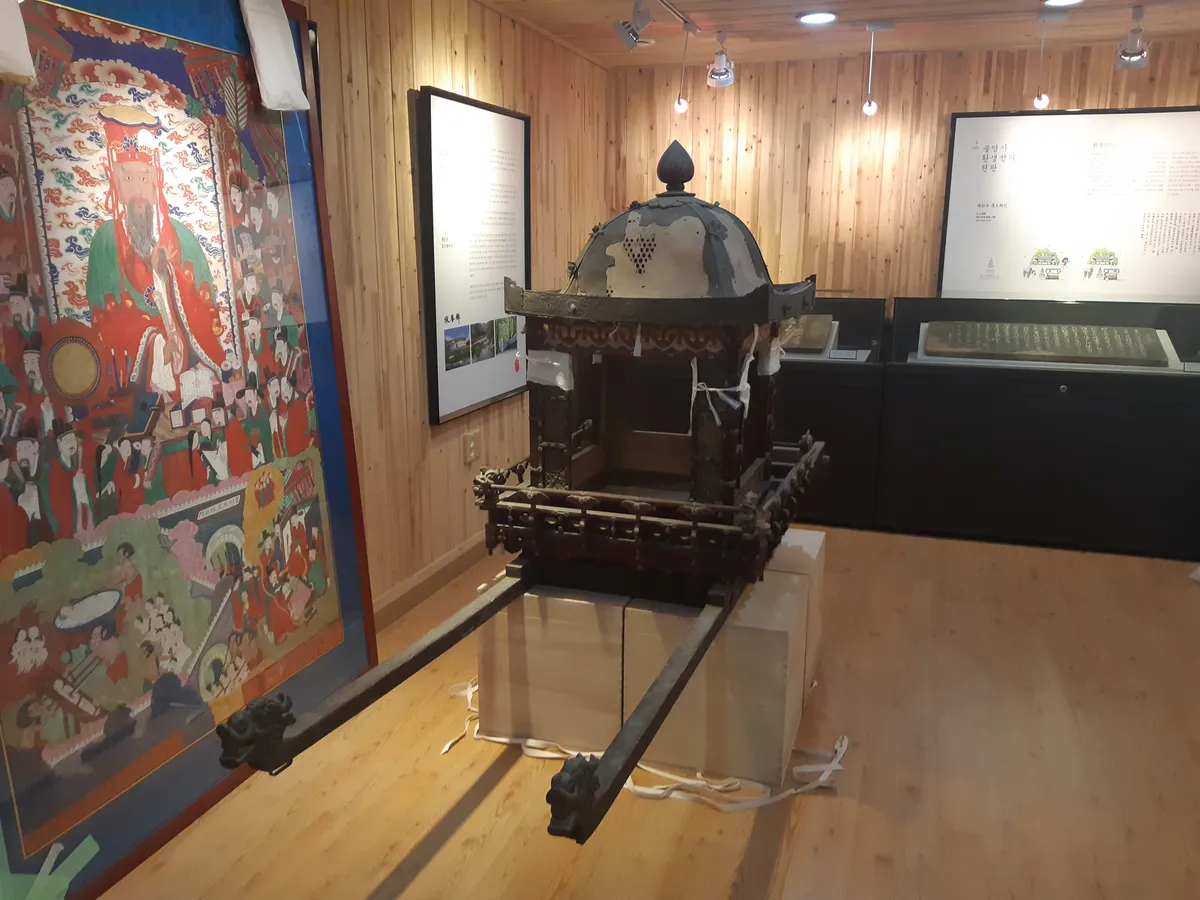
Buryeongsa Buryeon, Uljin
蔚珍 佛影寺 佛輦
경상북도 울진군
Basic information
- Designation
- Treasure No.2127
- Category
- Craft
- Era
- 1670년(현종 11년)
- Designated year
- 2021
- Location
- 울진군, 경상북도— 경상북도 울진군 불영사길 48 (금강송면, 불영사)
- Coordinates
- 36.941005, 129.274062Kakao address conversion
AI Docent
Coming soonAn AI-generated, friendly retelling of this heritage site is available in Korean. An English version is on our roadmap — for now, please see the official description below.
Description
Machine-translatedThis English description was machine-translated and may contain inaccuracies. Refer to the original Korean text for details.
The Uljin Bulyeongsa Buddhist Palanquin comprises two Buddhist ceremony-use palanquins created in 1670 (eleventh year of King Hyeonjong) by painters Gwanghyeon, Seongnyeol, and Deogjin, representing the work with most intact form among approximately twenty known Joseon late-period Buddhist palanquins. Buddhist palanquins serve as crucial ceremony vehicles bearing Buddhist statues, relics, scriptures, buddha plaques, deceased spirits, and other worship objects to ceremony grounds during sacred processions—functionally essential ritual implements. However, all surviving Buddhist palanquin artifacts date post-Japanese-Invasion period, with very few possessing known creation dates. In this context, the Uljin Bulyeongsa Buddhist Palanquin warrants particular emphasis, containing clear 1670 creation dates with dharma-master Hakjong (dharma-chief patron) documentation including motivation and background for palanquin creation, participating sponsor records, and presumed palanquin-creator monk identification—collectively providing invaluable Joseon late-period Buddhist woodcraft research material. Overall design demonstrates simple balanced aesthetics coupled with refined detailed composition showing remarkable craftsmanship in wooden arched-roof construction, phoenix sculpture, ornamental carved panels, palanquin-pole dragon-head decoration, and railing embellishment. Particularly notable becomes the first documented example of copper mirrors attached to the palanquin main-curtain (pearl-curtain), traditionally understood as providing symbolic illumination for ignorance similar to Buddha-statue bilateral mirrors or Buddhist-painting consecration-sack mirrors—establishing profound Buddhist symbolic meaning. This represents new religious-ceremony research perspective, establishing substantial ritual-historical significance. Additionally, materials including brass, tin, and iron demonstrate refined manufacturing intent, while extensive metal decorations and jewel attachments on roof and body showcase superior craftspeople's meticulous execution embodying Buddhist metalcraft excellence. The Uljin Bulyeongsa Buddhist Palanquin among Joseon late-period examples uniquely combines intact original form preservation with detailed creation-context documentation plus elevated artistic accomplishment, representing definitive Buddhist palanquin exemplar.
Location
지도를 불러오는 중…
Have you visited this place?
Log in and verify your visit on-site via GPS to record a stamp in My Journey. (QR verification coming later.)
Images: KOGL (khs.go.kr) · Data source: Korea Heritage Service Open API (khs.go.kr)