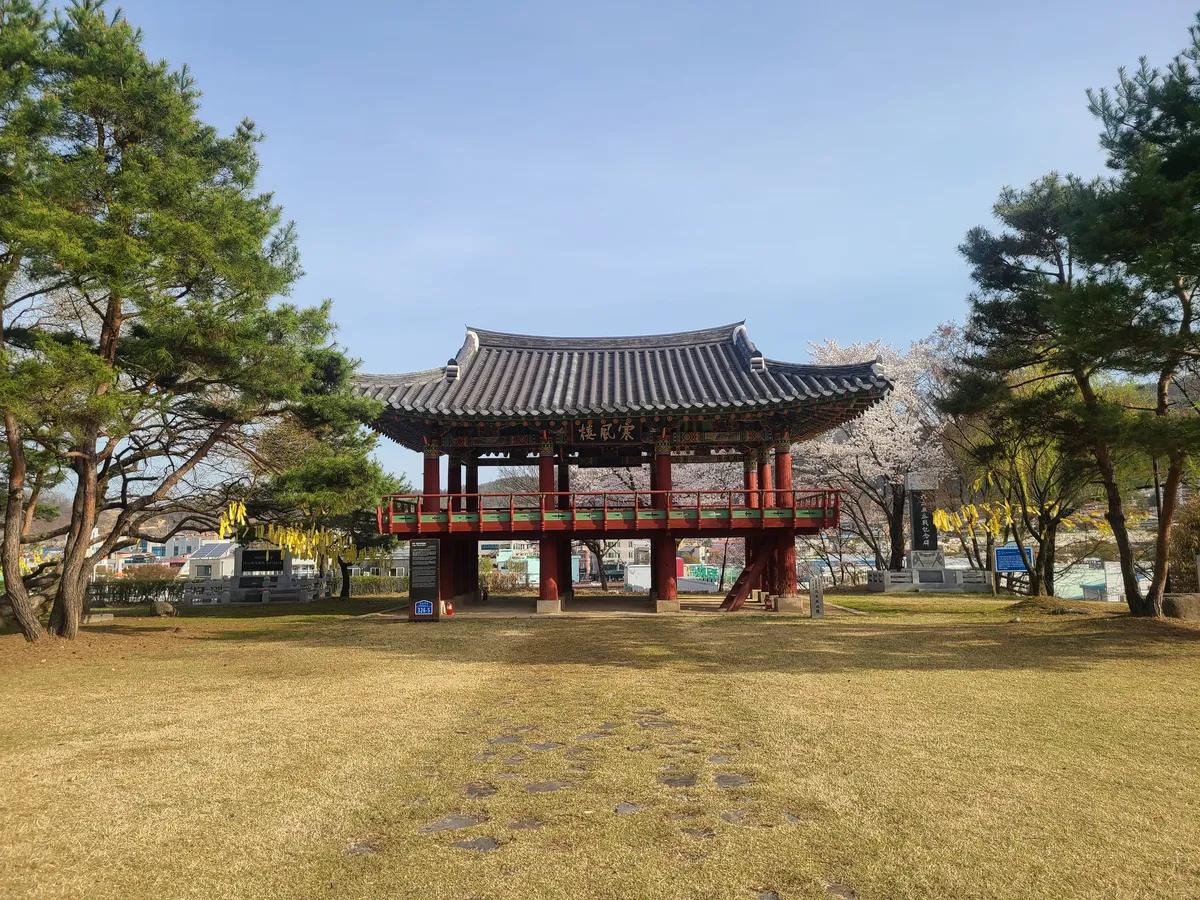
Hanpung Pavilion, Muju
茂朱 寒風樓
전북특별자치도 무주군
Basic information
- Designation
- Treasure No.2129
- Category
- Architecture
- Era
- 조선시대
- Designated year
- 2021
- Location
- 무주군, 전북특별자치도— 전라북도 무주군 한풍루로 326-5 (무주읍, 한풍루)
- Coordinates
- 36.003940, 127.662294
AI Docent
Coming soonAn AI-generated, friendly retelling of this heritage site is available in Korean. An English version is on our roadmap — for now, please see the official description below.
Description
Machine-translatedThis English description was machine-translated and may contain inaccuracies. Refer to the original Korean text for details.
'Hanpung Tower of Muju,' a Joseon administrative building, represents a cultural heritage praised by Baekho Im Je, a sixteenth-century official scholar, as the most prominent among Honam's 'Three Cold' sites—Muju Hanpung Tower, Namwon Gwanghan Tower, and Jeonju Hanbil Hall. The inscribed plaque is traditionally attributed to Han Seok-bong, and numerous scholar-officials enjoyed poetry and painting there, preserving period and cultural understanding through the building. While exact founding remains uncertain, fifteenth-century literati records and 'Augmented Geographical Description of the Unified Realm' confirm establishment from early Joseon, with documentation of complete destruction during the 1592 Imjin War and subsequent reconstruction. Muju Hanpung Tower features three-bays front, two-bays-side two-story hip-roof pavilion architecture with column-head bracket styling characteristics, exemplifying Joseon late-period official pavilion conventions. Architectural elements including lower-level standard columns, upper and lower pillar proportions and fluting techniques, decorative beam carving, and rear-eave reinforcement bracing demonstrate structural stability and aesthetic consideration unique to Muju Hanpung Tower. Recent timber dendrochronology analysis confirming sixteenth-to-seventeenth-century repair-period main timber components—including pillars and decorative beams—establishes authentic restoration. The building's preservation of architectural heritage through pre-Imjin War conditions, post-war reconstruction and restoration, and recovery from Japanese colonial-period demolition threats to original configuration, combined with mid-seventeenth-century period characteristics visible in available two-story official pavilions, merits high historical, architectural, and scholarly value assessment.
Location
지도를 불러오는 중…
Have you visited this place?
Log in and verify your visit on-site via GPS to record a stamp in My Journey. (QR verification coming later.)
Images: KOGL (khs.go.kr) · Data source: Korea Heritage Service Open API (khs.go.kr)