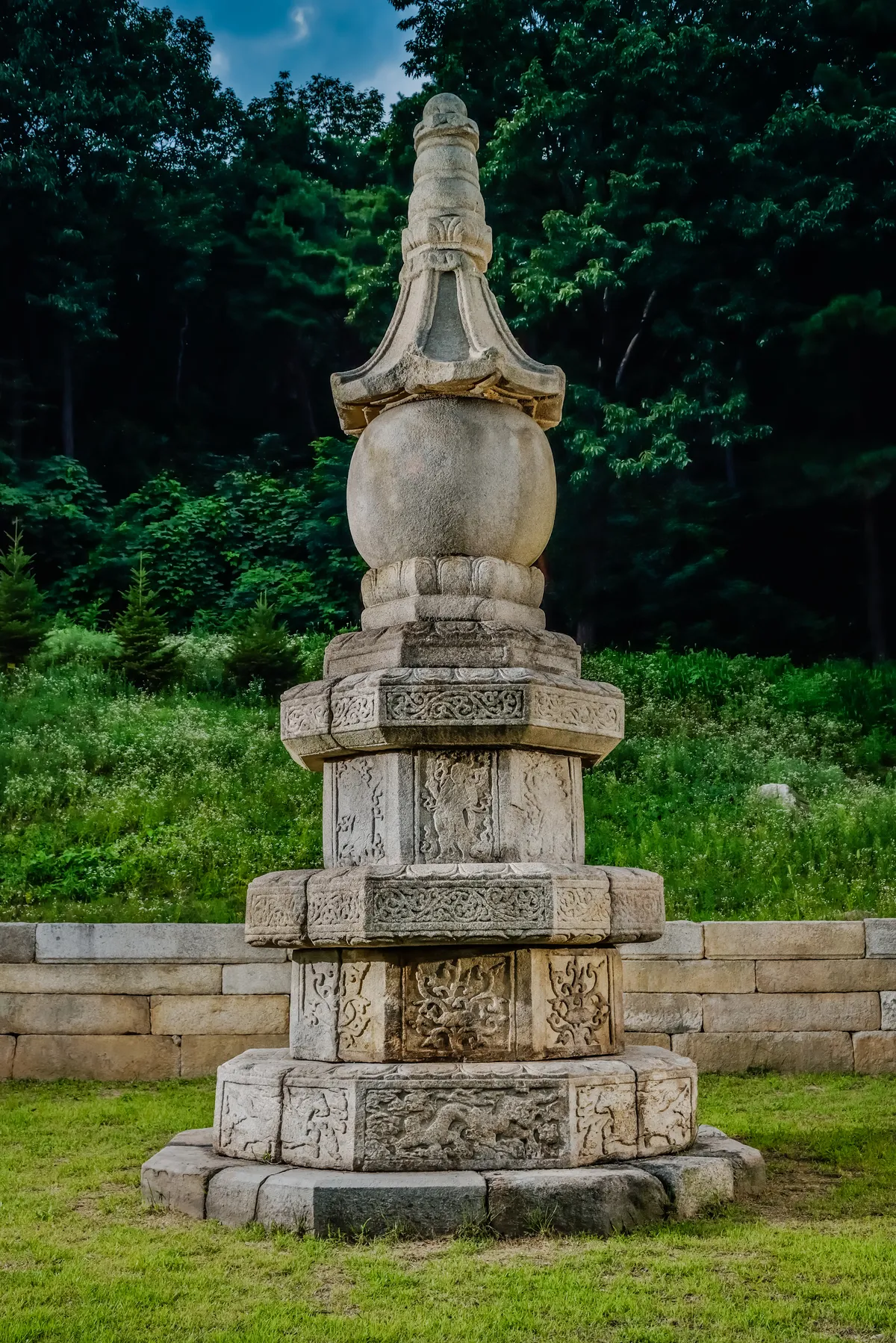
Hoeamsaji Saritap, Yangju
楊州 檜岩寺址 舍利塔
경기도 양주시
Basic information
- Designation
- Treasure No.2130
- Category
- Sites & Pagodas
- Era
- 조선시대
- Designated year
- 2021
- Location
- 양주시, 경기도— 경기도 양주시 회암동 산 14-3
- Coordinates
- 37.846186, 127.106684
AI Docent
Coming soonAn AI-generated, friendly retelling of this heritage site is available in Korean. An English version is on our roadmap — for now, please see the official description below.
Description
Machine-translatedThis English description was machine-translated and may contain inaccuracies. Refer to the original Korean text for details.
The Yangjju Hoeiamsa Reliquary Tower represents a grand-scale Buddhist relic tower commissioned by early-Joseon royalty, possessing excellent preservation condition while conveying diverse elements of royal Buddhist art through its form, Buddhist iconography, and decorative patterns. Situated within the 'Yangjju Hoeiamsa Historical Site,' the tower underwent excavation and scholarly research establishing it as a Buddhist relic tower enshrining Shakyamuni Buddha's authentic remains. The diverse carvings adorning the tower demonstrate stylistic similarities to early-Joseon royal-commissioned stone structures, suggesting potential influence relationships with the Samhwa Pagoda within the Hoeiamsa complex. The reliquary tower comprises an octagonal multi-tiered base section, spherical tower body, and upper ornamental section. Constructed on an octagonal foundation with two-stage base tiers atop the ground stone, the base stones are carved higher than other pagodas while the crowning stones are exceptionally thick, featuring the highest base among existing reliquary towers. The base facets display diverse ornamentation with dragons, qilins, floral patterns, scrollwork, and celestial beings sequentially arranged from the lower-tier base stone through upper-tier crowning stone. The tower body comprises a spherical form resembling another reliquary tower overlaid upon the structure. The entire four-tiered base construction, upper section forming a low octagonal tier with spherical tower body and roofstone, and upper ornamental finial create an ascending composition. Overall styling, construction techniques, and detailed patterns demonstrate similarity to early-Joseon royal tombs and related stone structures, suggesting design and execution by master stonemasons of the highest caliber. The reliquary tower's scale, stone-dressing condition, and construction methodology exemplify early-Joseon stone art mastery and significance as a representative masterwork with considerable historical, scholarly, and formal aesthetic value.
Location
지도를 불러오는 중…
Have you visited this place?
Log in and verify your visit on-site via GPS to record a stamp in My Journey. (QR verification coming later.)
Images: KOGL (khs.go.kr) · Data source: Korea Heritage Service Open API (khs.go.kr)