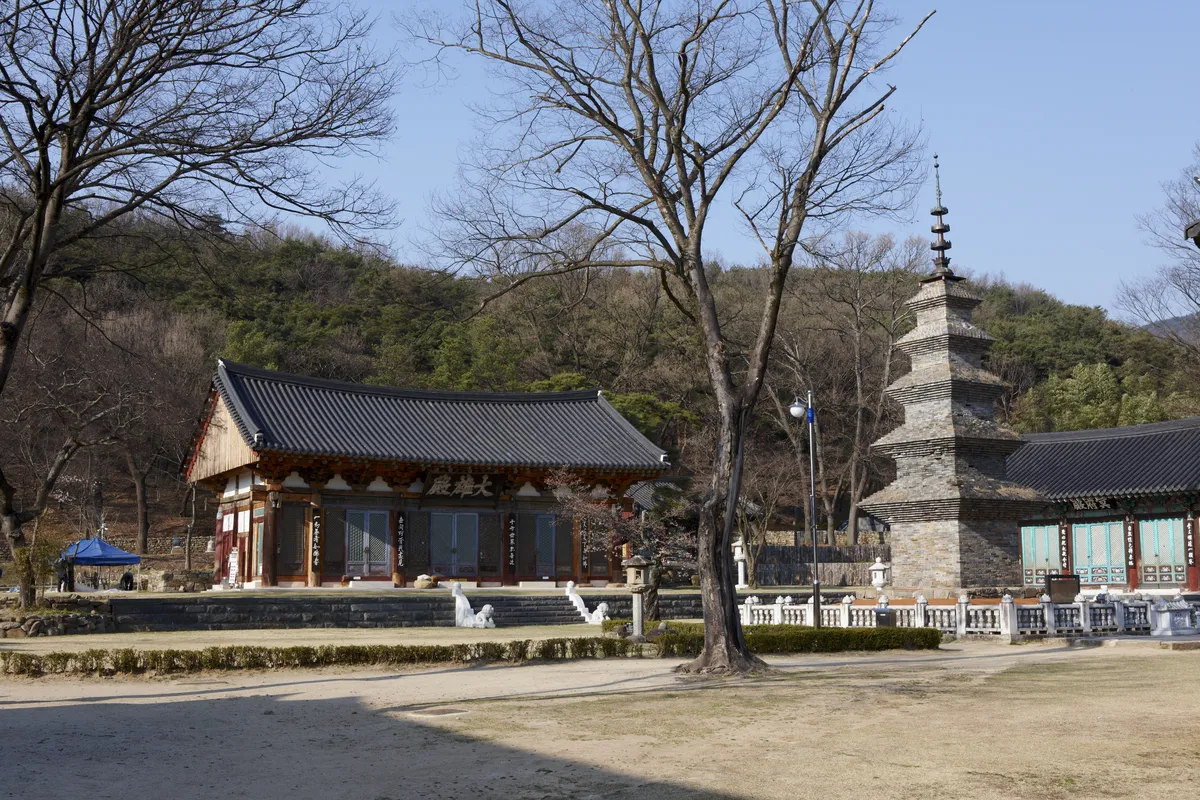
Songrimsa Daeungjeon Hall, Chilgok
漆谷 松林寺 大雄殿
경상북도 칠곡군
Basic information
- Designation
- Treasure No.2131
- Category
- Architecture
- Era
- 조선시대
- Designated year
- 2021
- Location
- 칠곡군, 경상북도— 경상북도 칠곡군 송림길 73 (동명면)
- Coordinates
- 35.982403, 128.577483
AI Docent
Coming soonAn AI-generated, friendly retelling of this heritage site is available in Korean. An English version is on our roadmap — for now, please see the official description below.
Description
Machine-translatedThis English description was machine-translated and may contain inaccuracies. Refer to the original Korean text for details.
Songlimsa Great Treasure Hall presents a single-story five-bays front, three-bays-side structure, with five-bay frontage representing an uncommon configuration among extant late-Joseon Buddhist halls. Historical records indicate pre-Imjin War structures, particularly principal halls, typically employed two-story construction or three-plus-bay spacing as the dominant style; post-Imjin War seventeenth-century reconstruction efforts generally failed to restore previous scale, with most temple structures progressively shrinking. Ongoing temple contraction acceleration following the Imjin War eventually established standardized three-bays front by three-bays-side configurations maintaining institutional hall status through visual and spatial function. Within these trends, Songlimsa Great Treasure Hall's five-bay principal hall reconstruction distinguishes itself through scale alone, earning recognition apart from three-bay-predominant contemporary temples. Few examples of five-bay late-Joseon Buddhist halls survive, with most currently designated as nationally protected heritage, background considerations supporting this assessment. Songlimsa Great Treasure Hall's 1649 reconstruction achieved floor-plan distinction through its Buddhist platform and rear Buddha wall positioning and bay configuration, maintaining archaic characteristics differentiated from contemporary reconstruction structures. The centrally positioned Buddhist platform appears unusually grand—measuring approximately 13 meters horizontally, 2.44 meters in depth, and 1.03 meters in height, with elaborate relief carvings adorning the front surface. The central three bays occupied by the Buddhist platform effectively reduce actual worship space despite five-bay configuration. Interior ceremonial requirements necessitated worship space expansion, naturally resulting in rear-positioned pillar row repositioning (removal method) to expand pre-Buddha image worship areas—representing contemporary period-specific trends. Songlimsa Great Treasure Hall, however, established rear-area Buddha walls with rear pillars while positioning platforms to three-bay widths, creating interior central occupancy—an ancient technique reflected in structures like Manboksa Site West Gold Hall and Muranji Extreme Bliss Hall. This main-bay configuration represents ancient technique implementation while the bracket work employs decorative bracket styling without curved extensions, classified as decorative bracket configuration—representing relatively early-period styling rarely employed in late-Joseon design. The concentrated deployment of decorative bracket styling in Palgongsan region temple construction merits particular attention, with Master Sculptor Gak-won establishing foundational presence and his successor artisans' continuation of regional construction representing specialized characteristics warranting deeper future research. 1850 reconstruction employed reused wood components referenced in the ridge-beam inscriptions indicating multiple structural changes from earlier Great Treasure Hall construction. Faced with timber scarcity, reconstruction utilized salvaged Great Treasure Hall components completing projects through reused materials; evidence suggests potential roof form transformation from hip-roof to gable-roof configuration during repairs. The 1850 reconstruction represented timber scarcity-driven work with aggressive salvaged-material utilization producing architectural transformation—commonly observable in late-Joseon principal halls, though Songlimsa Great Treasure Hall distinguishes itself through preserved material evidence and inscription documentation compared to other halls relying solely on component conjecture.
Location
지도를 불러오는 중…
Have you visited this place?
Log in and verify your visit on-site via GPS to record a stamp in My Journey. (QR verification coming later.)
Images: KOGL (khs.go.kr) · Data source: Korea Heritage Service Open API (khs.go.kr)