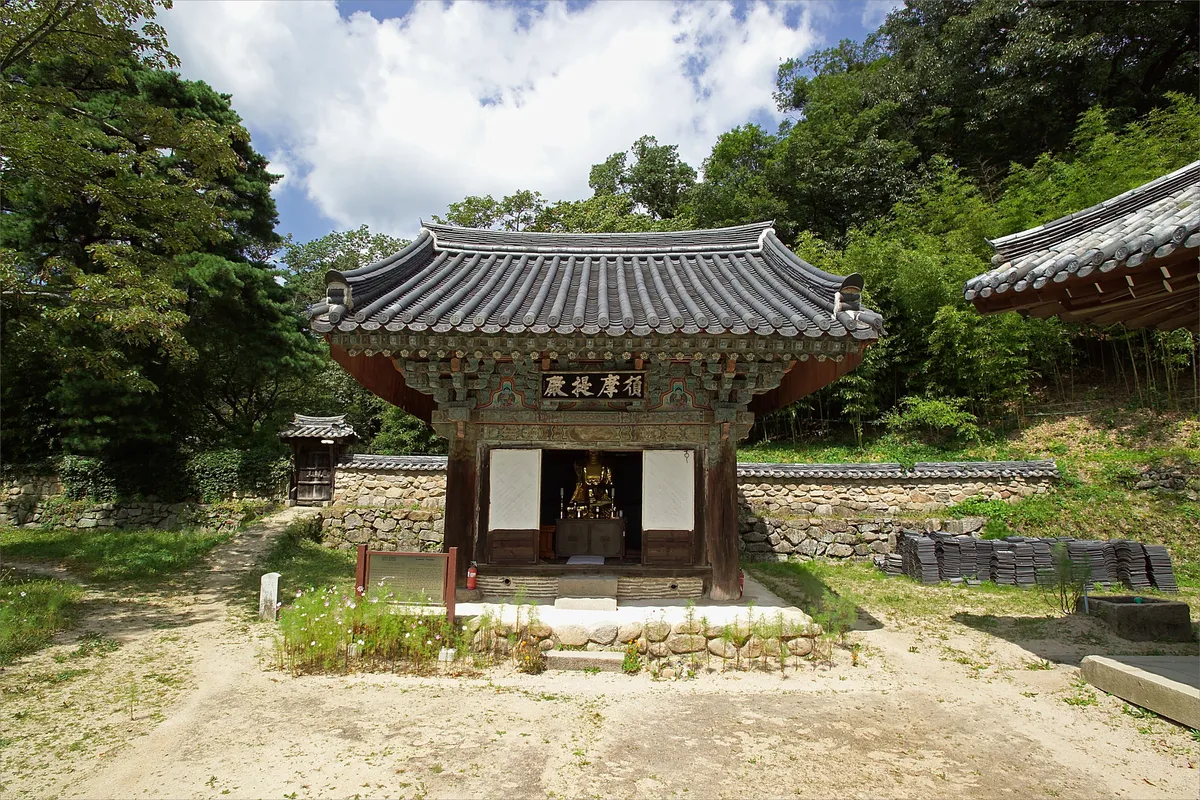
Donghwasa Sumaje Hall, Daegu
大邱 桐華寺 須摩提殿
대구광역시 동구
Basic information
- Designation
- Treasure No.2133
- Category
- Architecture
- Era
- 조선시대
- Designated year
- 2021
- Location
- 동구, 대구광역시— 대구광역시 동구 동화사1길 1 (도학동)
- Coordinates
- 35.992770, 128.705397
AI Docent
Coming soonAn AI-generated, friendly retelling of this heritage site is available in Korean. An English version is on our roadmap — for now, please see the official description below.
Description
Machine-translatedThis English description was machine-translated and may contain inaccuracies. Refer to the original Korean text for details.
Daegu Donghwasa Sumajaejeon was constructed in 1465 (King Sejong 11) and underwent reconstruction in 1702 (King Sukjong 28) following the Imjin War, with extant structural remains confirming seventeenth-century and ancient construction technique coexistence, archaeological chronology aligning with historical documentation. Sumajaejeon features a four-bays-square configuration with multi-bracket bracket work and gable roof design, representing the sole surviving example of four-bays-square multi-bracket gable roof Buddhist halls domestically. While gable roof structures typically omit side bracket work, this example maintains decorative corner brackets and planar structural components, suggesting earlier multi-bracket hip-roof construction potentially disassembled with partial material reuse for reconstruction, exemplifying rare instances of such transformations. This architectural evolution potentially sequences the building's chronology—establishment as multi-bracket hip-roof Buddhist hall in 1465 followed by partial post-Imjin War damage leading to 1702 disassembly and reconstruction employing salvaged materials as gable roof structure, substantiating the building's connected history. Sumajaejeon's bracket ornamentation mirrors the Extreme Bliss Hall through consistent decorative bracket styling without extending curved ornament treatment applied uniformly to front and rear, inner and outer positions, representing seventeenth-to-eighteenth-century techniques concentrated in Palgongsan-centered Yeongnam regions as distinctive regional characteristics exemplifying identical-lineage specialist craftsman activation. The roof framework technique merits particular distinction. Despite overall triple-beam construction appearance, the central support beam lower surface extends inward with plate-bracket placement supporting the center ridgeline beam supporting the center ridgeline—appearing as double-beam oiryangga structure but actually representing unique triple-beam construction without intermediate ridgeline, achieving horizontal consistency between front-rear ridgelines while establishing original structural approaches supporting center ridgelines. This roof construction technique, absent from other cultural heritage examples, demonstrates important traditional timber architectural framework diversity. The ancient beveled ridgeline joint elements remaining between central and inner ridgelines additionally represent significant preservation features.
Location
지도를 불러오는 중…
Have you visited this place?
Log in and verify your visit on-site via GPS to record a stamp in My Journey. (QR verification coming later.)
Images: KOGL (khs.go.kr) · Data source: Korea Heritage Service Open API (khs.go.kr)