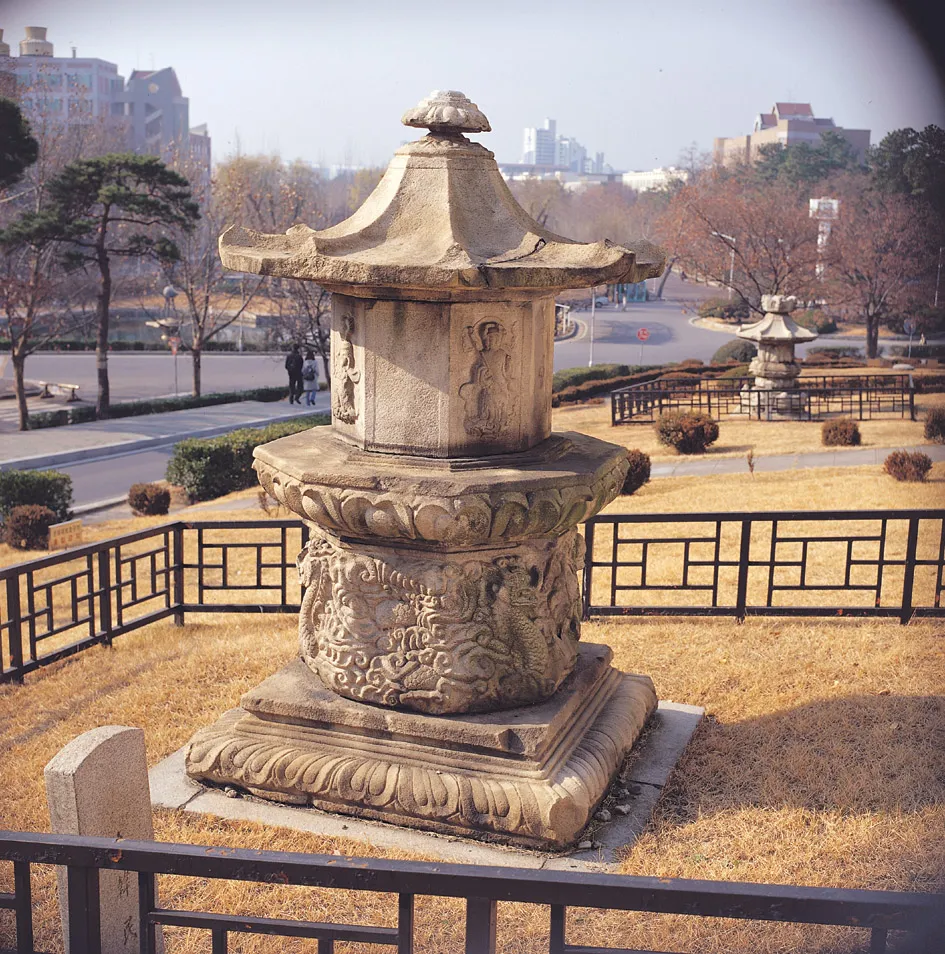
Stupa with Lotus, Cloud and Dragon Design in Relief in Sangyeok-dong, Daegu
大邱 山格洞 蓮花 雲龍裝飾 僧塔
대구광역시 북구
Basic information
- Designation
- Treasure No.135
- Category
- Sites & Pagodas
- Era
- 고려시대
- Designated year
- 1963
- Location
- 북구, 대구광역시— 대구 북구 산격3동 1370번지 경북대학교박물관
- Coordinates
- 35.888739, 128.613334
AI Docent
Coming soonAn AI-generated, friendly retelling of this heritage site is available in Korean. An English version is on our roadmap — for now, please see the official description below.
Description
The stupa, located at Kyungpook National University Museum, consists of the main body enshrining the sarira, the stylobate, and the top ornament. The lower layer of the stylobate is quadrangular, with each facet engraved with patterns of lotus flowers facing downward. The middle layer of the stylobate is a round-shaped octagon, with clouds engraved on the entire surface. Four dragons were clearly carved in relief in four directions. Its clear angle and the strong touch of the carving exude the spirit of the Goryeo Dynasty. The main body of the stupa has pole patterns at the edges of the octagonal core stone. The front and back facets are engraved with an old Korean-style door design, and the images of the Four Guardian Kings are carved on both sides of the door to observe Buddhism. The roof stone is also octagonal and is precipitous at the top with the wide bottom. The eaves are straight except at angled positions, where they are slightly turned upward. Generally, it assumes the octagonal form, which followed the characteristics of the Goryeo Dynasty. In many respects, it reminds one of the Stupa at the Godalsa Temple Site in Yeoju (National Treasure No. 4) but lags behind in terms of the molding technique, implying that it might have been built in the early Goryeo Dynasty. The part above the main one seems rather reduced, whereas the stylobate looks so grand, especially with the carvings of clouds and dragons on the middle layer of the stylobate. It had been kept in a Japanese house and was moved to the Kyungpook National University Museum. Thus, nothing has been known about the artist and the original place.
Location
지도를 불러오는 중…
Have you visited this place?
Log in and verify your visit on-site via GPS to record a stamp in My Journey. (QR verification coming later.)
Images: KOGL (khs.go.kr) · Data source: Korea Heritage Service Open API (khs.go.kr)