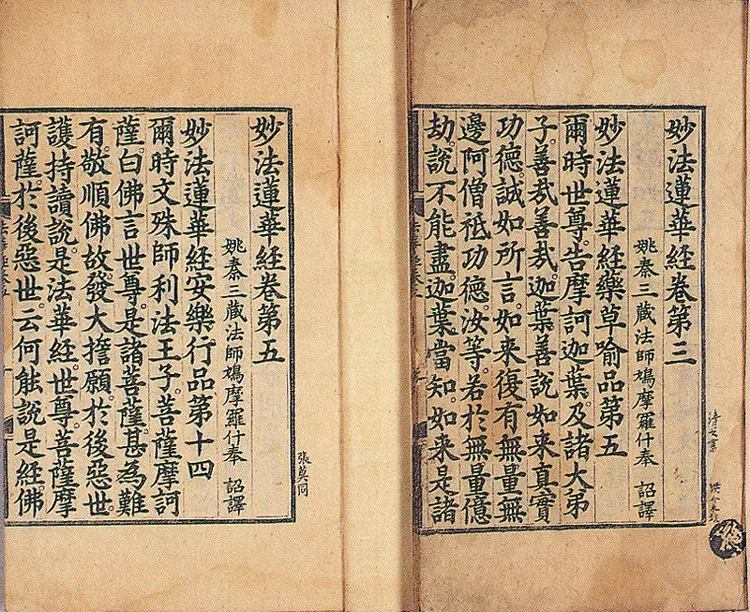
Myobeobyeonhwagyeong Gwon3~4, 5~7(1993)
妙法蓮華經 卷三~四, 五~七(1993)
서울특별시 서대문구
Basic information
- Designation
- Treasure No.1147-1
- Category
- Books & Records
- Era
- 1470년
- Designated year
- 1993
- Location
- 서대문구, 서울특별시— 서울특별시 서대문구 충정로9길 10-10 (충정로2가, (재)현담문고)
- Coordinates
- 37.564993, 126.964911Kakao address conversion
AI Docent
Coming soonAn AI-generated, friendly retelling of this heritage site is available in Korean. An English version is on our roadmap — for now, please see the official description below.
Description
Saddharmapundarika Sutra (Lotus Sutra) is the principal scripture of the Cheontae Order of Korean Buddhism. The main idea of the book is that the way to become a Buddha is open to everyone. Along with the Avatamsaka Sutra (Flower Garland Sutra), this sutra was a principal scripture that wielded great influence on the establishment of Buddhist thoughts in Korea. Saddharmapundarika Sutra was first translated into Chinese by Kumarajiva of the Later Jin; from his translation, Volumes 3 to 4 and 5 to 7 are bound into one book each. Measuring 21.6 cm wide and 35.6 cm long, the books were inscribed on woodblocks and printed on mulberry paper, and the covers were made later. The texts are marked with dots in order to let the readers know where to pause. In 1470 (first year of the reign of King Seongjong of the Joseon Dynasty), Queen Jeonghui, wife of King Sejo, ordered the publishing of these books to pray for the souls of her husband and two deceased sons. The woodblocks for printing these books were used again in 1483 (13th year of King Seongjong’s reign) and 1488 (19th year of the same reign), and the publications are designated as Treasure Nos. 936 and 950, respectively. Since royal families took the initiative in the publication, the best technicians and craftsmen took part in the project. Therefore, the woodblock printing is very delicate, elegant, and detailed, the printing conditions are excellent, and the books are preserved quite well.
Location
지도를 불러오는 중…
Have you visited this place?
Log in and verify your visit on-site via GPS to record a stamp in My Journey. (QR verification coming later.)
Images: KOGL (khs.go.kr) · Data source: Korea Heritage Service Open API (khs.go.kr)