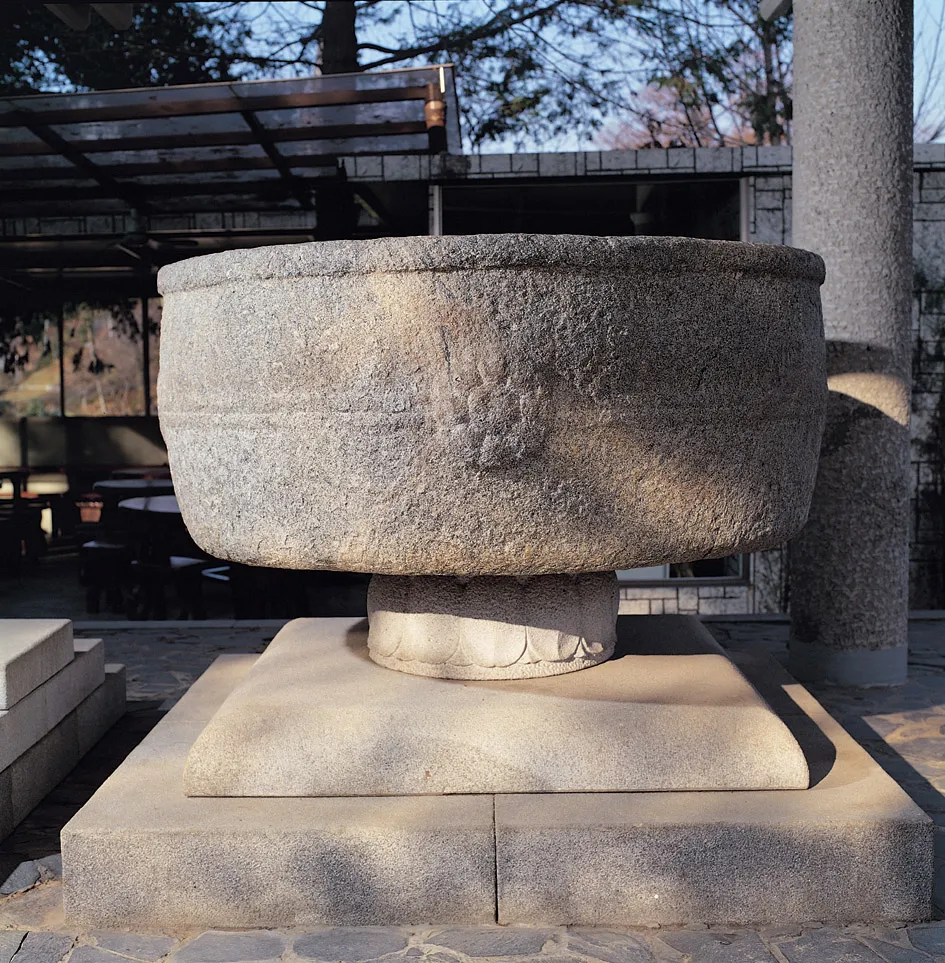
Stone Basin in Jung-dong, Gongju
公州 中洞 石槽
충청남도 공주시
Basic information
- Designation
- Treasure No.148
- Category
- Other
- Era
- 백제시대
- Designated year
- 1963
- Location
- 공주시, 충청남도— 충남 공주시 관광단지길 34, 국립공주박물관 (웅진동)
- Coordinates
- 36.466033, 127.111822
AI Docent
Coming soonAn AI-generated, friendly retelling of this heritage site is available in Korean. An English version is on our roadmap — for now, please see the official description below.
Description
This stone basin, which is kept in the garden of the Gongju National Museum, was probably filled with lotus flowers to decorate a temple. The basin was originally located at the Daetongsa Temple site in Banjuk-dong, Gongju along with the Stone Basin of Banjuk-dong, Gongju (Treasure No. 149), but the Japanese army used it as a manger during the Japanese occupation of Korea. It was kept for some time at the Jungdong Elementary School, hence its name (“Jungdong stone basin”), before being moved to its current location in Jung-dong, Gongju in 1940. It is believed that the two stone basins were made at the same time to be erected in front of a building as they are identical in style and technique but different in scale. The original prop pillar, which supports the stone basin, was broken by the Japanese army, so the current prop pillar was made by copying that of the stone basin of Banjuk-dong, which is carved with a lotus design. The stone basin is shaped like a bowl with a high foot and the border of the mouth is surrounded with a thick protruding band. The outer surface is carved with two small stringed-belts and embossed with lotus flower designs that are relatively intact compared to those of the stone basin in Banjuk-dong. According to Samguk sagi (The History of the Three Kingdoms), Daetongsa Temple was founded in 529 (the 7th year of the reign of King Seong of Baekje), this is an important relic of the Baekje Dynasty with the exact date of the construction. The form of the stone basin and the lotus design are valuable materials for the study of Buddhist art of Baekje.
Location
지도를 불러오는 중…
Have you visited this place?
Log in and verify your visit on-site via GPS to record a stamp in My Journey. (QR verification coming later.)
Images: KOGL (khs.go.kr) · Data source: Korea Heritage Service Open API (khs.go.kr)