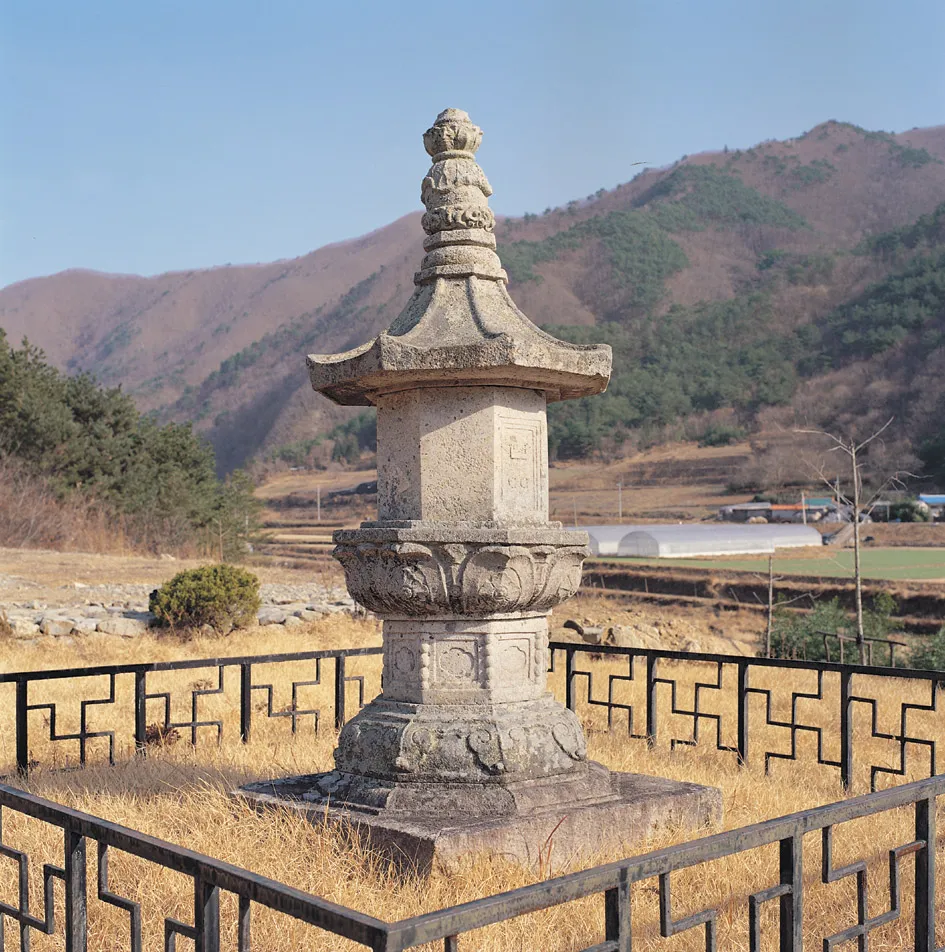
West Stupa of Borimsa Temple, Jangheung
長興 寶林寺 西 僧塔
전라남도 장흥군
Basic information
- Designation
- Treasure No.156
- Category
- Sites & Pagodas
- Era
- 고려시대
- Designated year
- 1963
- Location
- 장흥군, 전라남도— 전남 장흥군 유치면 봉덕신덕길 62-1, 보림사 (봉덕리) / (지번)전남 장흥군 유치면 봉덕리 산50 보림사
- Coordinates
- 34.812792, 126.887727
AI Docent
Coming soonAn AI-generated, friendly retelling of this heritage site is available in Korean. An English version is on our roadmap — for now, please see the official description below.
Description
These two stupas are situated in a pair in the west to Borimsa Temple. One of the two stupas is octagonal in form and consists of a three-layer stylobate on a square base stone, main body, and roof stone. The bottom layer of the stylobate is engraved with double lotus patterns; and each edge of the thick wide middle layer is carved with stringed-bead-like column patterns. The top layer of the stylobate is similar to the bottom layer in terms of its size and width, and is engraved with eight lotus petals. Also, one side of the core stone of the main body is engraved with an old Korean-style door with a lock and two door rings. The roof stone slopes sharply, and each end of its eight corners turns swiftly upward. The other stupa is also octagonal in form and exhibits the same style of stylobate as the first one. However, the middle layer of the stylobate is unadorned and its top layer is thinner and wider than that of the stupa on the right. The core stone of the main body is engraved with an old Korean-style door and lock. However, as its roof stone is badly broken, it is difficult to determine its original form. The stupa on the right is perfectly intact and abundantly decorated, while the stupa on the left displays a graceful form but is unadorned, making it look a little smaller overall. Judging from their identical finishing technique, it is assumed that these stupas were erected in the Goryeo Dynasty. The finials of both stupas are well-preserved. However, the sarira reliquary was stolen in 1941, and was restored in 1944.
Location
지도를 불러오는 중…
Have you visited this place?
Log in and verify your visit on-site via GPS to record a stamp in My Journey. (QR verification coming later.)
Images: KOGL (khs.go.kr) · Data source: Korea Heritage Service Open API (khs.go.kr)