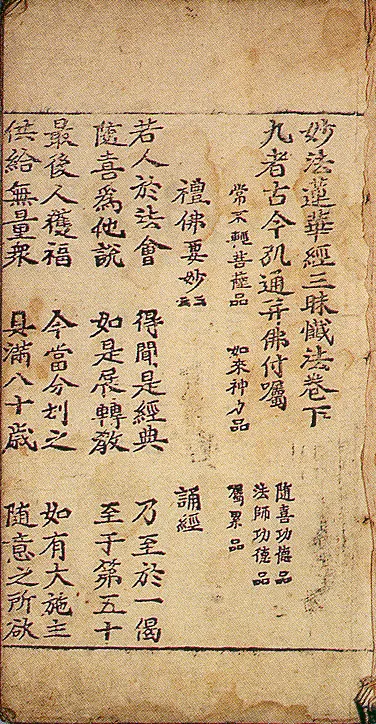
Myobeobyeonhwagyeongsammaechambeop Gwonha
妙法蓮華經三昧懺法 卷下
충청북도 단양군
Basic information
- Designation
- Treasure No.1162
- Category
- Books & Records
- Designated year
- 1993
- Location
- 단양군, 충청북도— 충청북도 단양군 영춘면 구인사길 73 (백자리, 구인사)
- Coordinates
- 37.031829, 128.480805Kakao address conversion
AI Docent
Coming soonAn AI-generated, friendly retelling of this heritage site is available in Korean. An English version is on our roadmap — for now, please see the official description below.
Description
The main philosophy contained in this sutra is that anyone can be a Buddha. As a basic sutra adopted by the Cheontae Order of Korean Buddhism, this sutra, along with Mahavajpulya-Buddha-Avatamsaka-Sutra, played a leading role in the establishment of Buddhist philosophy in Korea. The method of meditation and repentance based on the Lotus Sutra is a ritual of repenting of sins committed, worshipping Buddha based on the Lotus Sutra, and reading Buddhist scriptures. It was a method of engaging in self-discipline that was widely prevalent in Korea until the end of the Goryeo Period (918-1392) after its introduction from China by Monk Uicheon. This book is part of the three-volume compilation based on the Lotus Sutra, and it measures 34.3㎝ by 19㎝. The wood block is presumed to have been made toward the end of the Goryeo Period, judging from the form and character style of the wood block. This book was printed on mulberry paper in 1472 (the 3rd year of King Seongjong’s reign). According to the relevant records, Queen Dowager Insu (mother of King Seongjong) had this book printed along with a prologue written by Kim Su-on, after finding where the wood block was kept, to pray for the peace of dead royal ancestors. This is the only book left among the 20 sets of books on the method of meditation and repentance based on the Lotus Sutra. This book is a precious material for those studying the development process of the Cheontae Order of Korean Buddhism.
Location
지도를 불러오는 중…
Have you visited this place?
Log in and verify your visit on-site via GPS to record a stamp in My Journey. (QR verification coming later.)
Images: KOGL (khs.go.kr) · Data source: Korea Heritage Service Open API (khs.go.kr)