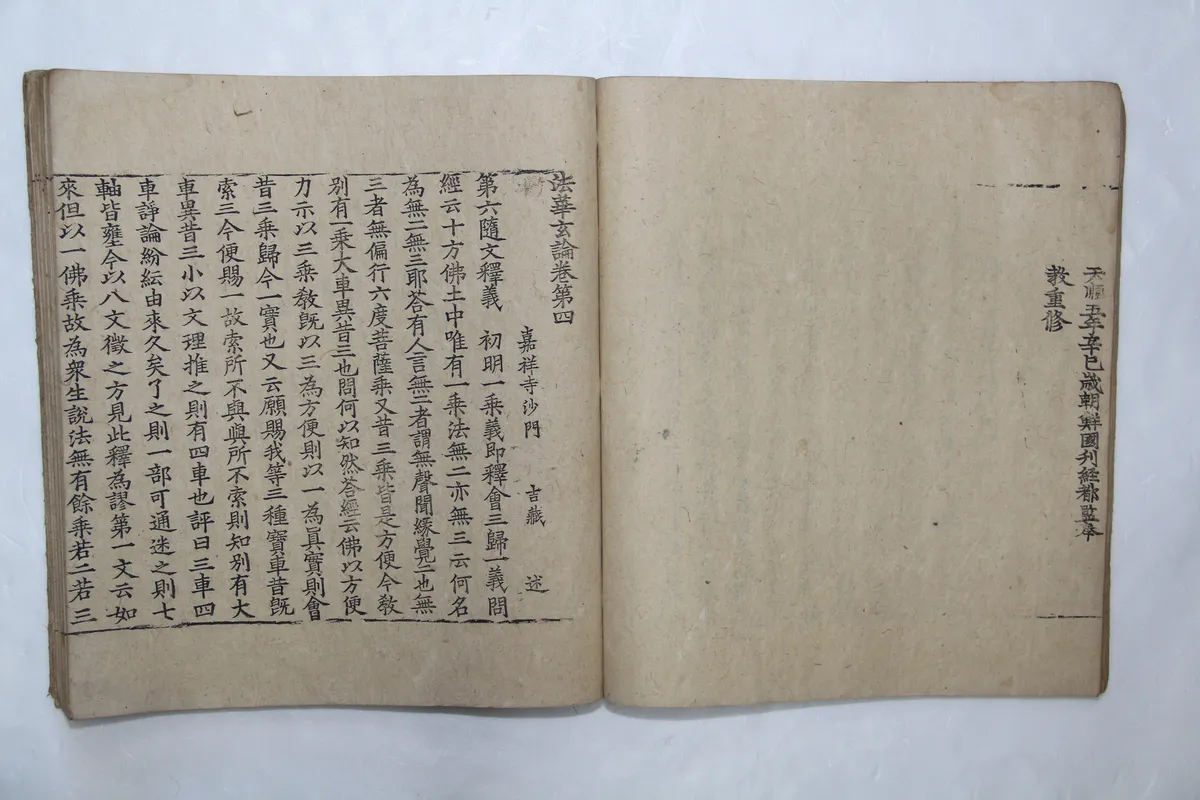
Beophwahyeonron Gwon3∼4
法華玄論 卷三∼四
서울특별시 성북구
Basic information
- Designation
- Treasure No.2179
- Category
- Books & Records
- Era
- 1461년(세조 7)
- Designated year
- 2022
- Location
- 성북구, 서울특별시— 서울특별시 성북구
- Coordinates
- 37.589359, 127.016703
AI Docent
Coming soonAn AI-generated, friendly retelling of this heritage site is available in Korean. An English version is on our roadmap — for now, please see the official description below.
Description
Machine-translatedThis English description was machine-translated and may contain inaccuracies. Refer to the original Korean text for details.
The Beopwhwa Hyeonron comprises comprehensive interpretive commentary on the Lotus Sutra, explaining essential Buddhist doctrinal concepts, specialized terminology, and scriptural passages organized into ten fascicle divisions. This work originated from woodblock printing execution in 1102 at the Daeheung Wang Temple during Goryeo's King Sukjong's reign, subsequently reproduced through woodblock reproduction printing during the 1461 Gyeongju Documentation Ministry's republication efforts executed in King Sejo's seventh year. Previous scholarly consensus presumed that Great Enlightenment National Teacher Uicheon's authoritative Buddhist canon edition might have undergone only limited restricted printing; however, discovery of this republished version confirms that the Daeheung Wang Temple Documentation Ministry achieved substantially more extensive printing production operations than previously documented in scholarly literature. The Beopwhwa Hyeonron volumes 3-4 represent incomplete edition specimens; however, they constitute the sole surviving copy of this particular carved woodblock edition format. Contemporary scholarship has not identified comparable surviving versions, thereby establishing singular importance for demonstrating the scope of original Chinese-source woodblock reproductions and production chronology documentation. This represents the only currently documented surviving version of this specific woodblock edition, thereby providing essential primary source materials for understanding traditional Daeheung Wang Temple printing operations and early Joseon period woodblock production methodology and printing practices. Additionally, the resource provides invaluable source material for comprehensive Lotus Sutra philosophical studies while demonstrating early Joseon period block-carving techniques, ink-marking conventions, and notation methodologies. This material therefore warrants preservation designation as an invaluable treasure documenting Buddhist doctrinal transmission and printing practice history.
Location
지도를 불러오는 중…
Have you visited this place?
Log in and verify your visit on-site via GPS to record a stamp in My Journey. (QR verification coming later.)
Images: KOGL (khs.go.kr) · Data source: Korea Heritage Service Open API (khs.go.kr)