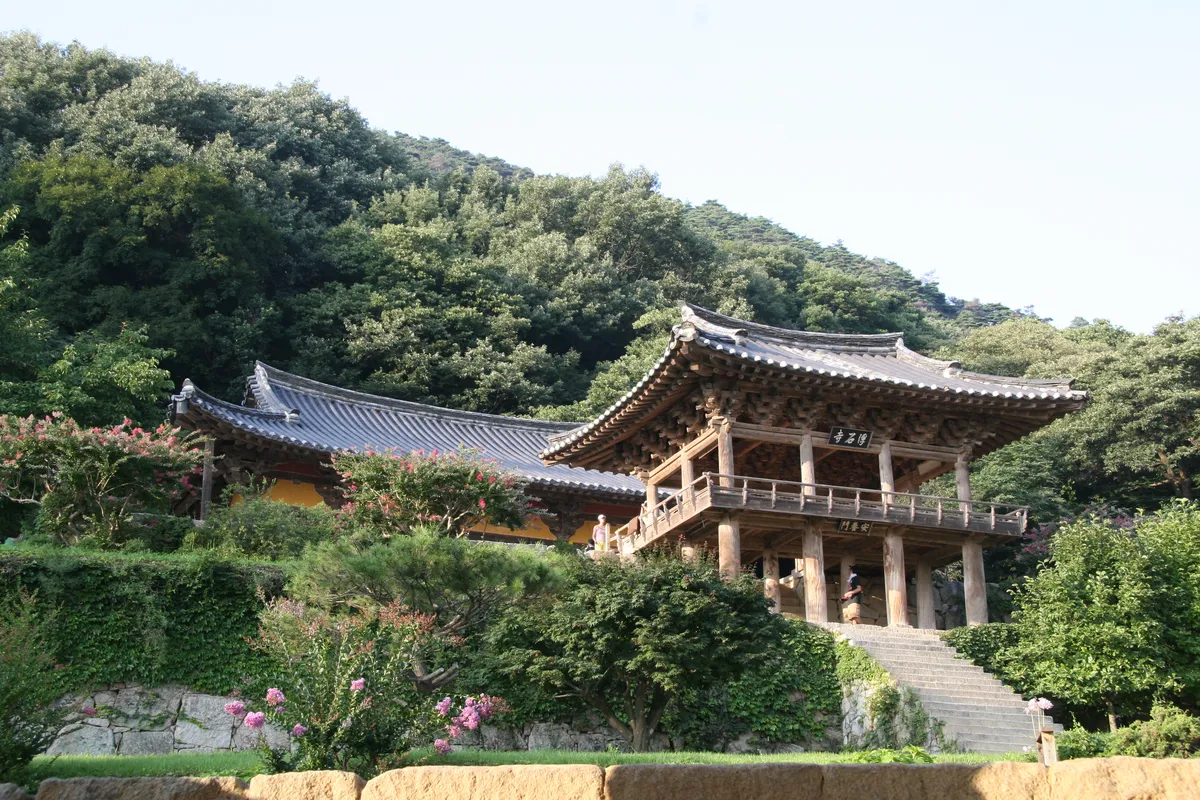
Buseoksa Anyang Pavilion, Yeongju
榮州 浮石寺 安養樓
경상북도 영주시
Basic information
- Designation
- Treasure No.2183
- Category
- Architecture
- Era
- 조선시대
- Designated year
- 2022
- Location
- 영주시, 경상북도— 경상북도 영주시 부석사로 345 (부석면, 부석사)
- Coordinates
- 36.958000, 128.657800Museum-based location
AI Docent
Coming soonAn AI-generated, friendly retelling of this heritage site is available in Korean. An English version is on our roadmap — for now, please see the official description below.
Description
Machine-translatedThis English description was machine-translated and may contain inaccuracies. Refer to the original Korean text for details.
The Anyang-ru (Tower of Bliss) at Buseok Temple in Yeongju is located at 345 Buseok-ro, Buseok-myeon, Yeongju-si, Gyeongsangbuk-do. Situated within Buseok Temple, which was inscribed as UNESCO World Heritage in 2018 as one of the "Mountain Temples of Korea," Anyang-ru stands before the National Treasure Buseok Temple's Muryang-su Hall (Hall of Infinite Life). This literary pavilion measures 3 bays on the front and 2 bays on the side, utilizing a two-story multiple-bracket style hip-and-gable roof design, representing a quintessential example of sixteenth-century Buddhist temple literary pavilion architecture. According to documentary sources including the Gyeam Daily Record (Gyeam-ilrok), the "Record of Anyang-ru's Reconstruction at Buseok Temple" (Buseok-sa Anyang-ru Jung-chang-gi), and the "Record of Anyang-ru Repairs at Muryang-su Hall" (Muryang-su-jeon Anyang-ru Jung-su-gi), the site originally contained a single-story structure called the Gangyun Pavilion (Gangyun-gak). This building was destroyed by fire in 1555, after which the two-story literary pavilion named Anyang-ru was constructed at the same location in 1576. Within the overall temple layout, Anyang-ru strategically deflects the temple's main processional axis, intensifying the religious reverence and visual impact upon entering the Muryang-su Hall precinct. The lower story consists entirely of columns without intervening walls, with a central staircase serving as the main entrance leading to the Muryang-su Hall in a below-pavilion entrance configuration (nu-ha jin-ipseong). A plaque reading "Anyang-mun" hangs at this entrance. The upper story remains completely open on all sides without wall enclosures, with the entire interior floor consisting of a geometric parquet pattern, functioning as a lecture hall. The bracket arms comprise two-bay exterior and three-bay interior outsets. Main-space bracket arms are positioned individually between column-head bracket sections. The bracket arms present different appearances externally and internally: externally, the bracket cantilevers feature short lengths with blunt-cut forms resembling paw-shaped corbels, while internally the cantilevers display cross-shaped forms identical to the primary members (chim-cha). The chim-cha retains the archaic bracket-eye (gong-an) technique visible in designs prior to the mid-Joseon period. Decorative florets (hwa-ban) surmount the beams, supporting the central ridge-beam through portico bracket members. Above the secondary beam, opposing flower-petal-shaped bracket members and standard flower-petal bracket members support the intermediate roof-beam in an orthogonal configuration, representing ancient techniques recognized from the mid-Joseon period or earlier.
Location
지도를 불러오는 중…
Have you visited this place?
Log in and verify your visit on-site via GPS to record a stamp in My Journey. (QR verification coming later.)
Images: KOGL (khs.go.kr) · Data source: Korea Heritage Service Open API (khs.go.kr)