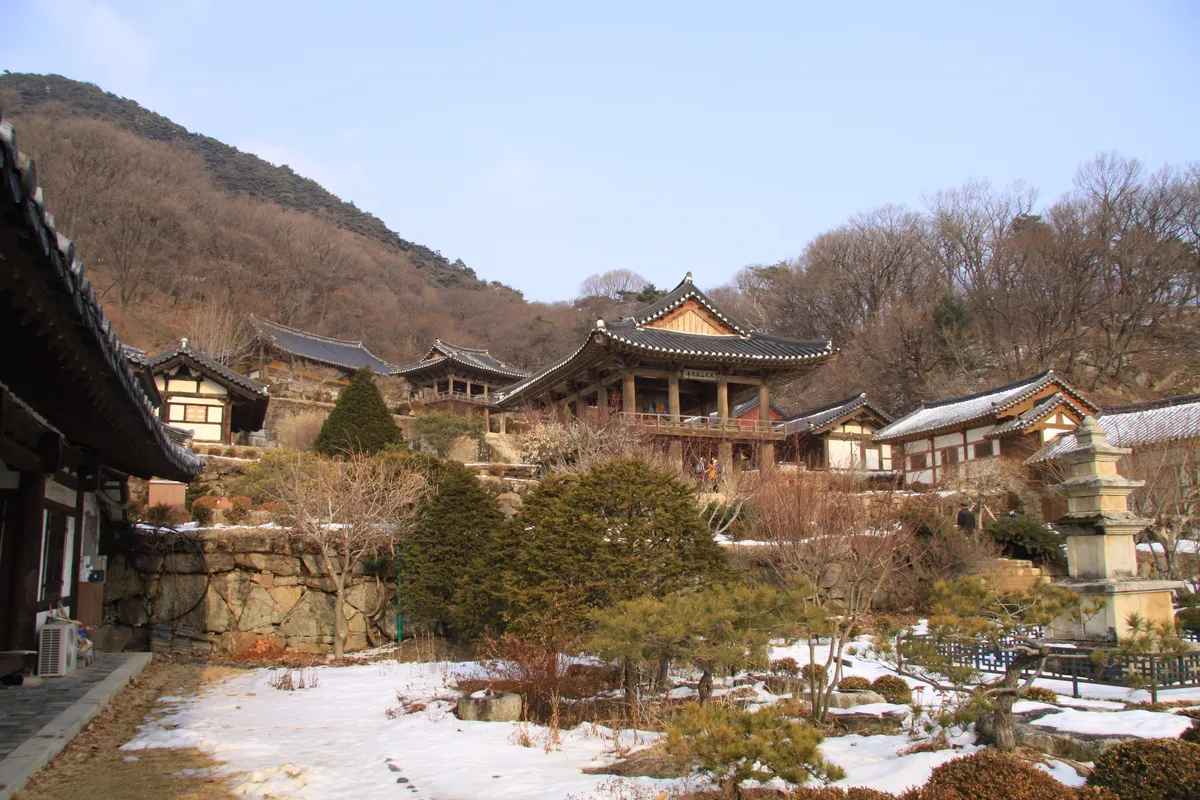
Buseoksa Beomjong Pavilion, Yeongju
榮州 浮石寺 梵鐘閣
경상북도 영주시
Basic information
- Designation
- Treasure No.2184
- Category
- Architecture
- Era
- 조선시대
- Designated year
- 2022
- Location
- 영주시, 경상북도— 경상북도 영주시 부석면 북지리 156
- Coordinates
- 36.998446, 128.687083Kakao address conversion
AI Docent
Coming soonAn AI-generated, friendly retelling of this heritage site is available in Korean. An English version is on our roadmap — for now, please see the official description below.
Description
Machine-translatedThis English description was machine-translated and may contain inaccuracies. Refer to the original Korean text for details.
The Bell Pavilion (Beomjong-gak) at Buseok Temple in Yeongju is located at 345 Buseok-ro, Buseok-myeon, Yeongju-si, Gyeongsangbuk-do. Situated within Buseok Temple, which was designated as UNESCO World Heritage in 2018 as one of the "Mountain Temples of Korea," the bell pavilion represents bell-tower architecture of the mid-eighteenth century, measuring 3 bays on the front and 4 bays on the side with a two-story wing-bracket style hip-and-gable roof configuration. Documentary sources including the Gyeam Daily Record and "Buseok Temple Record" (Buseok-sa-gi) reference the structure as the "Bell Tower" (jongryu) or "Bell Pavilion" (beomjong-gak). According to the "Record of Bell Pavilion Repairs at Buseok Temple," the bell pavilion was destroyed by fire in 1746 and subsequently rebuilt in 1747. The "Cheongryangsan Gazetteer" notes that a metal bell was housed within the bell pavilion's interior, though the bell's location has remained unknown since the nineteenth century. Whereas bell pavilions are typically positioned to the left and right of temples, Buseok Temple's bell pavilion uniquely occupies the central processional axis with the lower story serving dual purposes as a passageway. Notably, the side measurement exceeds the frontal bay count, with the central bay functioning as a corridor and the building's placement creating a staggered processional axis. The structure measures 3 bays frontally and 4 bays on the side, with the frontal roof configured as a hip-and-gable design while the rear roof employs a gable configuration. The lower story comprises columns exclusively, with a central staircase providing access below the pavilion to the Anyang-ru (below-pavilion entry format), with the column diameter at the exterior face exceeding that of the interior column. The upper story remains completely open on all four sides with the entire interior floor composed of geometric parquet, containing a dharma drum (beop-go), wooden fish percussion instrument (mok-eo), and wind gong (un-pan) for Buddhist ceremonies. The bracket arms on the frontal and left-right lateral faces consist of one-bay exterior with two-wing bracket configurations. The external cantilevers feature upward-curved blade forms in the initial-wing style and downward-curved blade forms in the secondary-wing style, with florets positioned between bracket components. The rear employs a simplified primary-wing style without intermediate roof beams. Notably, the florets display elaborate decoration with wind-scroll carved details representing mid-eighteenth-century carving techniques. The roof wind-boards lack full-length ridge trim, with original decorative coloring remaining within the interior from the bell pavilion's reconstruction period.
Location
지도를 불러오는 중…
Have you visited this place?
Log in and verify your visit on-site via GPS to record a stamp in My Journey. (QR verification coming later.)
Images: KOGL (khs.go.kr) · Data source: Korea Heritage Service Open API (khs.go.kr)