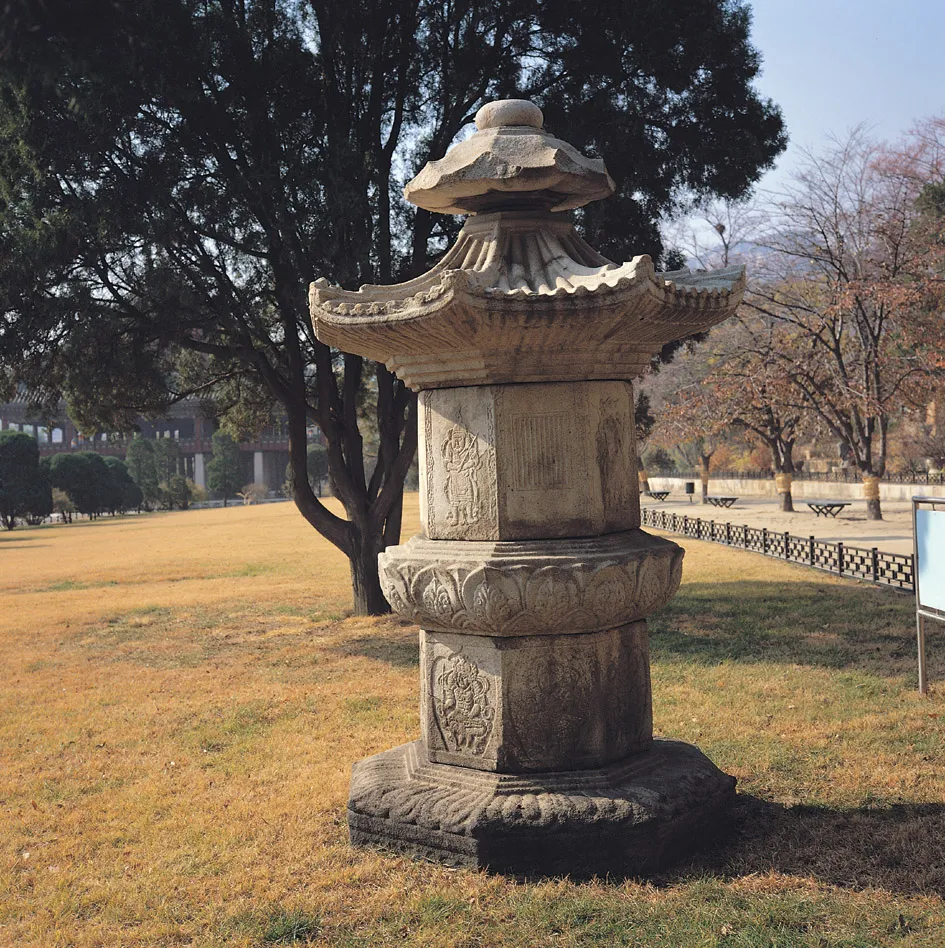
Stupa of State Preceptor Wongong from Geodonsa Temple Site, Wonju
原州 居頓寺址 圓空國師塔
서울특별시 용산구
Basic information
- Designation
- Treasure No.190
- Category
- Sites & Pagodas
- Era
- 고려시대
- Designated year
- 1963
- Location
- 용산구, 서울특별시— 서울 용산구 서빙고로 137, 국립중앙박물관 (용산동6가)
- Coordinates
- 37.523465, 126.981527
AI Docent
Coming soonAn AI-generated, friendly retelling of this heritage site is available in Korean. An English version is on our roadmap — for now, please see the official description below.
Description
Originally located at the former site of Geodonsa Temple but kept in a Japanese house during the Japanese occupation, this stupa was moved to Gyeongbokgung Palace in 1948 and currently stands in the precincts of the National Museum of Korea. The stupa, whose foundation stone is missing, sits on a stylobate consisting of three octagonal layers. Every face of the bottom layer is engraved with a panel decoration design inside which a flower pattern is carved. The top and bottom parts of the middle layer are carved with a line pattern, while the center is engraved with a panel decoration design in which images of the Eight Guardian deities are engraved. The upper layer is carved with two folds of lotus petals. Every corner of the main body’s octagonal core stone is carved with a pillar pattern overlaid with a flower design. The faces of both the front and back are engraved with a door and lock design, while the faces on the right and left are carved with a window design, and the remaining two facets are carved with images of the Four Guardian Kings. The octagonal roof stone has a four-tiered cornice and an upper surface carved with antefixes. The eaves are thin, and turn sharply upward at the eight corners. The sloping side of the roof contains runnels to drain away rainwater. The stupa’s roof follows the style of wooden structures, as evidenced by the end tile at the tip of the slope of the roof. An octagonal roof-shaped ornament is placed on top of the stupa. As the Stele for State Preceptor Wongong at Geodonsa Temple Site (Treasure No. 78) was erected in 1025 (the 16th year of the reign of King Hyeonjong of the Goryeo Dynasty), it is assumed that this stupa was also built in the same year. A typical octagonal stupa of the early Goryeo Dynasty, it is also a fine example of a pagoda showing the influence of the Unified Silla Period, being well proportioned and displaying a refined and dignified appearance with its splendid carvings.
Location
지도를 불러오는 중…
Have you visited this place?
Log in and verify your visit on-site via GPS to record a stamp in My Journey. (QR verification coming later.)
Images: KOGL (khs.go.kr) · Data source: Korea Heritage Service Open API (khs.go.kr)