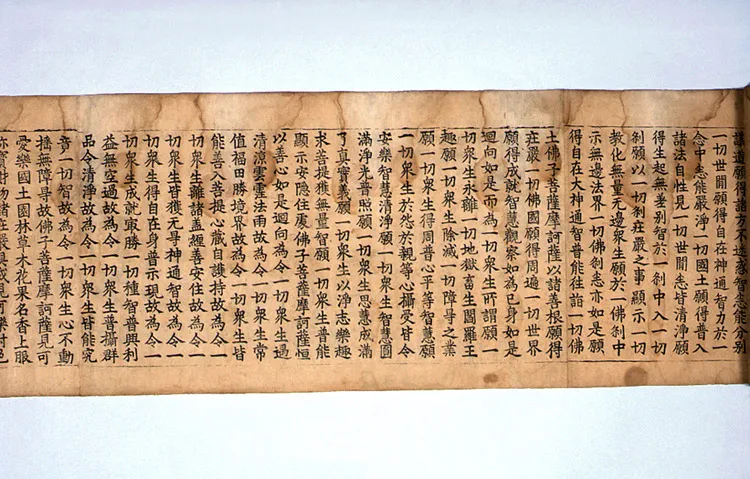
Chojobon Daebanggwangbulhwaeomgyeong Jubon Gwon30
初雕本 大方廣佛華嚴經 周本 卷三十
강원특별자치도 원주시
Basic information
- Designation
- Treasure No.1191
- Category
- Books & Records
- Designated year
- 1994
- Location
- 원주시, 강원특별자치도— 강원특별자치도 원주시 오크밸리2길 260(지정면, 뮤지엄SAN)
- Coordinates
- 37.415333, 127.823409Kakao address conversion
AI Docent
Coming soonAn AI-generated, friendly retelling of this heritage site is available in Korean. An English version is on our roadmap — for now, please see the official description below.
Description
Daebanggwangbul hwaeomgyeong is also called Hwaeomgyeong (Avatamsaka Sutra) for short. Based on the basic ideology asserting that Buddha and all creatures are one rather than two separate entities, it is a fundamental sutra of Hwaeom Order; it greatly influenced the establishment of Korean Buddhism along with Beophwagyeong (Lotus Sutra). It is a compilation of the 30th volume out of the 80 volumes of Avatamsaka Sutra of Zhou version, translated by Silchananta of the Tang Dynasty. It is one of the First Tripitaka Koreanas engraved during the reign of King Hyeonjong of the Goryeo Dynasty. This book is a wood block copy printed on mulberry paper. The printed papers are pasted successively into a long paper to be rolled up into one scroll. Although preserved relatively well, it lost its cover. On the first page, the title and approximately twenty letters are missing. Nonetheless, under the title of the book is a writing “New Translation,” suggesting that this book was copied from the 80 volumes of Avatamsaka Sutra of Zhou version. The First Tripitaka Koreana is Korea’s first Tripitaka engraved to defend the nation against Khitan’s invasion. The style of calligraphy looks stronger and more vigorous compared to that of Haeinsa Temple’s Tripitaka. The engravings are intricate, with each line consisting of 14 letters unlike Haeinsa Temple’s Tripitaka, which has 17 letters on each line. Based on the paper quality and the printed condition, this First Tripitaka Koreana Edition was probably published in the 11th century.
Location
지도를 불러오는 중…
Have you visited this place?
Log in and verify your visit on-site via GPS to record a stamp in My Journey. (QR verification coming later.)
Images: KOGL (khs.go.kr) · Data source: Korea Heritage Service Open API (khs.go.kr)