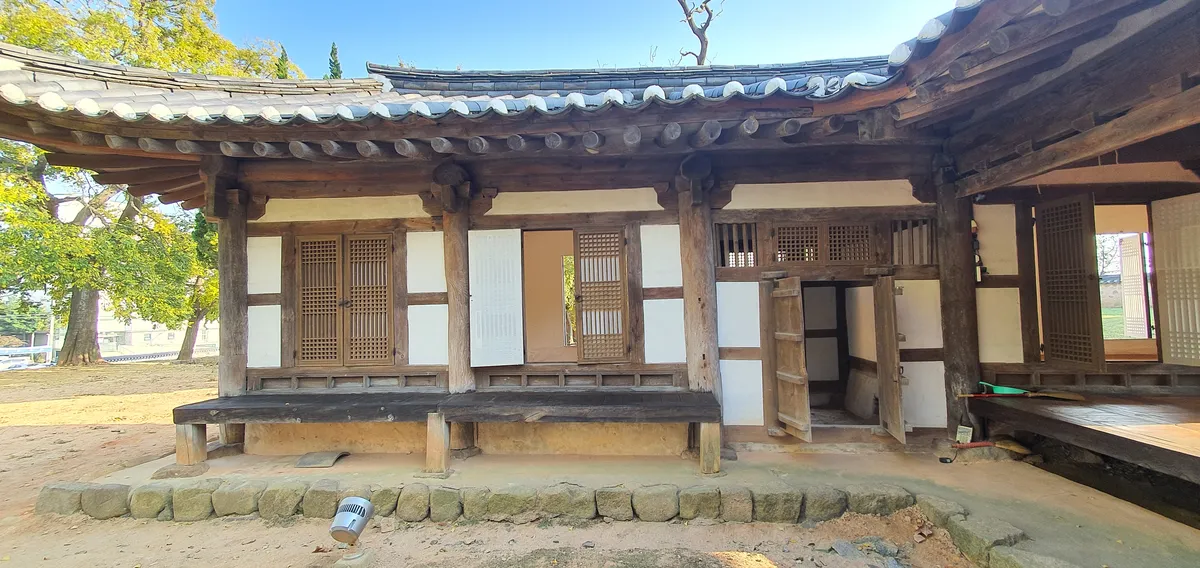
Naea, Gimje
金堤 內衙
전북특별자치도 김제시
Basic information
- Designation
- Treasure No.2193
- Category
- Architecture
- Era
- 조선시대
- Designated year
- 2022
- Location
- 김제시, 전북특별자치도— 전라북도 김제시 동헌4길 46-1 (교동)
- Coordinates
- 35.800617, 126.882441Kakao address conversion
AI Docent
Coming soonAn AI-generated, friendly retelling of this heritage site is available in Korean. An English version is on our roadmap — for now, please see the official description below.
Description
Machine-translatedThis English description was machine-translated and may contain inaccuracies. Refer to the original Korean text for details.
Gimje Nae-a (Inner Quarters of District Magistrate's Residence) is estimated to have been built around 1749 and is preserved alongside the official administrative building (dongheun) and pavilion structure (pigeum-gak), providing a rare example through which to examine the daily life of provincial magistrates. While the dongheun functioned as the administrative office building, the nae-a served as the residence where the magistrate's family lived. These three structures—administrative building, leisure pavilion, and residential quarters—represent the three essential spaces comprising a magistrate's daily responsibilities: work, leisure, and residential life. The three spaces interconnect while maintaining independent functional zones. The dongheun was destroyed during the Imjin War and the Byeongja War but was rebuilt in 1699 by Magistrate Lee Se-sung and named Sachil-heon, continuing to the present. The Pigeum-gak was constructed in 1633 as a pavilion by Magistrate Jeong Hong-myeong and remains the only building at Gimje Government Office predating the Byeongja War. Gimje Nae-a displays an inverted-U-shaped floor plan, with the central main structure featuring a five-rafter hip-and-gable roof and flanking wings comprising three-rafter hipped-roof configurations. Based on analysis of ridge-beam inscriptions and dendrochronological dating of major beam components, the structure was likely constructed in 1749. Unlike the southward-facing dongheun, the nae-a was constructed facing east, reducing mutual interference between buildings. The wing facing the dongheun was configured similar to the outer quarters (sarang-chae) of civilian residences, protecting the inner courtyard while accommodating external relationships. The opposite wing contained the inner chamber and kitchen, establishing the residence's functional center. The application of inner/outer spatial concepts (naewoe) to flanking wings separated by the central hall represents a distinctive aspect of Gimje Nae-a's spatial organization. Bracket systems omit decorative elaboration, creating a restrained appearance, though the universal use of cylindrical columns throughout references palace-style architectural conventions. The central hall's structural elements—tapered columns, expansive beams, bracket members, and floating roof beams—demonstrate sophisticated design quality. Gimje Nae-a exemplifies the advantages and limitations of modular assembly construction techniques, with standardized eight-foot bay modules composing the entire structure: the main section comprises two-bay units (sixteen feet) as a five-rafter structure, while flanking wings utilize single-bay units (eight feet) as three-rafter structures. Consequently, all spatial dimensions conform to eight-foot increments, with standardized facade treatments mechanically repeated in response to functional requirements. These characteristics likely resulted from the convergence of multiple factors: enhanced construction productivity following the establishment of wage-labor systems in late-Joseon official architecture, technological advancement through the specialization of construction workers' roles, and improved material procurement efficiency through the emergence of private timber merchants.
Location
지도를 불러오는 중…
Have you visited this place?
Log in and verify your visit on-site via GPS to record a stamp in My Journey. (QR verification coming later.)
Images: KOGL (khs.go.kr) · Data source: Korea Heritage Service Open API (khs.go.kr)