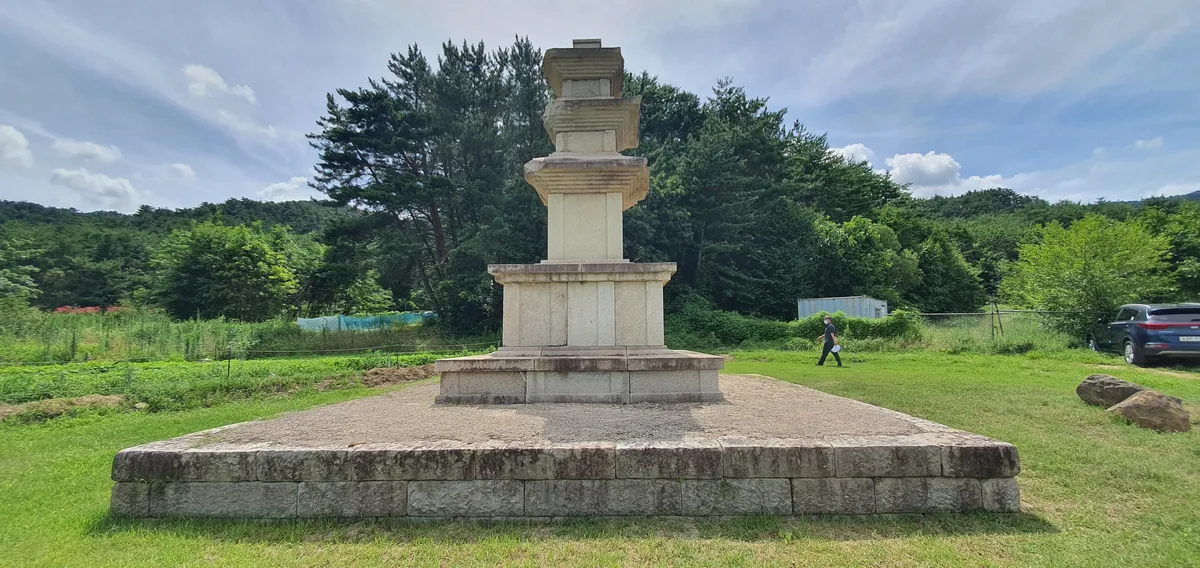
(jeon)yeombulsaji Dong·seo Three-story Stone Pagoda, Gyeongju
慶州 傳 念佛寺址 東‧西 三層石塔
경상북도 경주시
Basic information
- Designation
- Treasure No.2194
- Category
- Sites & Pagodas
- Era
- 통일신라시대
- Designated year
- 2022
- Location
- 경주시, 경상북도— 경상북도 경주시 남산동 1129-3
- Coordinates
- 35.787942, 129.243792Kakao address conversion
AI Docent
Coming soonAn AI-generated, friendly retelling of this heritage site is available in Korean. An English version is on our roadmap — for now, please see the official description below.
Description
Machine-translatedThis English description was machine-translated and may contain inaccuracies. Refer to the original Korean text for details.
The Three-Story Stone Pagodas (East and West) at the Site of the Former Yeombul Temple in Gyeongju were revealed through excavation surveys conducted from 2003 to 2008 to belong to a Buddhist temple established in the early eighth century and presumed abandoned during the twelfth century. The twin three-story stone pagodas standing 5.85 meters in height were constructed during the Unified Silla period, specifically the first half of the eighth century. Both pagodas consist of two-tier foundation platforms (sangdae, hadae), with the pagoda body (tap-sin) and roof-tiles (ok-gae-seok) each constructed from single stone pieces. The upper ornamental finial (sangyun-bu) has largely disappeared, with only the exposed platform stone (nopan-seok) remaining. The eastern pagoda, which had been relocated to Bulguk Temple Station plaza in 1963, was restored to its original location in 2009 coinciding with site conservation work. Excavation results confirmed that an additional foundation layer was constructed to align the eastern pagoda's height with the western pagoda. The western pagoda, which had collapsed, was similarly restored to its original position based on excavation findings, with the complete structure matching the eastern pagoda in form and configuration. Although certain new stone components were incorporated during restoration work, the overall construction techniques, architectural style, and excavation findings concerning the pagodas' foundation structures validate their classification as eighth-century structures, establishing them as precious historical documents for understanding the prototype and stylistic evolution of Unified Silla stone pagodas. Considering such historical, scholarly, and artistic value, these pagodas demonstrate sufficient merit for designation as national-level heritage.
Location
지도를 불러오는 중…
Have you visited this place?
Log in and verify your visit on-site via GPS to record a stamp in My Journey. (QR verification coming later.)
Images: KOGL (khs.go.kr) · Data source: Korea Heritage Service Open API (khs.go.kr)