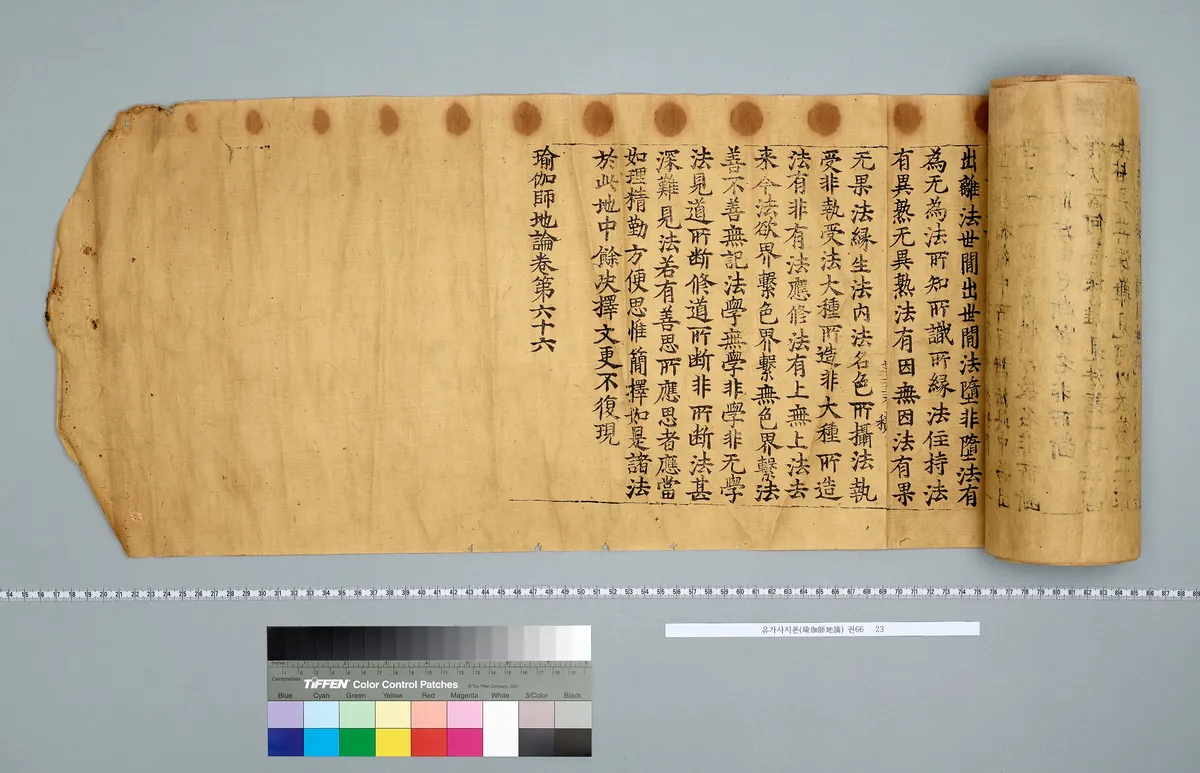
Chojobon Yugasajiron Gwon66
初雕本 瑜伽師地論 卷六十六
서울특별시 용산구
Basic information
- Designation
- Treasure No.2199
- Category
- Books & Records
- Era
- 고려 11세기 경
- Designated year
- 2022
- Location
- 용산구, 서울특별시— 서울특별시 용산구 서빙고로 139 (용산동6가, 국립한글박물관)
- Coordinates
- 37.521069, 126.980486Kakao address conversion
AI Docent
Coming soonAn AI-generated, friendly retelling of this heritage site is available in Korean. An English version is on our roadmap — for now, please see the official description below.
Description
Machine-translatedThis English description was machine-translated and may contain inaccuracies. Refer to the original Korean text for details.
The 'Yogacarabhumi-sastra, Fascicle 66' held at the National Hangeul Museum is one of 100 complete fascicles. As the 66th fascicle contained in the 'Chok' (積) function of the Chojo-Tripitaka, it exists as the sole extant example, with no other instances yet discovered among other Tripitaka collections. The 'Yogacarabhumi-sastra' is a 100-fascicle work translated into Chinese by the Tang monk Xuanzang, comprising Buddhist teachings expounded daily by the Bodhisattva Maitreya over four months. It covers the stages of practice for those engaging in yoga (meditation), clarifies terminology related to Yogacara Buddhism, and forms the fundamental ideology of Mahayana Buddhism. While Fascicles 15, 17, 32, and 53 of the Chojo version are designated as National Treasures, and four recarved versions of the 'Yogacarabhumi-sastra' are designated as Treasures, the deficiency in preservation condition with missing front portions is noted. However, the exceptional scholarly value lies in its unique transmission as the only extant fascicle, and critically in the presence of finely detailed Seokeun-gugyeol (Sino-Korean reading marks) marked in Korean, making it invaluable source material for Korean linguistic history research and providing insights into the academic level of Yogacara Buddhism studies during the Goryeo period. The 'Yogacarabhumi-sastra, Fascicle 66' represents an important cultural heritage through which we can examine the language, religion, and literature of our nation in the disciplines of Korean linguistics, paleography, Buddhist philosophy, and bibliography.
Location
지도를 불러오는 중…
Have you visited this place?
Log in and verify your visit on-site via GPS to record a stamp in My Journey. (QR verification coming later.)
Images: KOGL (khs.go.kr) · Data source: Korea Heritage Service Open API (khs.go.kr)