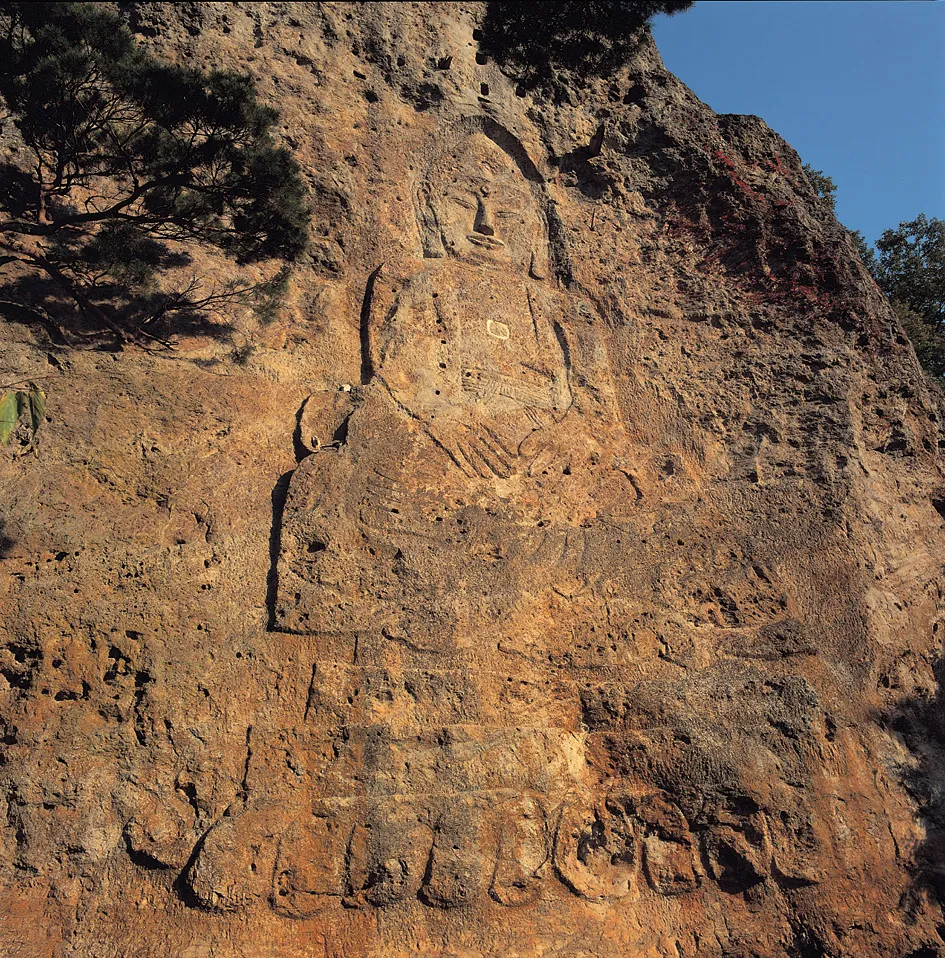
Seonunsa Dongburamji Rock-carved Seated Buddha, Gochang
高敞 禪雲寺 東佛庵址 磨崖如來坐像
전북특별자치도 고창군
Basic information
- Designation
- Treasure No.1200
- Category
- Sculpture
- Era
- 고려시대
- Designated year
- 1994
- Location
- 고창군, 전북특별자치도— 전북 고창군 아산면 도솔길 294, 선운사 (삼인리)
- Coordinates
- 35.480961, 126.562799
AI Docent
Coming soonAn AI-generated, friendly retelling of this heritage site is available in Korean. An English version is on our roadmap — for now, please see the official description below.
Description
It is a rock-carved seated Buddha on the roadside on the way to Dosoram Hermitage of Seonunsa Temple. A deep cut is made around the head, and the engraving gets thicker from the head to the bottom of the statue. The rectangular, flat face looks somewhat stiff, but the upturned thin eyes, high nose, and straight, plump lips form a mystical smile on the face. There are thin samdo, i.e., three wrinkles, on the neck, but the top of the body and the head are almost stuck together; thus, the head seems to have been placed on the top of the body. The upper body is rectangular, and the chest is wide and flat. As such, the statue is expressed in a planar way. The robe covers both shoulders, and the pleats are superficially expressed in lines. The knot of the skirt is clearly carved across the bottom of the flat chest. The two hands placed side by side on the knees look relatively big and coarse compared to the size of the body, so the overall shape of the statue appears unrealistic. This statue is made in the unique style of rock-carved Buddha of the Goryeo Dynasty, similar to the Rock-Carved Seated Buddha in Wolchulsan Mountain. The tiered top pedestal built comparatively high is covered with the lower ends of the robe, and the bottom pedestal is depicted with a pattern of lotus flowers facing downward. This statue of Buddha is drawing a lot of attention as one of the big rock-carved Buddhist statues of the early Goryeo Dynasty, particularly because the secret record on the Donghak Peasant Revolution was discovered from the chest area of the statue.
Location
지도를 불러오는 중…
Have you visited this place?
Log in and verify your visit on-site via GPS to record a stamp in My Journey. (QR verification coming later.)
Images: KOGL (khs.go.kr) · Data source: Korea Heritage Service Open API (khs.go.kr)