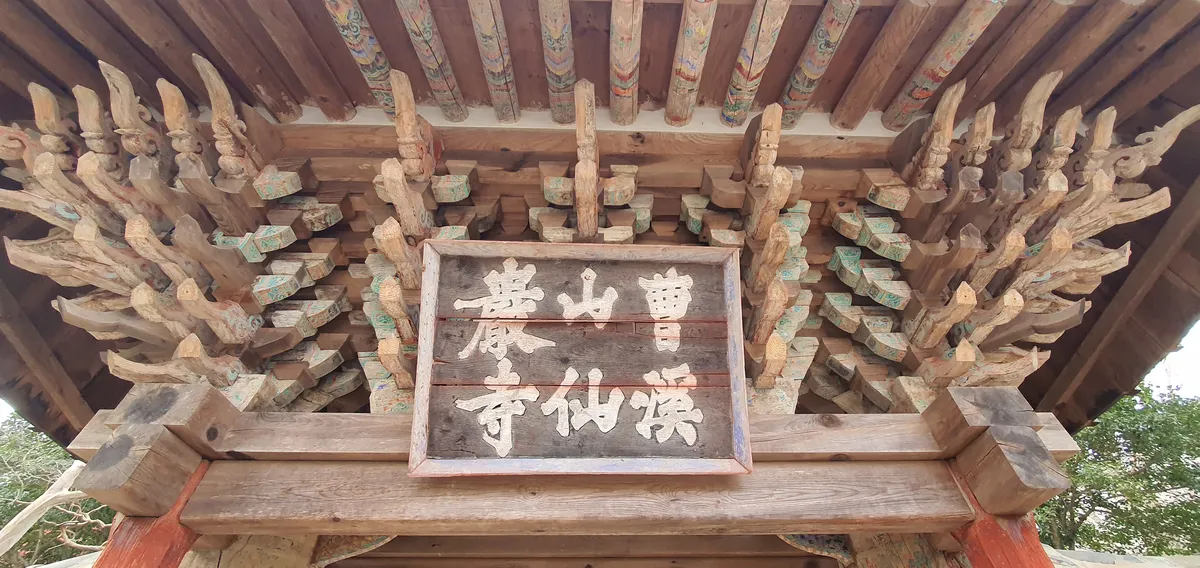
Iljumun Gate of Seonamsa Temple, Suncheon
順天 仙巖寺 一柱門
전라남도 순천시
Basic information
- Designation
- Treasure No.2201
- Category
- Architecture
- Era
- 조선시대
- Designated year
- 2022
- Location
- 순천시, 전라남도— 전라남도 순천시 선암사길 450 (승주읍, 선암사)
- Coordinates
- 34.989500, 127.103400Museum-based location
AI Docent
✨ AI-generatedWelcome to Seonam Temple's Iljumun Gate—one of Korea's most remarkable architectural survivors. This elegant single-pillar gate, nestled in Suncheon's mountains, has stood here since at least 1540, when it was reconstructed during the Joseon era. What makes this gate truly special? It's the *only* Joseon-period single-pillar gate that escaped destruction during Korea's most turbulent centuries—surviving both major wars in the 1590s and 1630s. Look closely at its design: a graceful tapered pillar supports a gabled roof with intricate bracket systems, while curved beams frame the interior in a distinctive T-shape. You'll notice short stone and earthen walls flanking the main pillars, and if you look up, dragon-head ornaments added in 2001 catch the light beautifully. What's architecturally rare? This gate uses a two-armed beam frame—only two examples survive in all of Korea and North Korea combined. Standing here, you're witnessing a living connection to Joseon craftsmanship and Buddhist temple architecture at its finest.
⚠ This is an AI-generated retelling of the official description. For accuracy, refer to the official description below.
Description
Machine-translatedThis English description was machine-translated and may contain inaccuracies. Refer to the original Korean text for details.
Sunwon Seonam Temple's Single-Pillar Gate (Iljumun) is located at Seonam Temple, where two founding accounts exist: one attributing the temple's establishment to National Preceptor Doseon during the Unified Silla period, and another crediting Buddhist priest Ado from the Silla era. The gate, also referred to as the Jogye Gate (Jogye-mun), has documented references indicating a 1540 reconstruction. The gate displays plaques reading "Jogye Mountain Seonam Temple" (Jogyesan Seoanam-sa) on its front face and "Ancient Cheongryangsan Haecheon Temple" (Go Cheongryangsan Haecheon-sa) on its rear face. *Following a 1759 fire, Seonam Temple changed its name to Haecheon Temple, reverting to Seonam Temple in 1823. Seonam Temple's single-pillar gate features a single-bay gable roof with multiple-bracket system bracket arms positioned at both column-head and inter-column locations. The column section (chuk-bu) employs a two-armed beam frame configuration consisting of simple column and curved-beam composition in T-shaped form. The overall curved-beam arrangement follows a rectangular configuration. Distinctive to the design, short earthen and stone walls finished with lime mortar are installed adjacent to the main pillars. The pillars display tapered form with progressively decreasing diameter from lower to upper sections. The interior decoration remains minimal, except for the 2001 addition of dragon-head ornaments (yong-du) installed above the interior upper sections of the main pillars. Interior dragon-head embellishment examples appear at Daegu Donghwa Temple's single-pillar gate and Jangheung Borim Temple's single-pillar gate, though those structures suspend dragon heads from the ceiling whereas Seonam's dragon heads hang from the pillars, demonstrating stylistic variation. While Seonam Temple's original appearance cannot be confirmed, it survives as the sole architectural structure remaining unscathed from recorded Joseon-era reconstructions, notably escaping destruction during both the 1592 Imjin War and 1636 Byeongja War. The gate exemplifies mid-Joseon architectural characteristics with significant historical and scholarly value. Furthermore, the two-armed beam-frame configuration represents only two surviving examples throughout North and South Korea, with the other example being the Anju Bohyeon Temple single-pillar gate in North Korea, making Seonam's gate architecturally distinctive.
Location
지도를 불러오는 중…
Have you visited this place?
Log in and verify your visit on-site via GPS to record a stamp in My Journey. (QR verification coming later.)
Images: KOGL (khs.go.kr) · Data source: Korea Heritage Service Open API (khs.go.kr)