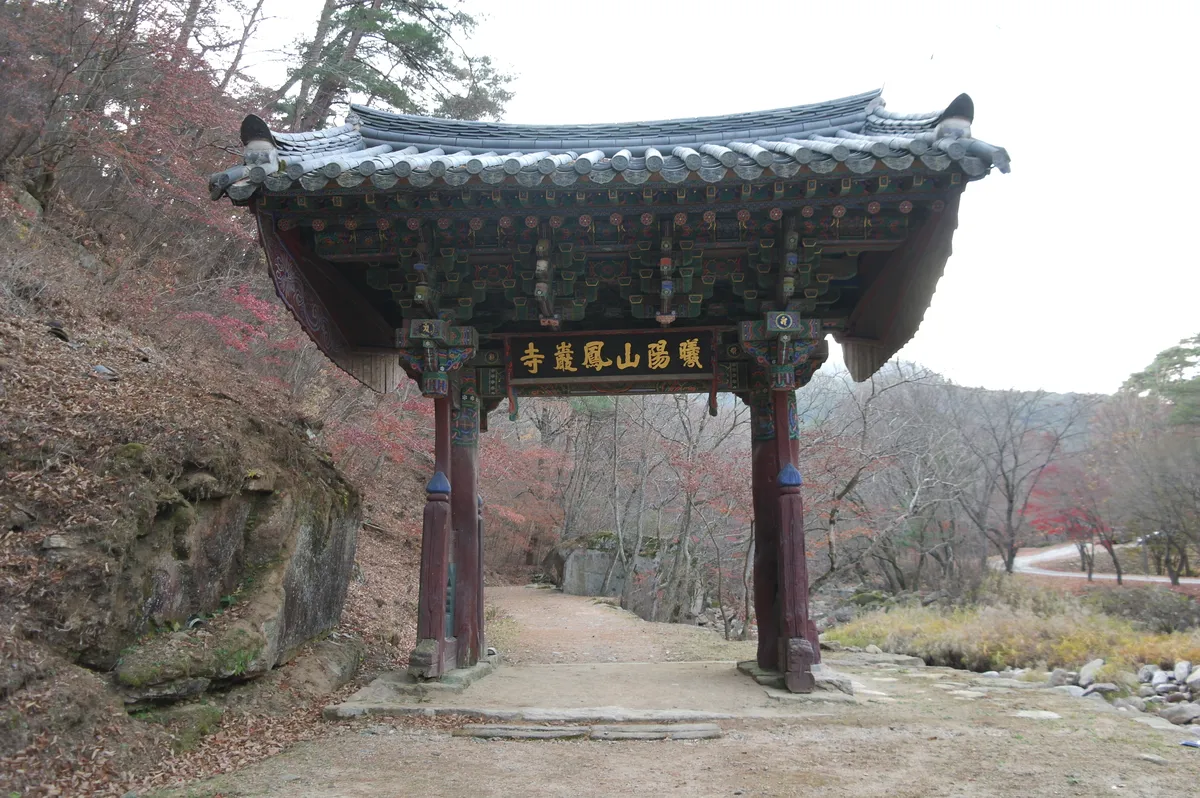
Bongamsa Bonghwang Gate, Mungyeong
聞慶 鳳巖寺 鳳凰門
경상북도 문경시
Basic information
- Designation
- Treasure No.2202
- Category
- Architecture
- Era
- 조선시대
- Designated year
- 2022
- Location
- 문경시, 경상북도— 경상북도 문경시 가은읍 원북리 627
- Coordinates
- 36.698878, 128.007627Kakao address conversion
AI Docent
Coming soonAn AI-generated, friendly retelling of this heritage site is available in Korean. An English version is on our roadmap — for now, please see the official description below.
Description
Machine-translatedThis English description was machine-translated and may contain inaccuracies. Refer to the original Korean text for details.
Mungyeong Bongam Temple's Phoenix Gate (Bongwhang-mun) is located at Bongam Temple, which was established by National Preceptor Jijung Doheon during the late Silla period. While no documented creation record exists for the Phoenix Gate, its construction is estimated to predate 1723. The gate displays a plaque reading "Mount Hiyangsan Bongam Temple" (Hiyangsan Bongam-sa) on its front face and "Phoenix Gate" (Bongwhang-mun) on its rear. Bongam Temple's Phoenix Gate comprises a single-bay gable-roof structure utilizing a five-rafter frame with multiple-bracket system bracket arms at both column-head and inter-column locations. The column section (chuk-bu) employs the Mungyeong region's distinctive palace-rail architectural style (gung-pan form), featuring decorative railings composed of wood inserted into column midpoints and lower sections. The pillars display tapered form without additional ornamentation. The roof features overlapping curved and secondary rafters in double-eave construction. The curved-beam arrangement displays an H-shaped configuration. Standard single-pillar-gate design typically employs rectangular (口-shaped) or grid-patterned (日-shaped) curved-beam configurations. However, Phoenix Gate's H-shaped arrangement, where the longitudinal-direction central curved-beam assumes primary load-bearing responsibility, represents a transitional load-distribution methodology transitioning from single-line arrangement to two-line arrangement. The bracket system incorporates external outsets exclusively, omitting internal projections. Primary bracket members at designated points utilize connecting pegs to facilitate load-transfer through bracket systems. This bracket arrangement maintains expansive roof dimensions while allowing frontal and side curved-beams to remain unobstructed by eave-coverage, creating an elevated and open appearance for the gate. Such construction methodology represents a technique exclusive to Bongam Temple's Phoenix Gate, demonstrating exceptional originality.
Location
지도를 불러오는 중…
Have you visited this place?
Log in and verify your visit on-site via GPS to record a stamp in My Journey. (QR verification coming later.)
Images: KOGL (khs.go.kr) · Data source: Korea Heritage Service Open API (khs.go.kr)