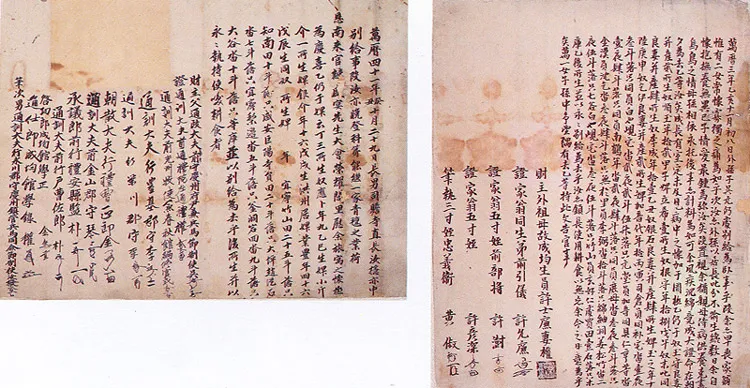
Oun Jongga Munjeok
吳澐 宗家 文籍
경상북도 고령군
Basic information
- Designation
- Treasure No.1203
- Category
- Books & Records
- Designated year
- 1994
- Location
- 고령군, 경상북도— 경상북도 고령군
- Coordinates
- 35.726065, 128.262896
AI Docent
Coming soonAn AI-generated, friendly retelling of this heritage site is available in Korean. An English version is on our roadmap — for now, please see the official description below.
Description
These documents, books, and paintings have been preserved by the descendants of O Un (1540∼1617), who was a Confucius scholar and a civil official during the mid-Joseon Dynasty. O Un studied under the teachings of famous Confucian scholars such as Yi Hwang (penname: Toegye) and Jo sik (penname: Nammyeong) and passed the civil service national examination in 1566. He was then appointed to several government positions such as Seonggyungwan baksa (Reference Consultant of the Royal Academy) and Magistrate of Chungju. When the Japanese Invasion of Korea broke out in 1592, he formed a righteous army and, under the command of General Gwak Jae-u, fought against Japanese soldiers. In 1599, he was appointed Cheomji jungchubusa, a high-ranking official position. He wrote a book titled Jukyumunjip. Among old documents and books preserved by the descendants of O Un for the past 400 years, the old documents include 18 volumes of Bunjaegi (records about the distribution of properties and servants during King Myeongjong’s reign and King Youngjo’s reign), 1 official document, 21 Family Registers, 85 Precepts of O Un and his descendants, and 1 Message of Condolence written by King Gwanghaegun after the passing of O Un. A total of 110 documents in 7 categories show the state of properties owned by the O Family’s Clan and also provide valuable information in studying social and economic history and family system and social class structure at that time. Classical Books consist of 12 volumes in 7 categories, including one wood block-printed copy of Daehakjanggudaejeon, Dongmunseon (5 books on military training), Nojuyeonsongdeoksi (1 bronze-printed copy), Hangusosi (2 handwritten copies), and Maechondongyak (1 handwritten copy). They are considered valuable materials in studying bibliography, village code, and calligraphy.
Location
지도를 불러오는 중…
Have you visited this place?
Log in and verify your visit on-site via GPS to record a stamp in My Journey. (QR verification coming later.)
Images: KOGL (khs.go.kr) · Data source: Korea Heritage Service Open API (khs.go.kr)