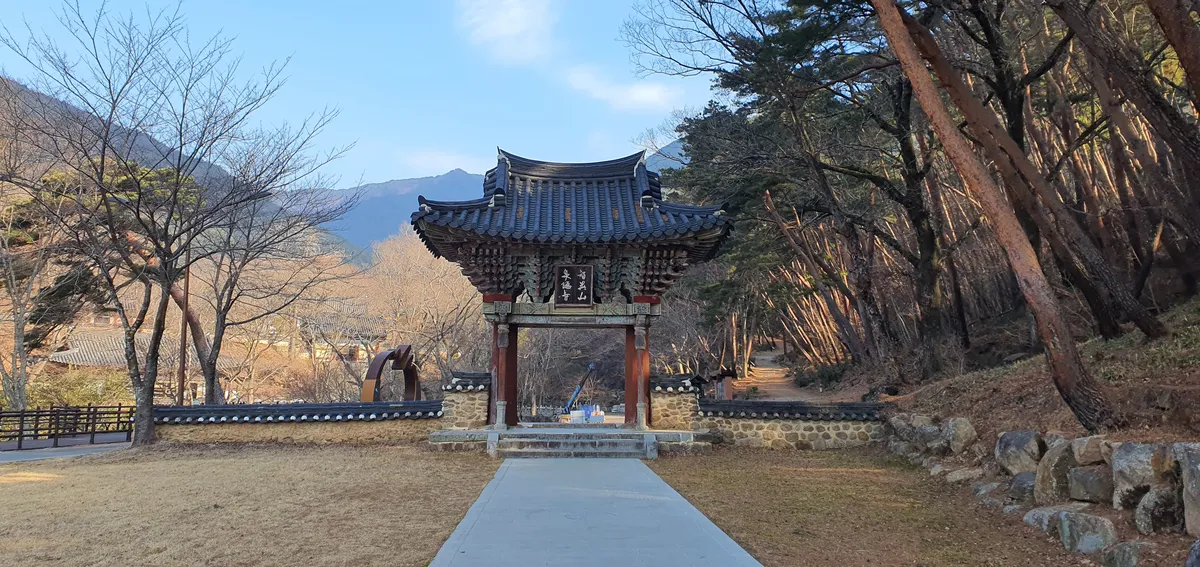
Cheoneunsa Iljumun Gate, Gurye
求禮 泉隱寺 一柱門
전라남도 구례군
Basic information
- Designation
- Treasure No.2203
- Category
- Architecture
- Era
- 조선시대
- Designated year
- 2022
- Location
- 구례군, 전라남도— 전라남도 구례군 광의면 방광리 산 1-1
- Coordinates
- 35.286935, 127.477592Kakao address conversion
AI Docent
Coming soonAn AI-generated, friendly retelling of this heritage site is available in Korean. An English version is on our roadmap — for now, please see the official description below.
Description
Machine-translatedThis English description was machine-translated and may contain inaccuracies. Refer to the original Korean text for details.
The Iljumun (single-pillar gate) of Cheoneuisa Temple in Gurye is located at a temple said to have been founded either by the monk Yeongi during the reign of King Heongang of Silla, or by the monk Deokun during the reign of King Heungdeok. According to the temple's most recent historical record (2015), the iljumun was constructed in 1723. Though the original name of the gate is uncertain (records mention Jogyemun, though it is unclear whether this refers specifically to the iljumun), the front face bears a plaque inscribed 'Jirisan Cheoneuisa' in the hand of the renowned calligrapher Wongyo Yi Gwangsa (1705-1775). The Cheoneuisa Iljumun features a single-bay hip-and-gable roof with a multiple-bracket system employing both column-head and intercolumnar bracket sets. The column section follows the supplementary-pillar type concentrated in the Jirisan region, consisting of two main pillars and four auxiliary pillars. The overall arrangement of the changbangs forms a Japanese character-shaped configuration, differing from the square-shaped arrangement of the pyeongbangs. Before 1973, photographs show no wall beside the gate; a wall was added later to demarcate the temple boundary. The roof eave is double-layered, consisting of round-section rafters and rectangular-section sub-rafters. A notable feature is that the bracket section is raised unusually high, giving the gate a taller appearance than other iljumun gates. Uniquely among iljumun gates in Korea, the threshold between the main pillars is made of stone rather than wood. According to tradition, the calligrapher Yi Gwangsa wrote the plaque in a flowing water-style script to ward off fire disasters that frequently plagued the temple. The Cheoneuisa Iljumun is a well-preserved example of a Joseon-period iljumun gate that reflects both regional architectural characteristics and the broader stylistic conventions of its time.
Location
지도를 불러오는 중…
Have you visited this place?
Log in and verify your visit on-site via GPS to record a stamp in My Journey. (QR verification coming later.)
Images: KOGL (khs.go.kr) · Data source: Korea Heritage Service Open API (khs.go.kr)