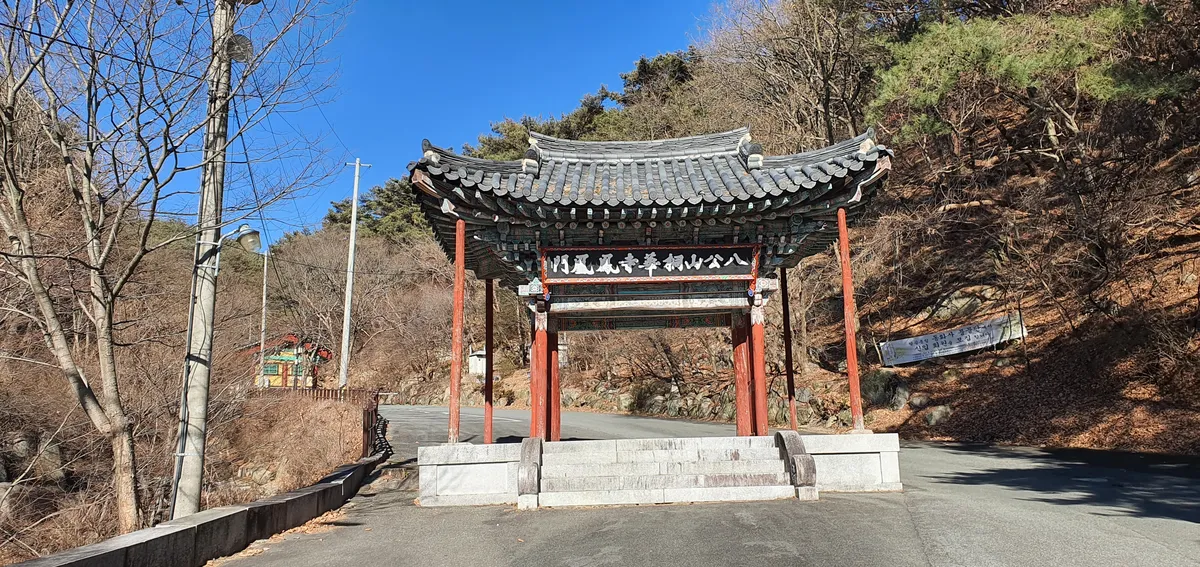
Donghwasa Bonghwang Gate, Daegu
大邱 桐華寺 鳳凰門
대구광역시 동구
Basic information
- Designation
- Treasure No.2204
- Category
- Architecture
- Era
- 조선시대
- Designated year
- 2022
- Location
- 동구, 대구광역시— 대구광역시 동구 동화사1길 1(도학동, 동화사)
- Coordinates
- 35.920400, 128.701900Museum-based location
AI Docent
Coming soonAn AI-generated, friendly retelling of this heritage site is available in Korean. An English version is on our roadmap — for now, please see the official description below.
Description
Machine-translatedThis English description was machine-translated and may contain inaccuracies. Refer to the original Korean text for details.
The Bonghwangmun Gate of Dongwasa Temple in Daegu is located at a temple said to have been founded during the Silla period (attributed to Geukdal Hwasang or Simji Wangsa). The iljumun known as Bonghwangmun (Phoenix Gate) was first constructed in 1633 (the eleventh year of King Injo's reign) during the late Joseon period. Originally situated at the site of the Onghomun Gate, it was relocated to its current position in 1965. The front face of the gate bears a plaque inscribed 'Palgongsan Dongwasa Bonghwangmun.' The Dongwasa Bonghwangmun is a single-bay hip-and-gable roof structure with five roof-timber framing and a multiple-bracket system employing both column-head and intercolumnar bracket sets. The column section is a rare hybrid form combining an upper-diagonal-brace type and a supplementary-pillar type (two auxiliary pillars flanking each main pillar); the auxiliary pillars appear to have been added between 1920 and 1951. The changbang arrangement follows a distinct configuration differing from the standard pyeongbang layout. The bracket arms are of the local gyodumyeong type (simply carved without protruding wing-tip forms), identical inside and out. The eave is double-layered, using main rafters and sub-rafters. The interior ceiling is a coffered style, with four coffered panels total; dragon heads are mounted in the two end panels. The Dongwasa Bonghwangmun preserves a regionally distinctive gyodumyeong bracket system and an unusual hybrid column section not found in other iljumun gates.
Location
지도를 불러오는 중…
Have you visited this place?
Log in and verify your visit on-site via GPS to record a stamp in My Journey. (QR verification coming later.)
Images: KOGL (khs.go.kr) · Data source: Korea Heritage Service Open API (khs.go.kr)