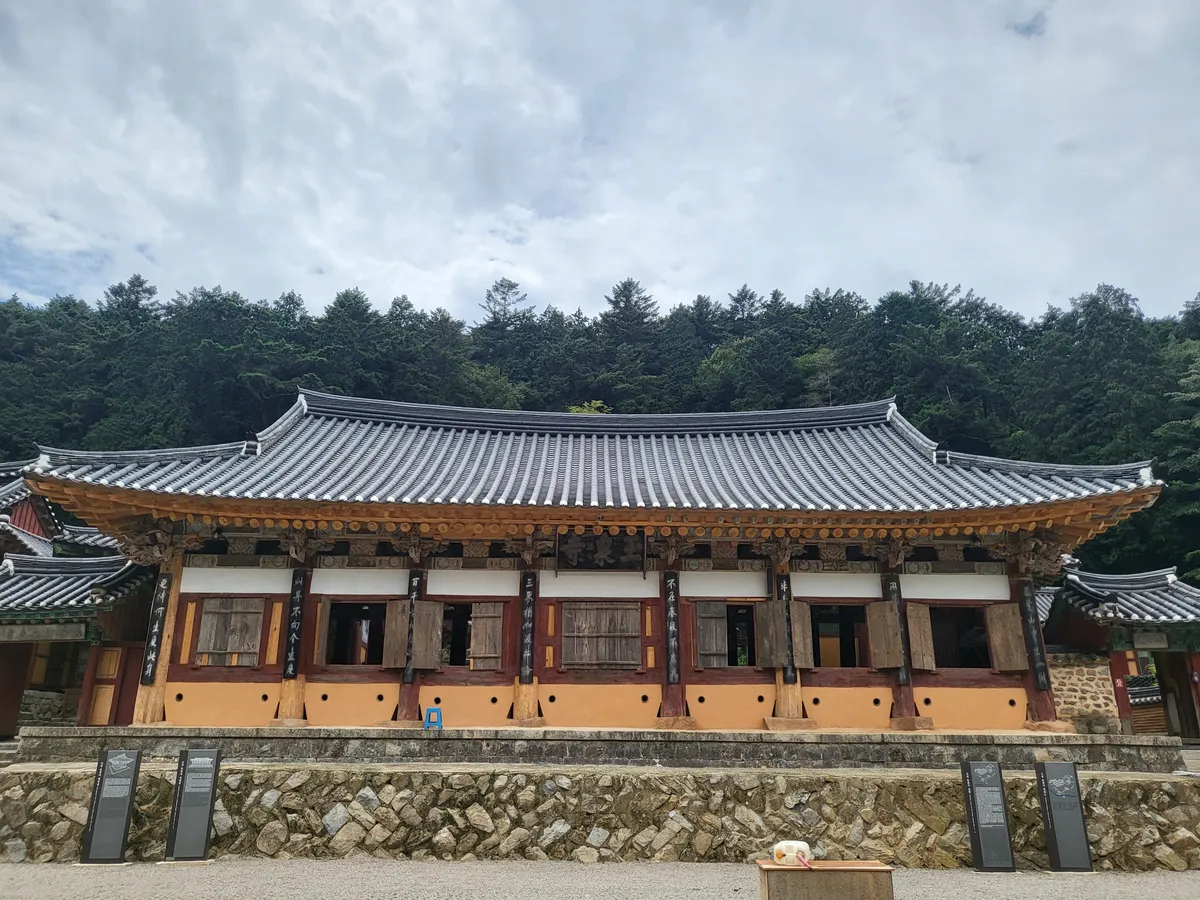
Okcheonsa Jabang Pavilion, Goseong
固城 玉泉寺 滋芳樓
경상남도 고성군
Basic information
- Designation
- Treasure No.2205
- Category
- Architecture
- Era
- 조선시대
- Designated year
- 2022
- Location
- 고성군, 경상남도— 경상남도 고성군 개천면 북평리 408
- Coordinates
- 35.080386, 128.262405Kakao address conversion
AI Docent
Coming soonAn AI-generated, friendly retelling of this heritage site is available in Korean. An English version is on our roadmap — for now, please see the official description below.
Description
Machine-translatedThis English description was machine-translated and may contain inaccuracies. Refer to the original Korean text for details.
Goseong Okcheon Temple's Jayangru (Self-Fragrance Tower) was originally constructed in 1664 as a principal gate (jeong-mun) positioned opposite the main Buddhist hall according to records including ridge-beam inscriptions. In 1764, it underwent major reconstruction into a pavilion form, subsequently referred to as "Main Tower" (jeong-ru) or "Fragrance-Gathering Tower" (chae-bang-ru). Temple access proceeds through side entrances flanking the Jayangru (corner-entrance configuration), bypassing passage beneath the literary pavilion itself. The frontal facade displays a plaque reading "Okcheon Temple" (Okcheon-sa), while the rear displays "Self-Fragrance Tower" (Jayangru). Goseong Okcheon Temple's Jayangru measures 7 bays on the front and 3 bays on the side, employing a five-rafter structural frame substantially larger in scale than the central Buddhist hall. The structure displays single-story full-hall architectural form without pavilion-support columns (nu-ha-chu), with the interior configured as a through-space (tong-gan) featuring central interior columns (go-chu). Elevated exterior platform landscaping precedes the Jayangru, requiring a natural-stone foundation wall approximately 158 centimeters in height to address topographic elevation variations, upon which an additional 60-centimeter-height stone platform foundation is installed. The bracket system employs wing-style bracket arms (yik-gong-hyeong) with exposed roof-beam construction creating a coffered-ceiling effect (yeon-deung-cheon-jang). All frontal bays feature wooden panel doors (pan-mun), enabling flexible control of openness and enclosure. The rear facade facing the central Buddhist hall incorporates an approximately 76-centimeter-height protective balustrade establishing an open configuration. Jayangru's floor plan demonstrates distinctive characteristics: the interior load-bearing columns occupy the central longitudinal axis, one bay of the platform facing the central Buddhist hall is eliminated and configured as external space, and the decorative embellishment of the bracket system, ornamental florets (hwa-ban) serving as upper-beam supports, and upper-column connecting boards (bo-a-ji) represent an exemplary masterwork among late-Joseon Buddhist temple pavilion ornamentation examples.
Location
지도를 불러오는 중…
Have you visited this place?
Log in and verify your visit on-site via GPS to record a stamp in My Journey. (QR verification coming later.)
Images: KOGL (khs.go.kr) · Data source: Korea Heritage Service Open API (khs.go.kr)