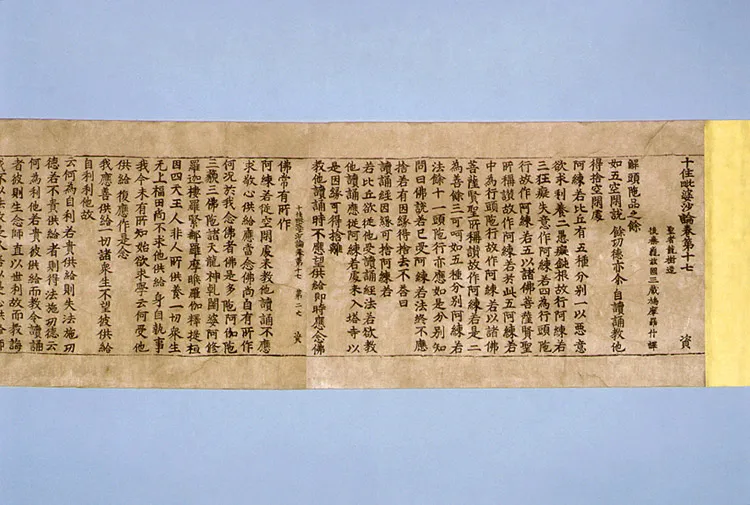
Chojobon Sipjubibasaron Gwon17
初雕本 十住毗婆沙論 卷十七
인천광역시 연수구
Basic information
- Designation
- Treasure No.1206
- Category
- Books & Records
- Designated year
- 1994
- Location
- 연수구, 인천광역시— 인천 연수구 청량로102번길 40-9, 가천박물관 (옥련동,가천박물관)
- Coordinates
- 37.419804, 126.656718
AI Docent
Coming soonAn AI-generated, friendly retelling of this heritage site is available in Korean. An English version is on our roadmap — for now, please see the official description below.
Description
Sipjubipasaron (Dasabhumika vibhasa Sastra) explains how to comply with the religious precepts and mental state of Bodhisattva, and it is included in Avatamsaka Sutra. As one of the early wooden Tripitakas made to fight against the invasion of the Khitan tribe with the power of Buddha during the reign of King Hyeonjong (1011∼1031) of the Goryeo Dynasty, it is the last among 17 volumes of Sipjubipasaron translated by Gumaraseup of the Later Qin Dynasty. It is printed on mulberry paper and composed of 28 sheets of paper measuring 30 cm long and 47.3 cm wide. The printed papers are pasted successively into a long paper so that they can be rolled into one scroll. There are several differences between the early wooden Tripitaka and Haeinsa Temple's Tripitaka (Jaejo Tripitaka or Goryeo Tripitaka), which was made later. For one, it is engraved more elaborately than that of Haeinsa Temple and is different in terms of the number of words per line. It also has no record showing its publication year. In addition, it has Pihwi (when the names of former kings appear, omit a stroke of the names or substitute them with synonymous words as a sign of respect for former kings) as well as some abbreviations. The early wooden Tripitaka uses the term “jang (丈) (similarly, yard)” or “pok (幅) (width)” to indicate the number of pages in a book, whereas Haeinsa Temple's Tripitaka utilizes only “jang (張).” Since the book uses “jang (丈)” and has no record of its publication, and the term “gyeong (敬)” (respect)'s last stroke is omitted, it appears to be a copy of the early wooden Tripitaka. Based on the book’s state of printing and quality of paper, it was apparently printed around the 11th century.
Location
지도를 불러오는 중…
Have you visited this place?
Log in and verify your visit on-site via GPS to record a stamp in My Journey. (QR verification coming later.)
Images: KOGL (khs.go.kr) · Data source: Korea Heritage Service Open API (khs.go.kr)