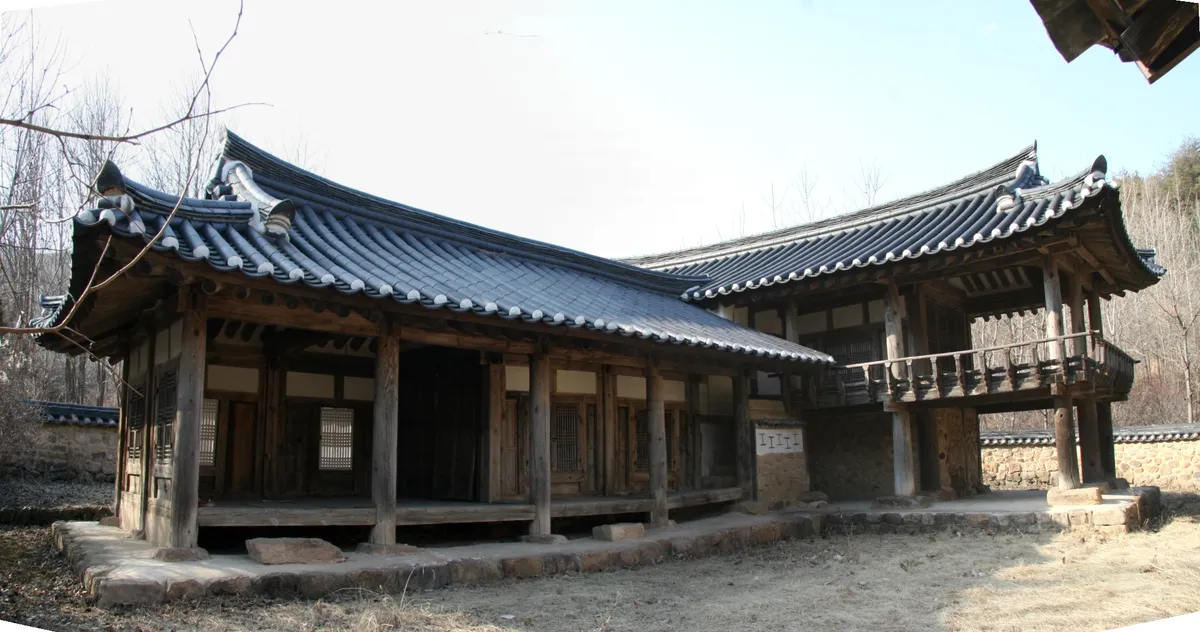
Daesan Pavilion, Sangju
尙州 對山樓
경상북도 상주시
Basic information
- Designation
- Treasure No.2206
- Category
- Architecture
- Era
- 조선시대
- Designated year
- 2022
- Location
- 상주시, 경상북도— 경상북도 상주시 채릉산로 799-46 (외서면)
- Coordinates
- 36.476454, 128.061920Kakao address conversion
AI Docent
Coming soonAn AI-generated, friendly retelling of this heritage site is available in Korean. An English version is on our roadmap — for now, please see the official description below.
Description
Machine-translatedThis English description was machine-translated and may contain inaccuracies. Refer to the original Korean text for details.
Daesan-ru (大山樓) in Sangju is a pavilion-study (書室) first constructed in 1602 by Ubok Jeong Gyeong-se* (愚伏 鄭經世, 1563–1633) as a place of retreat and scholarly pursuit after his return to his hometown, and was refined to its present form in 1778. It served as a center for learning and exchange of the head family and is a historical record through which one can glimpse the scholarly life of local literati during the Joseon period. * As a scholar continuing the traditions of the Yeongnam School in the 17th century, he was deeply versed in ritual studies (禮學) and was called a master of ritual studies together with Kim Jang-saeng (金長生). He produced a total of 107 disciples, including Yu Jin (柳袗), the third son of Yu Seong-ryong (柳成龍). Daesan-ru in Sangju is a two-story pavilion with a hipped-and-gabled roof in the five-rafter style (五量家), positioned with a mountain to the back and water to the front. The overall floor plan is configured in a jeong (丁)-shape: the southern vertical building is a single-story pavilion-house (亭舍) serving as a lecture space, while the northern horizontal building is the pavilion serving as a multipurpose space for rest, reception, and reading. The pavilion-house comprises four bays on the front and two bays on the side, consisting of two large halls and two heated rooms (ondol); the pavilion comprises two bays on the front and five bays on the side, with a one-bay ondol room at the center, a raised pavilion floor (numaru) in front, and a book storage room (seogo) at the back. The unique architectural techniques evident in the method of connecting the two buildings—the pavilion-house and pavilion—in a jeong (丁)-shape, the natural stone stairway and wall connecting the two spaces, the ondol arranged on the second floor of the pavilion, and the extended purlin bracket system (出目道里) with columns protruding outward to support the crossbeam demonstrate well the architectural value of Daesan-ru. Furthermore, given that the surrounding landscape is well-preserved together with related structures such as the Ubok head family house in the vicinity, and that various literary collections and documents produced here allow one to discern changes in local communities, the pavilion possesses sufficient historical and scholarly value to merit designation as a national cultural heritage.
Location
지도를 불러오는 중…
Have you visited this place?
Log in and verify your visit on-site via GPS to record a stamp in My Journey. (QR verification coming later.)
Images: KOGL (khs.go.kr) · Data source: Korea Heritage Service Open API (khs.go.kr)