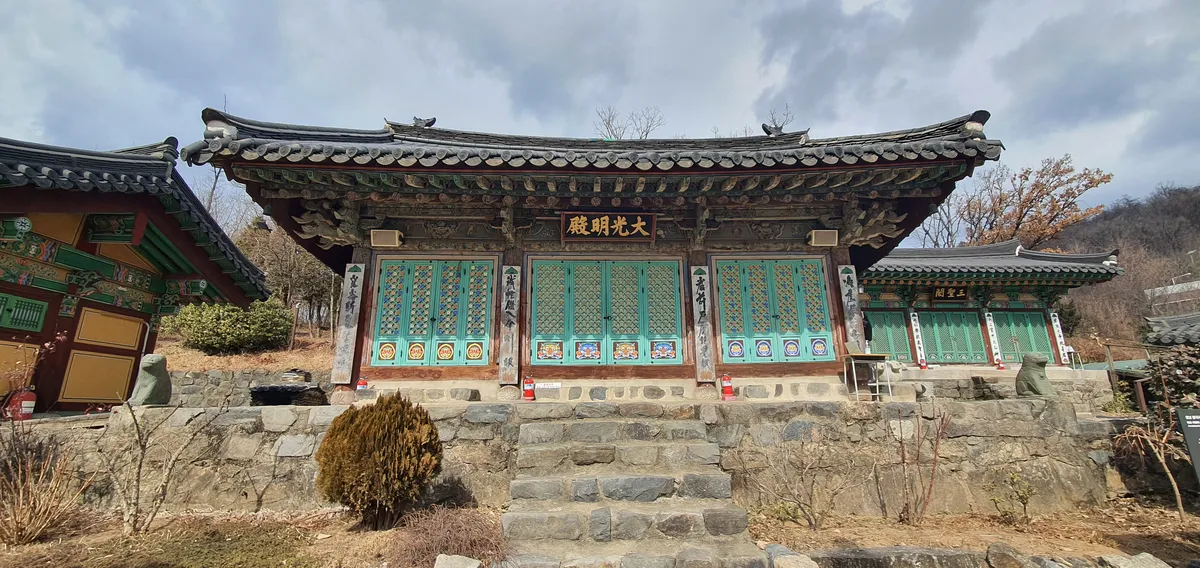
Bongguksa Daegwangmyeong Hall, Seongnam
城南 奉國寺 大光明殿
경기도 성남시
Basic information
- Designation
- Treasure No.2207
- Category
- Architecture
- Era
- 조선시대
- Designated year
- 2022
- Location
- 성남시, 경기도— 경기도 성남시 수정구 태평로 79 (태평동, 봉국사)
- Coordinates
- 37.450853, 127.135063Kakao address conversion
AI Docent
Coming soonAn AI-generated, friendly retelling of this heritage site is available in Korean. An English version is on our roadmap — for now, please see the official description below.
Description
Machine-translatedThis English description was machine-translated and may contain inaccuracies. Refer to the original Korean text for details.
Bongkook Temple was established through royal patronage following the deaths of Myeonghye and Myeongseon, two princesses and daughters of Joseon King Hyeonjong, who died from illness in succession. To honor their memory and pray for their spiritual peace, royal-directed temple construction was undertaken. Historical records document Bongkook Temple's establishment as newly constructed in 1674, and dendrochronological analysis of the primary structural beams in Daegwangmyeong Hall confirmed the wood-beam components dated to the late seventeenth century, establishing the hall's construction coinciding with the temple's founding. Bongkook Temple's Daegwangmyeong Hall measures 3 bays on the front and 3 bays on the side with a five-rafter structural configuration employing wing-bracket style multiple-bracket systems with overlapping double-eave ridge roof design. The structure uniquely incorporates an uncommon seventh-century bracket configuration employing protruding-rafter wing-bracket systems. The protruding-rafter wing-bracket system, while documented in early-seventeenth-century palace architecture at the Jongmyo Shrine's main hall, represents an exceptional application to Buddhist temple structures. Current structural analysis indicates the building was originally constructed as a hip-and-gable-roof structure employing protruding-rafter bracket arms during its initial seventh-century foundation period. The bracket system displays characteristics of nineteenth-century architectural modification: extended bracket cantilevers with flower-shaped ornamental finials, and upper-bracket members incorporating dragon-head carvings exemplify typical nineteenth-century decorative conventions. The bracket configuration structure and ornamentation demonstrate nineteenth-century style transformation. The central Buddhist hall's ornamental ceiling (dap-jip) structure demonstrates elaborate composition reflecting possible royal patronage, while the hall's interior spatial arrangement, with Buddha statue focal positioning and surrounding decorative embellishment, represents a representative example of late-Joseon Buddhist temple interior design.
Location
지도를 불러오는 중…
Have you visited this place?
Log in and verify your visit on-site via GPS to record a stamp in My Journey. (QR verification coming later.)
Images: KOGL (khs.go.kr) · Data source: Korea Heritage Service Open API (khs.go.kr)