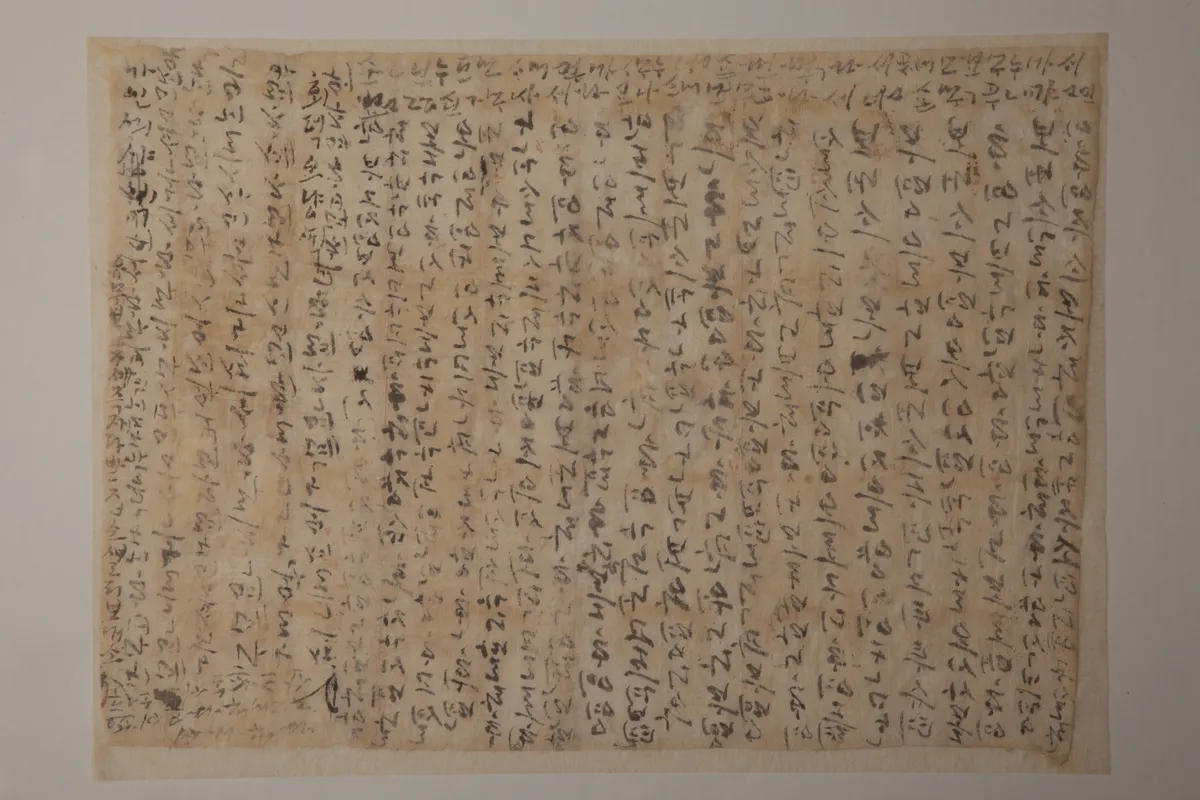
Nasingeol Hangeulpyeonji
羅臣傑 한글便紙
대전광역시 유성구
Basic information
- Designation
- Treasure No.2209
- Category
- Books & Records
- Era
- 1490년대 추정
- Designated year
- 2023
- Location
- 유성구, 대전광역시— 대전광역시 유성구 도안대로 398 (상대동, 대전역사박물관)
- Coordinates
- 36.336978, 127.335420Kakao address conversion
AI Docent
Coming soonAn AI-generated, friendly retelling of this heritage site is available in Korean. An English version is on our roadmap — for now, please see the official description below.
Description
Machine-translatedThis English description was machine-translated and may contain inaccuracies. Refer to the original Korean text for details.
The 'Na Sin-gyeol's Hangeul Letter' consists of two letters written in Korean by Na Sin-gyeol (羅臣傑, 1461-1524), a military official of early Joseon, to his wife Sin Chang-maeng-ssi (新昌孟氏). The letters were discovered in 2011 from the tomb of Sin Chang-maeng-ssi at Geumgodong, Yuseong-gu, Daejeon. Based on the archaic place name 'Youngangeun-do' (永安道) appearing in the letter content, documented between 1470-1498, and the fact that Na Sin-gyeol served as a military official in Hamgyeong Province in the 1490s, the letters are estimated to have been written during that period. Na Sin-gyeol came from a family with generations of military officials, and at the time of writing, he was serving as a junior military officer in Hamgyeong Province. A total of 41 artifacts were excavated from the tomb of his wife, including 28 clothing items such as jeogori (short jackets) and baji (trousers), and 13 items including the Hangeul letters. The letters were discovered near the head of the deceased, folded multiple times. The writing densely fills the upper, lower, left, and right margins of the page, with content primarily expressing longing for his mother and children, requesting that his wife send necessary clothing such as cheollik (a military officer's official robe), attend to agricultural work, and handle household matters diligently. Given that these letters were written in the 1490s, merely 45 years after the promulgation of Hangul in 1446, they demonstrate that the Korean alphabet was widely disseminated not only in the capital but also in remote border regions, reaching even lower-ranking officials. Notably, contrary to the prevailing notion that Hangul was primarily a women's script during the Joseon period, Na Sin-gyeol's fluent and unhindered writing reveals that men also actively used Hangul. While previously there were limitations in assessing the extent of Hangul's dissemination to the general population through government-published materials, the discovery of this letter provided a crucial opportunity to confirm that Hangul had become deeply known among Joseon citizens and was widely used in daily life. The 'Na Sin-gyeol's Hangeul Letter' is the oldest Korean-script correspondence discovered to date and serves as invaluable material illuminating 15th-century language use, including forms of address and honorifics. It possesses sufficient scholarly and historical significance for active use in researching the realities of early Joseon commoners' lives and household management, agricultural culture, women's daily life, military official clothing, and national language history, and most importantly as linguistic source material revealing the actual implementation of Hangul's promulgation.
Location
지도를 불러오는 중…
Have you visited this place?
Log in and verify your visit on-site via GPS to record a stamp in My Journey. (QR verification coming later.)
Images: KOGL (khs.go.kr) · Data source: Korea Heritage Service Open API (khs.go.kr)