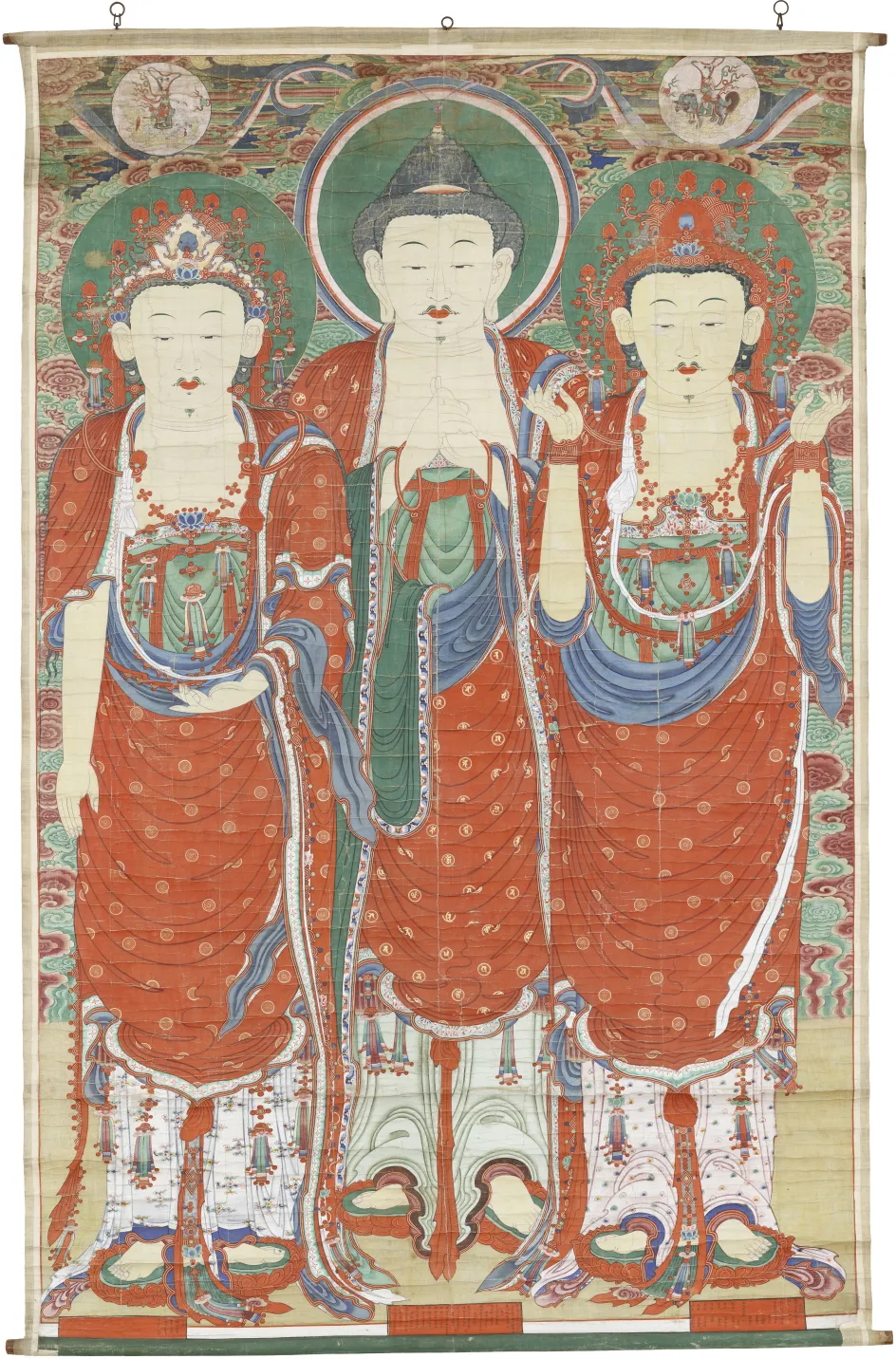
Cheongryongsa Birojanabul Samsin Hanging Buddhist Painting, Seoul
서울 靑龍寺 毘盧遮那佛 三身掛佛圖
서울특별시 종로구
Basic information
- Designation
- Treasure No.2211
- Category
- Painting
- Era
- 1806년(순조 6)
- Designated year
- 2023
- Location
- 종로구, 서울특별시— 서울특별시 종로구 동망산길 65 (숭인동, 청룡사)
- Coordinates
- 37.579979, 127.016778Kakao address conversion
AI Docent
Coming soonAn AI-generated, friendly retelling of this heritage site is available in Korean. An English version is on our roadmap — for now, please see the official description below.
Description
Machine-translatedThis English description was machine-translated and may contain inaccuracies. Refer to the original Korean text for details.
The 'Vairocana Buddha Triad Hanging Painting from Seoul Cheongnyong-sa' is a large-scale Buddhist painting created in 1806 at the request of Ssangung Choi-ssi (尙宮崔氏) of Wontong-sa (圓通寺) to pray for the longevity of King Sunjo and Queen Sunwon, executed by five Buddhist painters including Min-gwan (旻官) who were active from the late 18th to early 19th centuries. This hanging painting holds important significance as both a representative work by Min-gwan, a member of the Seoul Buddhist painter group that dominated painting production in the Seoul-Gyeonggi region during the late 18th to early 19th centuries, and as a royal-sponsored Buddhist painting commissioned by court ladies during this period. The composition, which fills the entire canvas with the Vairocana Buddha triad of Vairocana Buddha, Locana Buddha, and Shakyamuni Buddha, with attendant Bodhisattvas positioned half a step ahead of the main Buddha, represents an iconography that was widely popular in the Seoul-Gyeonggi region during the 18th and 19th centuries. Particularly notable is the novel iconography created by introducing Shakyamuni Buddha, who had previously appeared only as a protection deity in individual hanging paintings or eight-scene paintings, as a manifestation Buddha within the Vairocana triad, and by placing Manjushri and Samantabhadra in circular medallions on the upper left and right. The color palette and painting technique inherit traditions from 18th-century Buddhist paintings while strongly reflecting new elements that emerged in the early 19th century. The brushwork, composition, and overall execution are stable and balanced without distortion, representing superior artistic quality among Buddhist paintings of this period. Thus, the Vairocana Buddha Triad Hanging Painting holds artistic and scholarly significance as the first work reflecting the new hanging painting format and style of early 19th-century Seoul-Gyeonggi regions, as the unique Buddha triad hanging painting with Buddha-form Vairocana Buddha and bodhisattva-form Locana and Shakyamuni Buddhas wearing treasure crowns on both sides, and as a transitional work positioned between 18th and 19th-century stylistic developments.
Location
지도를 불러오는 중…
Have you visited this place?
Log in and verify your visit on-site via GPS to record a stamp in My Journey. (QR verification coming later.)
Images: KOGL (khs.go.kr) · Data source: Korea Heritage Service Open API (khs.go.kr)