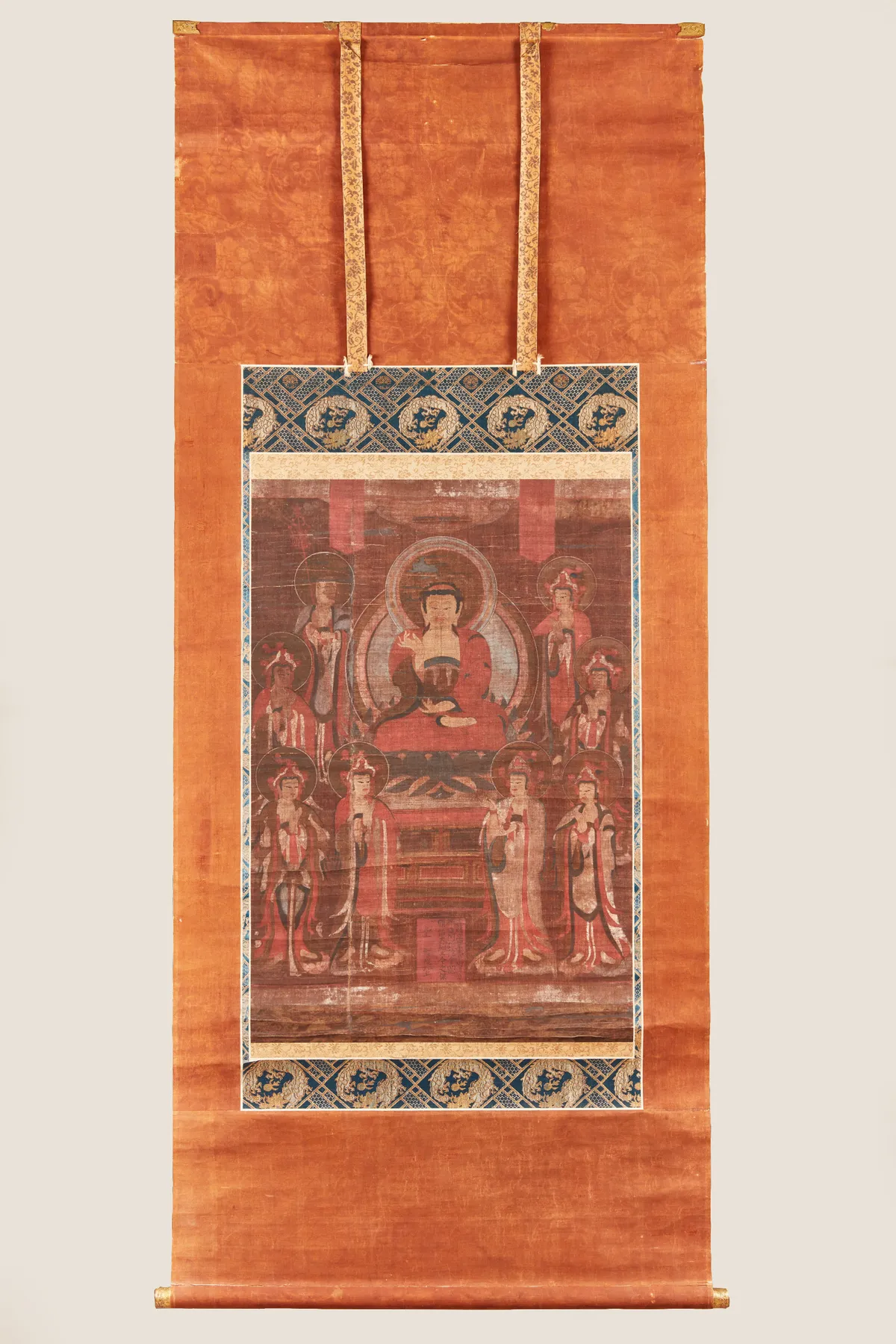
Amitayeoraegujondo
阿彌陀如來九尊圖
울산광역시 남구
Basic information
- Designation
- Treasure No.2218
- Category
- Painting
- Era
- 1565년(명종 20)
- Designated year
- 2023
- Location
- 남구, 울산광역시— 울산광역시 남구 두왕로 277 (신정동, 박물관) 울산박물관
- Coordinates
- 35.527144, 129.308689Kakao address conversion
AI Docent
Coming soonAn AI-generated, friendly retelling of this heritage site is available in Korean. An English version is on our roadmap — for now, please see the official description below.
Description
Machine-translatedThis English description was machine-translated and may contain inaccuracies. Refer to the original Korean text for details.
The Amitabha Tathagata Assembly of Nine (Amitayeo Gujondo) held at Ulsan Museum is a Buddhist painting from the early Joseon period with a precisely recorded production date of 1565 (the twentieth year of King Myeongjong's reign). The painting's dedicatory inscription (hwagi) records the date of creation, the title of the work, and the list of donors. Among the six extant examples of early Joseon Amitabha Assembly of Nine paintings, this is the only dated polychrome Buddhist painting still held within Korea, giving it particular historical and iconographic significance. The composition shows the central Amitabha Tathagata flanked by Avalokitesvara and Ksitigarbha bodhisattvas along with the Eight Great Bodhisattvas arranged symmetrically—a vestige of the late Goryeo Buddhist painting tradition. At the same time, the arrangement of bodhisattvas encircling the central figure, the rendering of the tathagata and bodhisattvas, the use of brushwork, and the color-dominant technique without patterned decoration reflect the new stylistic features of early Joseon Buddhist painting, particularly the characteristics of sixteenth-century works. Other distinctive stylistic elements of early Joseon Buddhist painting include the circular halo encircling the head and body of the principal figure, the round and broad cranial protuberance (yukye) with a crescent-shaped middle topknot jewel, and the color application without surface patterns. In these respects, the Amitabha Tathagata Assembly of Nine is an invaluable reference for the transition in Buddhist painting from the late Goryeo to the early Joseon period.
Location
지도를 불러오는 중…
Have you visited this place?
Log in and verify your visit on-site via GPS to record a stamp in My Journey. (QR verification coming later.)
Images: KOGL (khs.go.kr) · Data source: Korea Heritage Service Open API (khs.go.kr)