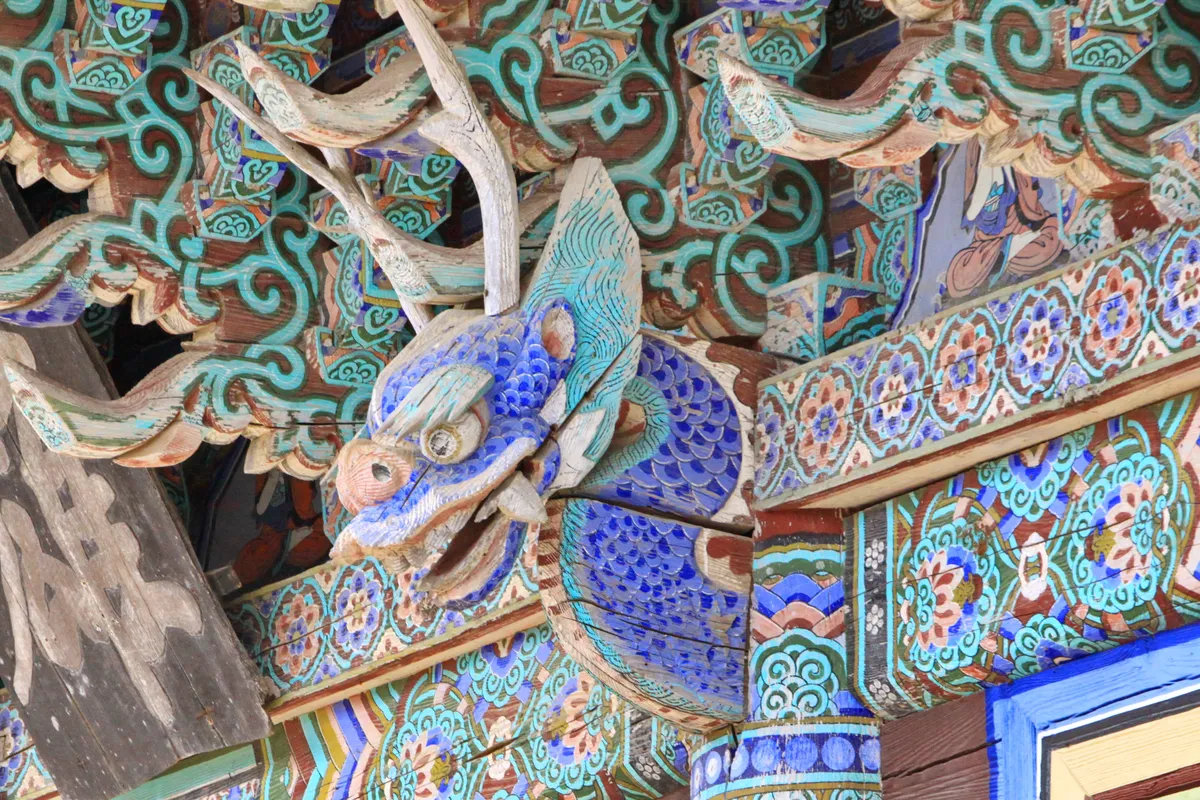
Baekryeonsa Daeungbojeon Hall, Gangjin
康津 白蓮寺 大雄寶殿
전라남도 강진군
Basic information
- Designation
- Treasure No.2220
- Category
- Architecture
- Era
- 조선시대
- Designated year
- 2023
- Location
- 강진군, 전라남도— 전라남도 강진군 백련사길 145 (도암면, 백련사)
- Coordinates
- 34.587757, 126.747892Kakao address conversion
AI Docent
Coming soonAn AI-generated, friendly retelling of this heritage site is available in Korean. An English version is on our roadmap — for now, please see the official description below.
Description
Machine-translatedThis English description was machine-translated and may contain inaccuracies. Refer to the original Korean text for details.
Gangjin Baekryeon Temple served during the Goryeo-end period as the monastic center of Wonmyo Jeonja Yose (1163-1245), continuing to host numerous Buddhist practitioners during the Joseon period. The temple's principal Buddhist hall (Daewungbojeon) underwent major reconstruction following a 1760 fire, with repairs completed in 1762. Gangjin Baekryeon Temple's Daewungbojeon possesses the following cultural heritage significance. First, it exemplifies eighteenth-century Buddhist temple architectural ornamentation trends. The Baekryeon hall's bracket system incorporates three-bay exterior and four-bay interior outsets. Primary bracket members externally display raised-tongue shapes decorated with lotus-flower patterns from the first through third bracket member levels, upward-curved blade forms with connected lotus-bud designs, and upward-curved roof-support forms decorated with dragon-head carvings. Internal bracket components sequentially from bottom to top display engraved lotus-bud, lotus-bulb, lotus-bulb, and lotus-flower designs surmounting dragon-head roof-support forms. This bracket cantilever configuration, formalized primarily throughout the Honam region, progressively disseminated into the Yeongnam region, with Baekryeon's construction date positioned intermediately within this dissemination timeline. Additionally, the configuration omitting ceiling-frame directly above the Buddha statue in favor of double-layered coffered ceilings filling interior space, multiple dragon and phoenix sculptures adorning the interior, blue and yellow dragon-shaped bracket-arm ornaments embedded in frontal pillars, and extended bracket cantilevers utilized as upper-beam connections exemplify important comparative elements for evaluating temporal and regional architectural style developments. Second, rich historical documentation concerning Buddhist temple construction. The "Record of Reconstruction of Mandeok Mountain Baekryeon Temple Main Hall" (Mandeoksan Baekryeun-sa Daebopgang Jung-su-gi) represents principal documentation. This reconstruction record not only documents precise project scheduling but meticulously catalogs responsibilities and artisan names including major financial patrons (dae-si-ju-chil), craftspeople-liaison officers (yeon-hwa-chil), chief construction supervisors (ya-jang), and carpentry-labor supervisors (mok-su-chil), enabling reconstruction of the construction implementation process and identification of relationships and influence networks among responsible parties. Particularly significant, the record provides historical documentation of Buddhist temple carpenter lineages and professional networks, including chief carpenters (do-pyeonsaeng), assistant carpenters (bu-pyeonsaeng), and Buddhist-monastic carpenters (seung-muk-pyeonsaeng). Complemented by records including "Record of Mandeok Mountain Baekryeon Temple Reconstruction" and "Mandeok Mountain Baekryeon Temple Stele," the transmitted "Mandeok Temple Chronicles" (Mandeok-sa-ji) enable comprehensive historical examination of Buddhist temple architectural production within the broader Buddhist historical framework. Third, important archaeological sites of Goryeo and Joseon Buddhist history. Baekryeon Temple witnessed the establishment of Wonmyo Jeonja's Baekryeon-jeol monastic assembly during the Goryeo period and the Chopyo Samwu dharma lectures during the Joseon period. The temple underwent reconstruction with patronage from Prince Hyoreung, and Buddhist monks collaborated with Confucian scholars in documenting reconstruction records and temple histories. Notably, Dasan Jeong Yak-yong (1762-1836) collaborated with temple monks in compiling the "Mandeok Temple Chronicles." The Daewungbojeon's plaque inscription represents the calligraphy of renowned late-Joseon calligrapher Wongyo Yi Gwang-sa, while the temple interior features collected calligraphic works of Silla-period renowned calligrapher Kim Saeng. Baekryeon's historical narrative illuminates interactions among political power, populace, and the interchange between Buddhist and Confucian traditions, with the Daewungbojeon exemplifying this period.
Location
지도를 불러오는 중…
Have you visited this place?
Log in and verify your visit on-site via GPS to record a stamp in My Journey. (QR verification coming later.)
Images: KOGL (khs.go.kr) · Data source: Korea Heritage Service Open API (khs.go.kr)