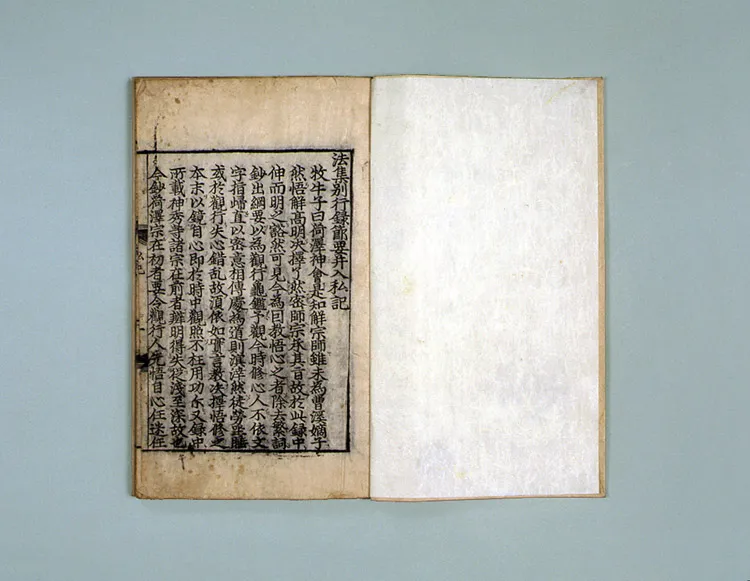
Beopjipbyeolhaengrokjeoryobyeongipsagi(1995)
法集別行錄節要幷入私記(1995)
강원특별자치도 원주시
Basic information
- Designation
- Treasure No.1222-1
- Category
- Books & Records
- Era
- 조선 성종 17년(1486)
- Designated year
- 1995
- Location
- 원주시, 강원특별자치도— 강원특별자치도 원주시 오크밸리2길 260(지정면, 뮤지엄SAN)
- Coordinates
- 37.415333, 127.823409Kakao address conversion
AI Docent
Coming soonAn AI-generated, friendly retelling of this heritage site is available in Korean. An English version is on our roadmap — for now, please see the official description below.
Description
This book was written by State Preceptor Jinul (1158-1210), the highest priest during the mid-Goryeo Dynasty, in the 5th year of the reign of King Huijong (1209) of the Goryeo Dynasty. It was published at Gyubongam Hermitage in Mudeungsan Mountain, Gwangju in the 17th year of the reign of King Seongjong (1486) of the Joseon Dynasty. It consists of one volume in one book. When he turned 8, Jinul went to master monk Jonghwi, who belonged to Sagul-san School among the Nine Mountain Seon Schools, to become a monk. He distanced himself from the conflicts between different schools of thoughts in Buddhist society at that time and devoted himself to studying and passed the national monastic examination in the 12th year of the reign of King Myeongjong (1182) of the Goryeo Dynasty. He then formed the association of meditation and wisdom jointly with monks who attended a Damseon Buddhist ceremony held at Bojesa Temple. Jinul’s ideology did not differentiate Gyojong (non-Zen sect) from Seonjong (Zen sect) but focused on the understanding and meditation of Buddha’s teachings. This book was written when Jinul attained maturity in thought. Considered the finest of Korean philosophy, it has been used as a textbook by many temples. This woodblock-printed copy is the oldest among woodblock-printed books remaining today. Even though it was made in the same year as the book designated as Treasure No.1148, it has been preserved better, and it has an epilogue.
Location
지도를 불러오는 중…
Have you visited this place?
Log in and verify your visit on-site via GPS to record a stamp in My Journey. (QR verification coming later.)
Images: KOGL (khs.go.kr) · Data source: Korea Heritage Service Open API (khs.go.kr)