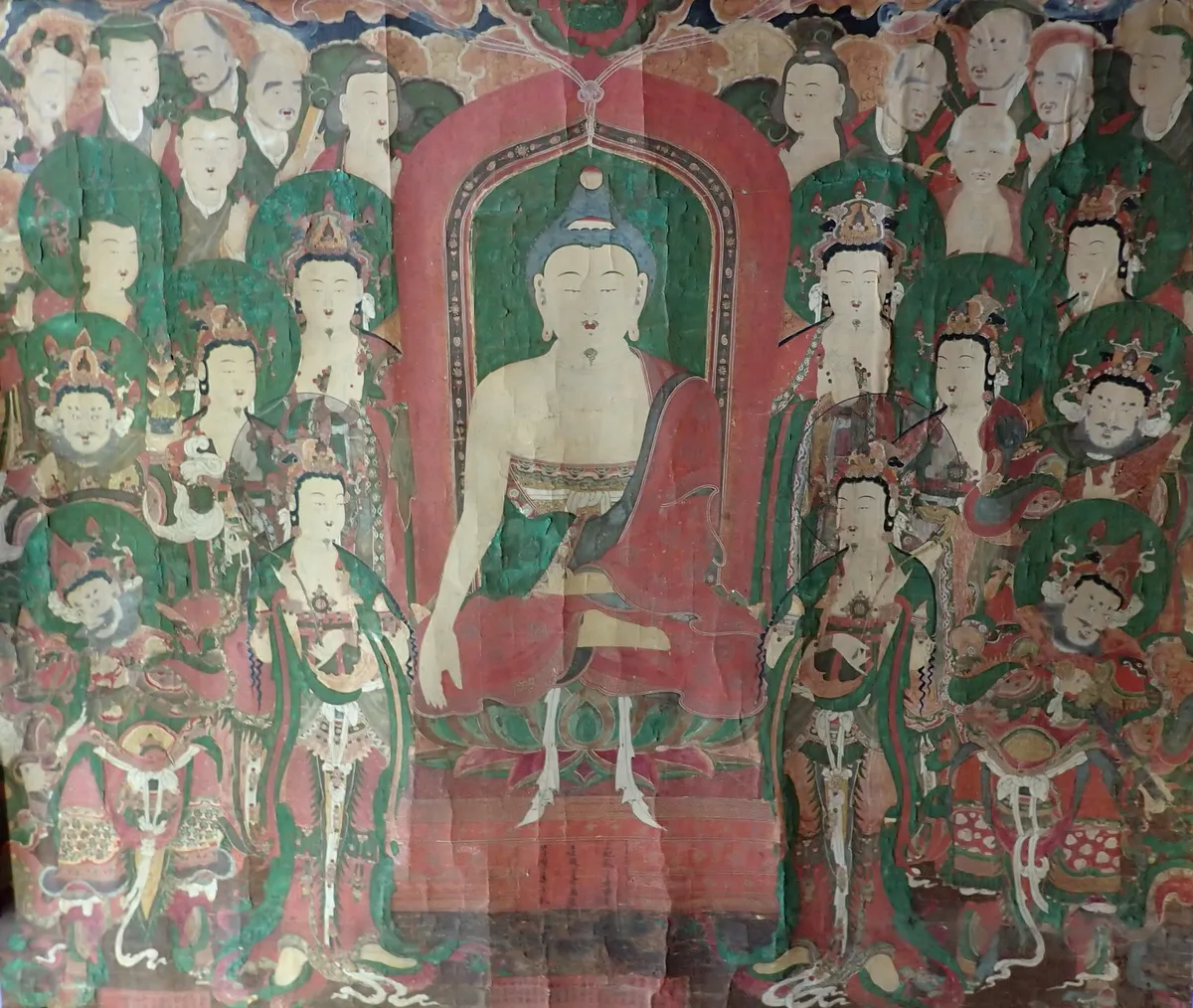
Gijang Gobulsa Vulture Peak Assembly Painting
機張 古佛寺 靈山會上圖
부산광역시 금정구
Basic information
- Designation
- Treasure No.2222
- Category
- Painting
- Era
- 1736년(영조 12)
- Designated year
- 2023
- Location
- 금정구, 부산광역시— 부산광역시 금정구 범어사로 296(청룡동, 범어사 성보박물관)
- Coordinates
- 35.278407, 129.074401Kakao address conversion
AI Docent
Coming soonAn AI-generated, friendly retelling of this heritage site is available in Korean. An English version is on our roadmap — for now, please see the official description below.
Description
Machine-translatedThis English description was machine-translated and may contain inaccuracies. Refer to the original Korean text for details.
The Yeongsanhoe Sangdo (Vulture Peak Assembly Painting) of Gobulsa Temple in Gijang has a clearly established production date of 1736 (the twelfth year of King Yeongjo's reign) based on its dedicatory inscription (hwagi). Although the inscription does not record the painter-monks responsible, the distinctive head shapes of the figures, the well-organized and stable composition centered on the tathagata, and the strong contrasts of low-chroma red and green suggest it was produced by painter-monks such as Uigyun and Milgi who were active in the Gyeongsang region, particularly around Palgongsan Mountain. The painting is executed in color on silk and depicts the moment when Sakyamuni Buddha preaches the Lotus Sutra on Vulture Peak. Sakyamuni Buddha, seated in full lotus position on a pedestal in the form of a Buddhist altar with a petal-shaped halo, is flanked on both sides according to their rank and role by eight bodhisattvas including Manjusri, Samantabhadra, and Ksitigarbha, the Four Heavenly Kings, and the Ten Great Disciples. On the altar where the main figure sits, a dedicatory prayer in neat regular script prays for the longevity of the king, the queen, and the crown prince—an unusual feature among extant paintings. The Gijang Gobulsa Yeongsanhoe Sangdo is a Vulture Peak Assembly painting with Sakyamuni Buddha as the central figure; its precise date, regional stylistic features, and rare dedicatory content make it an important example of eighteenth-century Korean Buddhist painting.
Location
지도를 불러오는 중…
Have you visited this place?
Log in and verify your visit on-site via GPS to record a stamp in My Journey. (QR verification coming later.)
Images: KOGL (khs.go.kr) · Data source: Korea Heritage Service Open API (khs.go.kr)