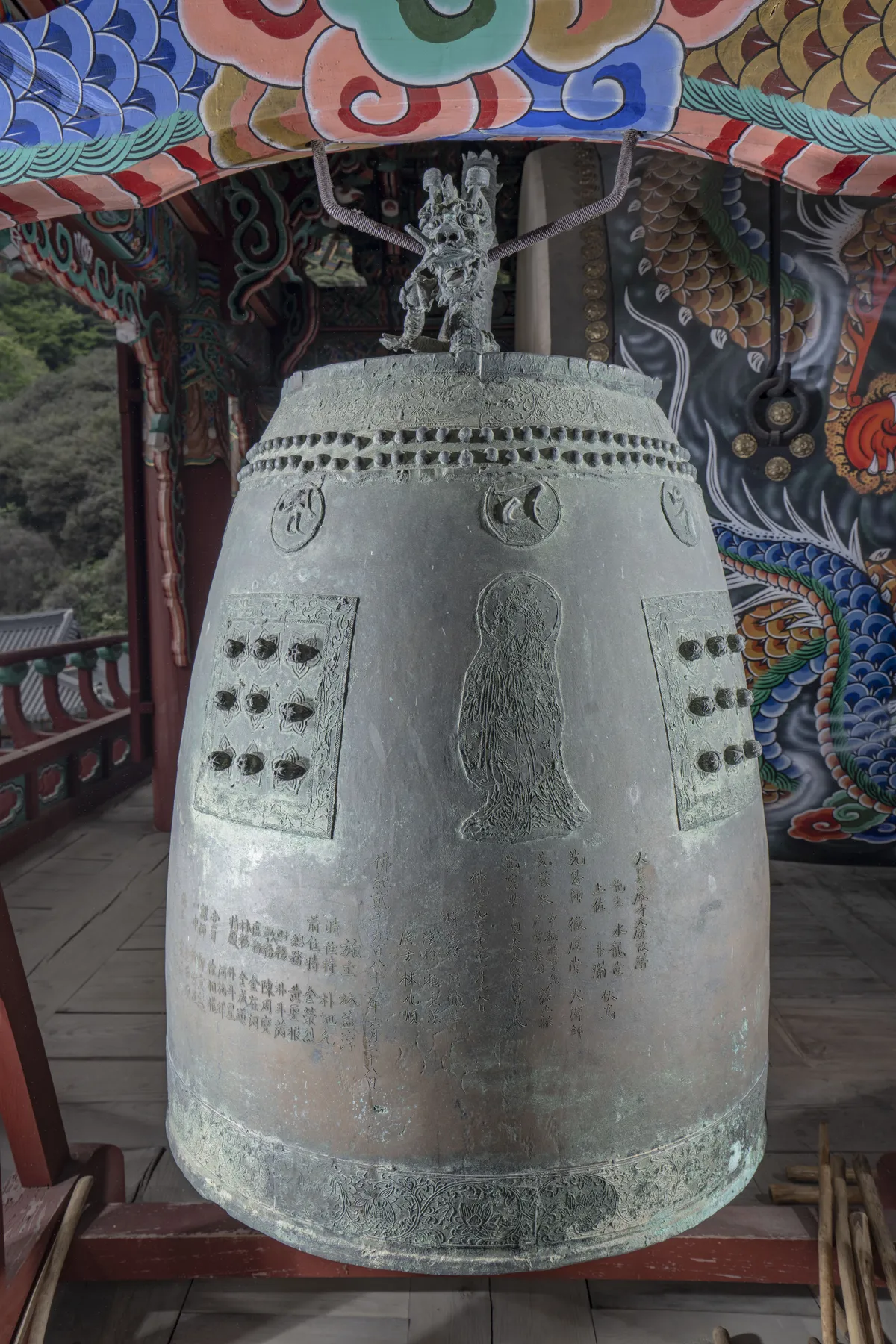
Hwaeomsa Bronze Bell, Gurye
求禮 華嚴寺 銅鍾
전라남도 구례군
Basic information
- Designation
- Treasure No.2306
- Category
- Craft
- Era
- 1711년(조선 숙종 37)
- Designated year
- 2025
- Location
- 구례군, 전라남도— 전라남도 구례군 화엄사로 539(마산면, 화엄사)
- Coordinates
- 35.227700, 127.500200Museum-based location
AI Docent
Coming soonAn AI-generated, friendly retelling of this heritage site is available in Korean. An English version is on our roadmap — for now, please see the official description below.
Description
Machine-translatedThis English description was machine-translated and may contain inaccuracies. Refer to the original Korean text for details.
The 'Guryeo Hwaeom Temple Bronze Bell' is definitively documented through engraved casting records on the bell's body to have been produced in 1711 (Sukjong 37) by bronze bell founder Yun Jong-baek, who primarily worked in Jeolla Province, in collaboration with Kim Won-hak and Han Cheon-seok. Originally cast for enshrinement at Unheung Temple, the bell's relocation to Hwaeom Temple cannot be precisely dated, though historical photographs from the Japanese colonial period confirm the temple already possessed it, and an engraved 1925 repair record documents its presence at that time. Yun Jong-baek, the bell's primary producer, was one of the Janghung Yun clan of civilian craftspeople who conducted vigorous bronze bell-casting activities during late Joseon. Prior to creating the Guryeo Hwaeom Temple bell, Yun Jong-baek produced the 'Jinbul Hermitage' bronze bell in Haenam (1709), drawing from historical bells preserved throughout Jeolla as models while establishing his distinctive artistic voice. This bell maintains traditional bell morphology including a single-dragon finial, upper and lower rims, lotus petal band, and bodhisattva figures, while incorporating individual craftsman preferences. The decorative boundary between the bell's shoulder and crown plate, which featured symmetrical pattern design in early Joseon, appears here as flower shapes; notably, Yun Jong-baek enhanced simple petal ornamentation by inserting monk figures within the flowers to create a scene suggestive of rebirth through lotus flowers in the Pure Land. Despite its large size, the Guryeo Hwaeom Temple bell exhibits excellent casting quality and outstanding formal balance, demonstrating high artistic merit. The bell's body preserves production records alongside repair documentation from both 1925 and 1955, conferring substantial documentary value worthy of designation as a National Treasure requiring systematic preservation and management.
Location
지도를 불러오는 중…
Have you visited this place?
Log in and verify your visit on-site via GPS to record a stamp in My Journey. (QR verification coming later.)
Images: KOGL (khs.go.kr) · Data source: Korea Heritage Service Open API (khs.go.kr)