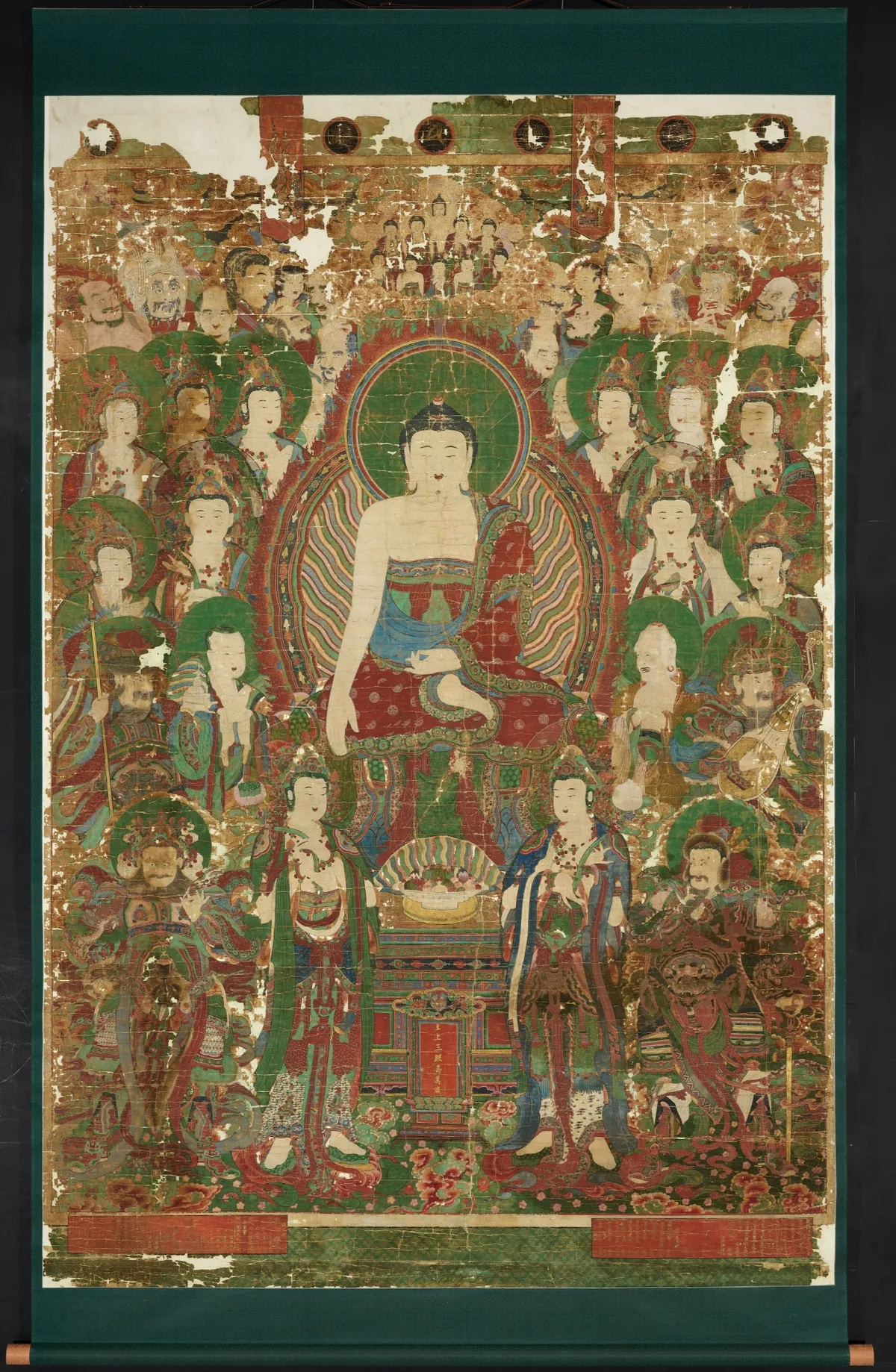
‘yeongchuksa’myeong Vulture Peak Assembly Painting
‘靈鷲寺’銘 靈山會上圖
서울특별시 용산구
Basic information
- Designation
- Treasure No.2308
- Category
- Painting
- Era
- 1742년(조선 영조 18)
- Designated year
- 2025
- Location
- 용산구, 서울특별시— 서울특별시 용산구 서빙고로 137(용산동6가, 국립중앙박물관)
- Coordinates
- 37.523500, 126.980100Museum-based location
AI Docent
Coming soonAn AI-generated, friendly retelling of this heritage site is available in Korean. An English version is on our roadmap — for now, please see the official description below.
Description
Machine-translatedThis English description was machine-translated and may contain inaccuracies. Refer to the original Korean text for details.
The 'Shakyamuni's Assembly on Vulture Peak, inscribed 'Youngjuksa Temple,' held at the National Museum of Korea, is a Buddhist painting whose production date of 1742 (Yongjo 18), creator Hyeshik, and original enshrinement location at Youngjuksa Temple are clearly documented in the painting's inscription. Rendered on silk with pigment, the composition depicts Shakyamuni Buddha delivering the Lotus Sutra on Vulture Peak, with the principal Buddha centrally positioned and flanked by ten bodhisattvas including Manjushri and Samantabhadra, alongside assembled retinues including Brahma, Indra, disciples, eight dharma protectors, pratyekabuddhas, Buddhas from other realms, attendant youths, and the Four Heavenly Kings arranged in harmonious hierarchical composition. The master painter Hyeshik led major Buddhist sculpture and painting projects at Pakyesa and Goun Temple in Uiseong between 1740-1741, demonstrating sufficient capability and organizational power to produce and restore over three thousand Buddhist sculptures and paintings, suggesting this work was created during his most accomplished period as a Buddhist painter. The composition employs flowing fine brushwork for figure representation, stable green and red color harmonics, an innovative technique depicting the halo's interior through ribbon patterns, the round Sanskrit character design at the halo's central jewel, and decorative patterning with ability patterns enriching the halo's green border, exemplifying characteristics of early-18th-century Yeongnam regional Buddhist painting while revealing Hyeshik's distinctive painting style in detailed expression. As among the largest surviving Assembly paintings, this work is evaluated as Hyeshik's representative masterpiece and a representative example of early-18th-century Assembly paintings. The painting inscription's reference to the Buddhist painter group self-identifying as 'Bishuhoe' represents a rare documented instance demonstrating late-Joseon Buddhist painter community identities and organized activities, conferring substantial scholarly value warranting designation as a National Treasure for sustained research and preservation.
Location
지도를 불러오는 중…
Have you visited this place?
Log in and verify your visit on-site via GPS to record a stamp in My Journey. (QR verification coming later.)
Images: KOGL (khs.go.kr) · Data source: Korea Heritage Service Open API (khs.go.kr)