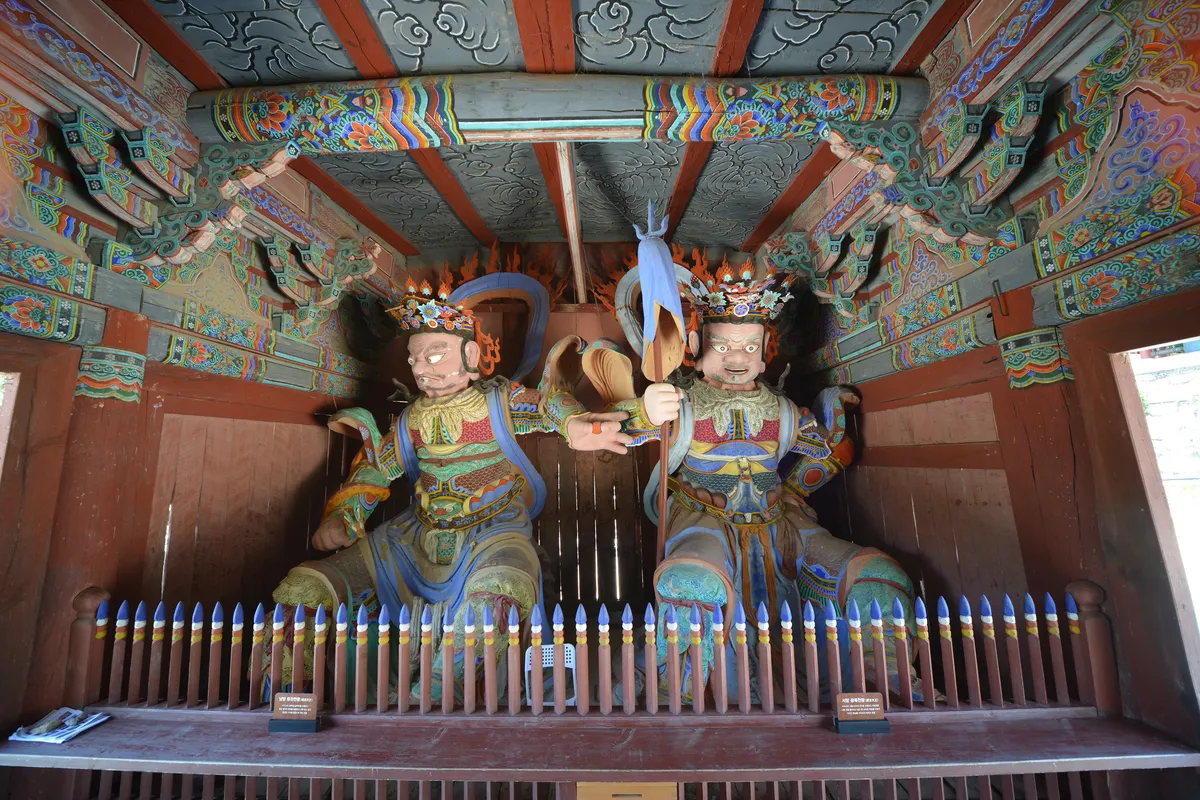
Hwaeomsa Sojosacheonwangsang, Gurye
求禮 華嚴寺 塑造四天王像
전라남도 구례군
Basic information
- Designation
- Treasure No.2224
- Category
- Sculpture
- Era
- 조선시대(17세기 전반, 1632~1636년 추정)
- Designated year
- 2023
- Location
- 구례군, 전라남도— 전라남도 구례군 화엄사로 539 (마산면, 화엄사)
- Coordinates
- 35.257316, 127.497720Kakao address conversion
AI Docent
Coming soonAn AI-generated, friendly retelling of this heritage site is available in Korean. An English version is on our roadmap — for now, please see the official description below.
Description
Machine-translatedThis English description was machine-translated and may contain inaccuracies. Refer to the original Korean text for details.
The Four Heavenly Kings enshrined at the temple gate are protective deities dwelling on Mount Sumeru protecting Buddhist law and Buddha lands from four cardinal directions. These kings govern their respective directions with ritual implements including treasured swords, banners and pagodas, dragons and wish-granting jewels, and lutes. They are depicted with wide-open eyes, gaping mouths inspiring fear, armored bodies, and demons or spirits trampled beneath their feet. The Guryae Hwaam-sa clay Four Heavenly King statues were created alongside the temple gate during the reconstruction process initiated by the eminent monk Byeok-am Gak-seong (碧巖覺性, 1575-1660) following destruction during the Japanese invasions and Seven Year War, estimated to have been created between 1632-1636. Byeok-am Gak-seong personally led monk soldiers in wartime participation and subsequently led the most active reconstruction efforts to restore Buddhism's prestige following the war. Following the general late Joseon Four Heavenly Kings arrangement pattern, Eastern and Northern Kings are positioned right of the temple gate entrance while Southern and Western Kings are positioned left. Measuring approximately 5 meters in height, these monumental statues feature wooden frames with clay overlay, representing the largest scale among sitting-position Four Heavenly King statues. They display robust physiques and impressive volume, unwavering vigilant expressions and postures, and meticulous detailed execution reflecting the vitality and artistic spirit of the Buddhist revival era. Characteristic features include large rectangular wrinkled faces, broad and thick nasal expression, and distinctively the Western King holding a treasured mongoose as a ritual implement. While sharing similar iconography and format with the previously-designated Suncheon Songwang-sa clay Four Heavenly Kings, they achieve increasingly dynamic and realistic sculptural expression through wider-stance stability, more pronounced arm motion dynamism, exhibiting superior technical and artistic value. Notably distinguished by the absence of supernatural beings beneath the feet, a rare occurrence alongside Yeosuu Heunguk-sa Four Heavenly Kings, these statues possess high artistic and scholarly value, warranting Treasure designation for research and preservation.
Location
지도를 불러오는 중…
Have you visited this place?
Log in and verify your visit on-site via GPS to record a stamp in My Journey. (QR verification coming later.)
Images: KOGL (khs.go.kr) · Data source: Korea Heritage Service Open API (khs.go.kr)