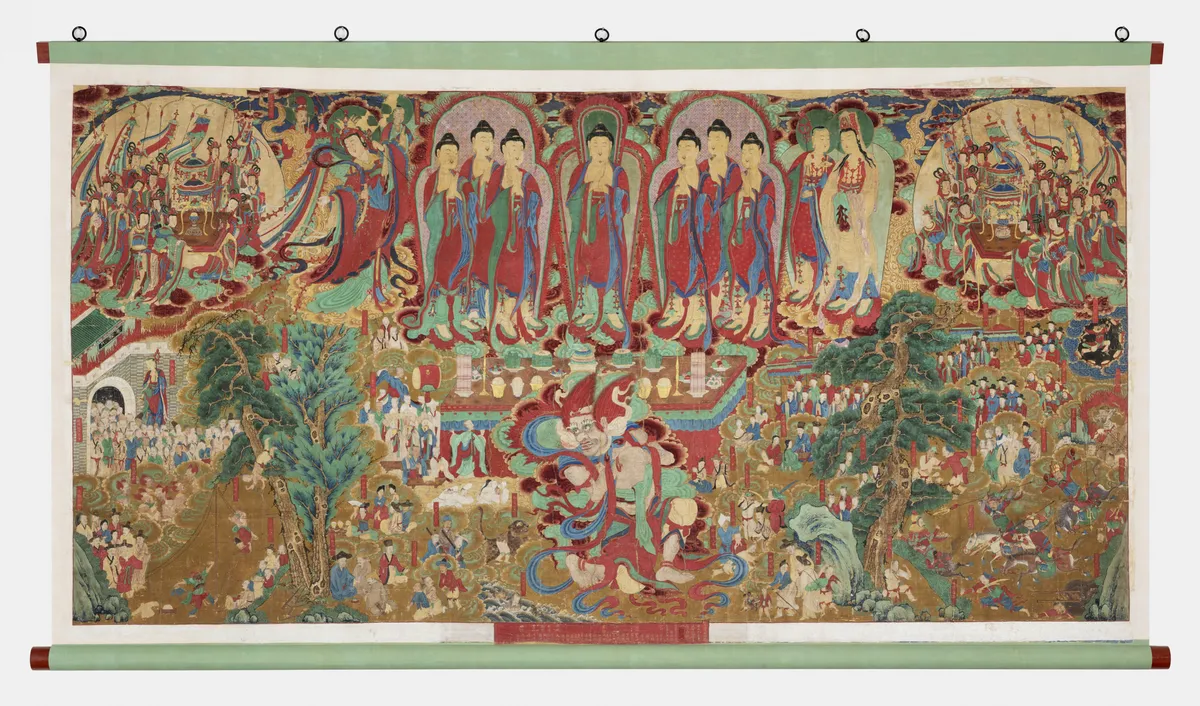
Yongjusa Gamrowangdo, Hwaseong
華城 龍珠寺 甘露王圖
경기도 화성시
Basic information
- Designation
- Treasure No.2276
- Category
- Painting
- Era
- 1790년(조선 정조 14)
- Designated year
- 2024
- Location
- 화성시, 경기도— 경기도 화성시 용주로 136(송산동, 용주사) 대한불교조계종 용주사
- Coordinates
- 37.211780, 127.005615Kakao address conversion
AI Docent
Coming soonAn AI-generated, friendly retelling of this heritage site is available in Korean. An English version is on our roadmap — for now, please see the official description below.
Description
Machine-translatedThis English description was machine-translated and may contain inaccuracies. Refer to the original Korean text for details.
The Gamjuowangdo (ritual visualization painting for water-land assembly) at Yongjusa Temple in Hwaseong is documented through its painting inscription to have been created in 1790 by lead painter Sanggyeom and fellow painters Hongmin, Seongyun, Youhong, and Beopseong. Commissioned for use in a water-land assembly ceremony conducted to transfer the deceased soul of Crown Prince Jangheonseja (1735-1762), this painting was created following King Jeongjo's 1789 relocation of his father's tomb to Hwaseong and establishment of Yongjusa Temple as a memorial temple. Placed in the main Buddha hall following its creation, this painting visually orchestrates the progression toward enlightened transfer through sequential composition, depicting the descent of Buddhas and Bodhisattvas in the upper register and ritual sustenance offerings and the assembly of unclaimed spirit-beings in the lower register. The painting achieves heightened efficacy through imagery of jade-lotus platforms on the composition's upper left and right, and a hell-gate motif in the lower register depicting Bodhisattva Jizang liberating the deceased. The inclusion of the Guide-path Bodhisattva with Venerable Mulian in the upper portion emphasizes Confucian filial piety while demonstrating connections between Gamjuowangdo and Lantern Festival assembly rituals. Notably, the lower register contains eighteenth-century genre painting imagery reminiscent of contemporary genre works and expressions influenced by novel illustrations, revealing the influence of general painting traditions on late Joseon Buddhist painting. The Hwaseong Yongjusa Gamjuowangdo achieves high aesthetic completion through stable composition and refined technical execution, representing a definitive example of mid-to-late eighteenth century painting that synthesizes Buddhist liberation theology with Confucian filial devotion, demonstrating both artistic and scholarly excellence.
Location
지도를 불러오는 중…
Have you visited this place?
Log in and verify your visit on-site via GPS to record a stamp in My Journey. (QR verification coming later.)
Images: KOGL (khs.go.kr) · Data source: Korea Heritage Service Open API (khs.go.kr)