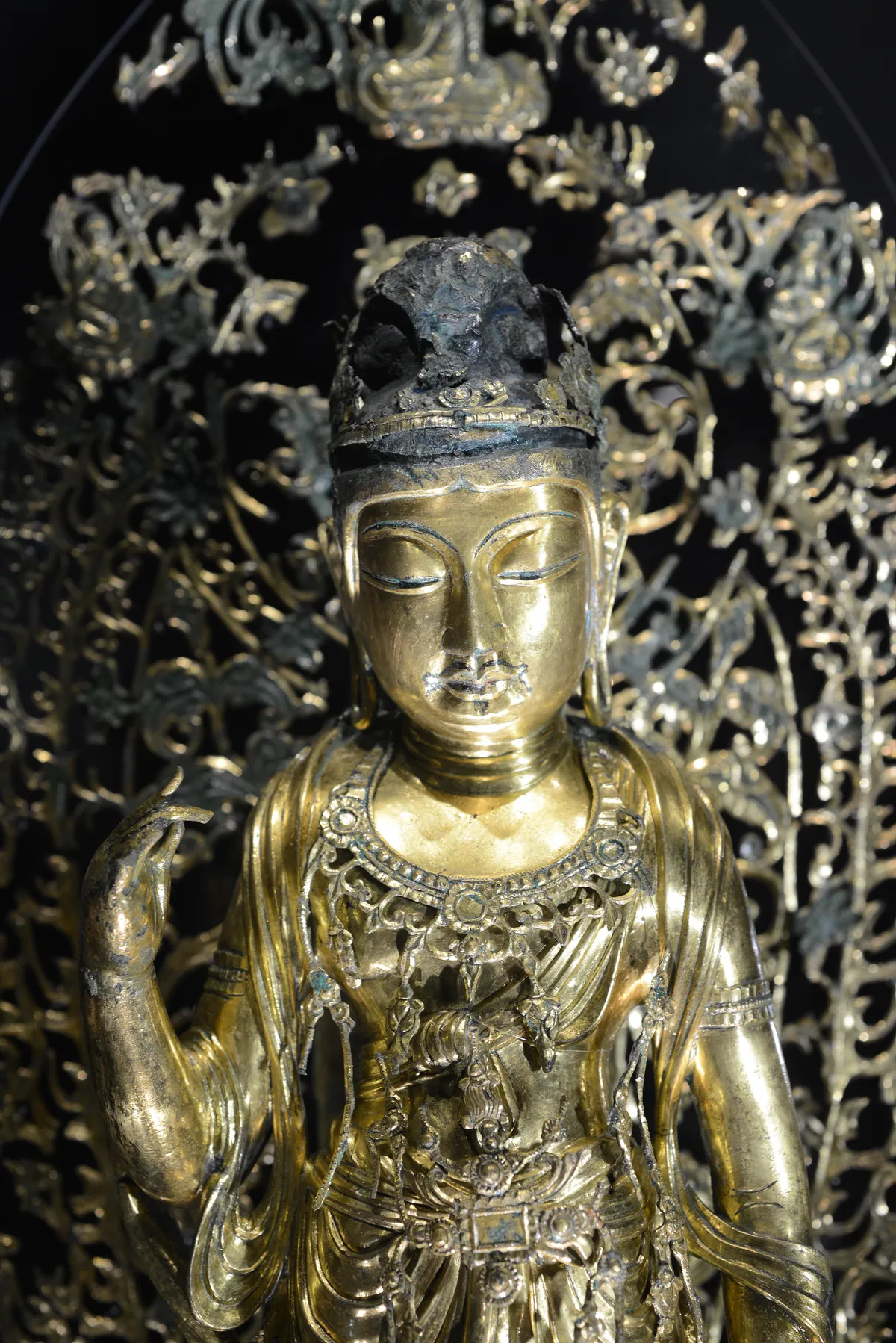
Seonrimwonji Chulto Geumdongbosal Standing Figure, Yangyang
襄陽 禪林院址 出土 金銅菩薩立像
강원특별자치도 춘천시
Basic information
- Designation
- Treasure No.2277
- Category
- Sculpture
- Era
- 통일신라(9세기)
- Designated year
- 2024
- Location
- 춘천시, 강원특별자치도— 강원특별자치도 춘천시 우석로 70(석사동, 국립춘천박물관)
- Coordinates
- 37.866100, 127.731800Museum-based location
AI Docent
Coming soonAn AI-generated, friendly retelling of this heritage site is available in Korean. An English version is on our roadmap — for now, please see the official description below.
Description
Machine-translatedThis English description was machine-translated and may contain inaccuracies. Refer to the original Korean text for details.
The gilt-bronze Bodhisattva standing statue excavated from the Seolliмwon Temple site in Yangyang was discovered in 2015 at an excavation site identified as a monastic residence area at the Seolliмwon Temple site in Gangwon province. Seolliмwon served as a formative center for Seon Buddhism during Unified Silla, and though the temple's active period was not extensive, it produced historically significant monks including Soonеung, Yeomgyeohwashang (7-844), and Honggak Seonsa (814-880), whose lineages sustained the temple's religious importance. This excavated gilt-bronze Bodhisattva standing statue represents an exceptionally rare complete assemblage, including its mandorla and base platform, reaching a height of 66.7 centimeters inclusive of the openwork mandorla—the largest confirmed bodhisattva statue from a precisely documented excavation. Discovered in an inverted position, the gilding state suggests the statue was buried shortly after creation, remaining undisturbed for approximately 1,100 years until modern excavation at its original sacred location. The sculpture demonstrates sophisticated manufacturing techniques, with the bodhisattva figure, mandorla, base platform, crown, hanging ornaments, and ritual vessel (water-pouring vessel) independently crafted to permit assembly and disassembly. The artist employed indigo pigmentation for hair rendering and ink for detailed features including eyebrows, eyes, nostril contours, facial hair, and demarcation lines. The protruding upper lip and three-dimensional drapery treatment, along with scarves and under-arm garment wrappings, exemplify ninth-century bodhisattva sculptural characteristics. Though portions of the mandorla and base platform have sustained minor losses, the preservation of original gilding over most surfaces and the sculpture's exceptional formal qualities demonstrate superior condition and exceptional artistic excellence.
Location
지도를 불러오는 중…
Have you visited this place?
Log in and verify your visit on-site via GPS to record a stamp in My Journey. (QR verification coming later.)
Images: KOGL (khs.go.kr) · Data source: Korea Heritage Service Open API (khs.go.kr)