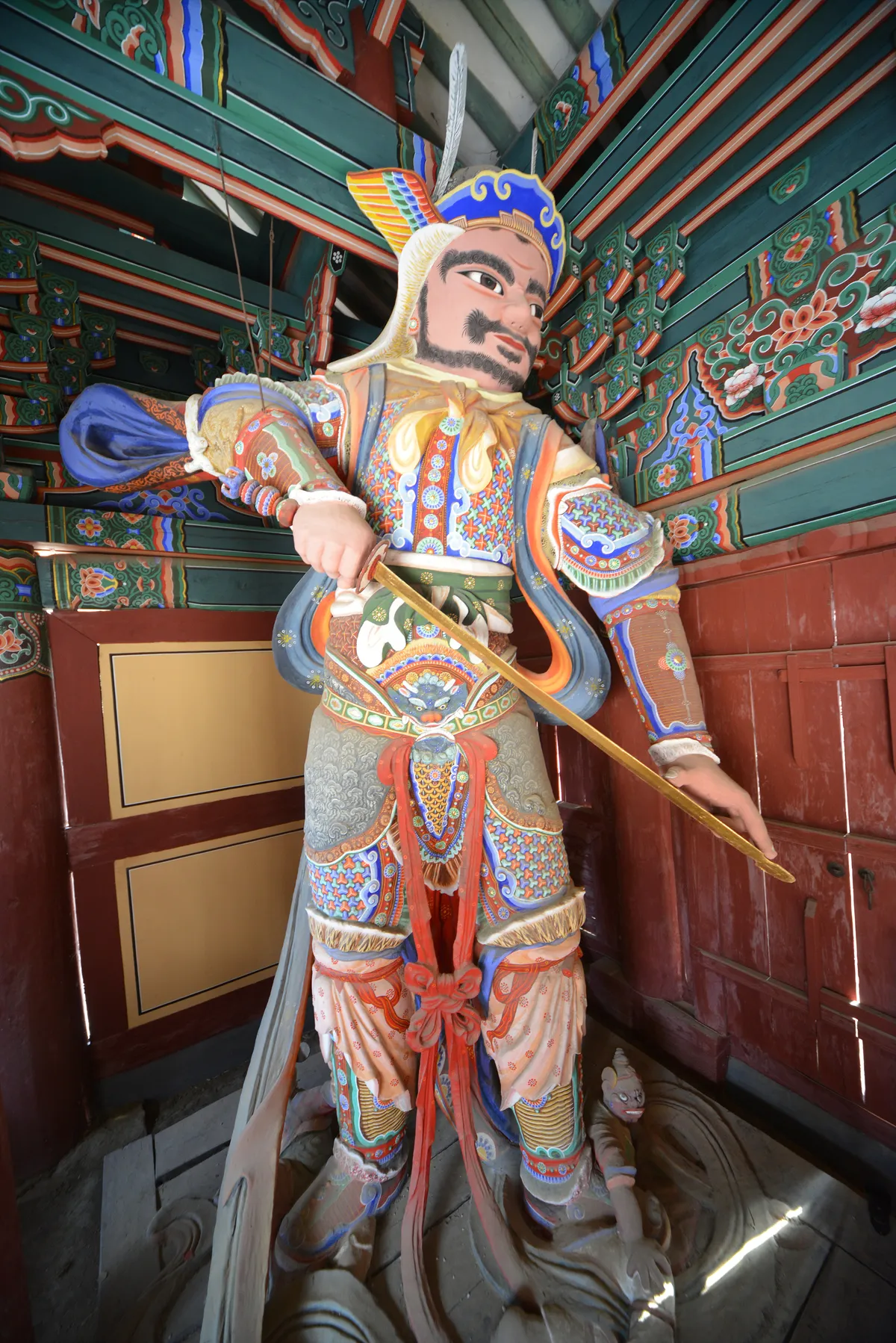
Beopjusa Sojosacheonwangsang, Boeun
報恩 法住寺 塑造四天王像
충청북도 보은군
Basic information
- Designation
- Treasure No.2226
- Category
- Sculpture
- Era
- ㅇ 조성연대 : 조선시대(17세기 중엽)
- Designated year
- 2023
- Location
- 보은군, 충청북도— 충청북도 보은군 법주사로 405 (속리산면, 법주사)
- Coordinates
- 36.542600, 127.812500Museum-based location
AI Docent
Coming soonAn AI-generated, friendly retelling of this heritage site is available in Korean. An English version is on our roadmap — for now, please see the official description below.
Description
Machine-translatedThis English description was machine-translated and may contain inaccuracies. Refer to the original Korean text for details.
The Four Heavenly Kings enshrined at the temple gate are protective deities dwelling on Mount Sumeru's slopes, guarding Buddhist law and lands from four cardinal directions. Each of the four kings governs their respective direction—East, West, South, and North—with corresponding ritual implements including treasured swords, banners and pagodas, dragons and wish-granting jewels, and lutes. They are characterized by wide-open eyes, gaping mouths inspiring fear, armored bodies, and demon or spirits trampled beneath their feet. The Boeun Beopju-sa Four Heavenly King clay statues were created during the 17th-century early renovation period following destruction during the Japanese invasions, commissioned by the eminent monk Byeok-am Gak-seong (碧巖覺性, 1575-1660). The wooden ring-date analysis and stylistic characteristics indicate completion in the mid-17th century. Following general late Joseon arrangement patterns, the Eastern and Northern Kings stand to the right of the temple gate entrance, while the Southern and Western Kings stand to the left. These statues were constructed with wooden frames topped with clay, representing extremely rare standing postures among Korea's extant Four Heavenly Kings and the largest scale at 5.7 meters, possessing considerable sculptural value. Additionally, they hold notable art-historical significance as unlike other Four Heavenly Kings wearing bodhisattva crowns, only the Southern and Northern Kings wear bodhisattva-form crowns, while the Eastern and Western Kings wear feathered helmet-style crowns. Beneath the feet of Beopju-sa's Kings appear supernatural beings depicted as Qing and Joseon officials, representing the first sculptural work intentionally created to overcome the shame of the Byeongja War of 1636 and to provide moral lessons and admonitions regarding corrupt officials, possessing significant social-historical meaning worthy of Treasure designation.
Location
지도를 불러오는 중…
Have you visited this place?
Log in and verify your visit on-site via GPS to record a stamp in My Journey. (QR verification coming later.)
Images: KOGL (khs.go.kr) · Data source: Korea Heritage Service Open API (khs.go.kr)