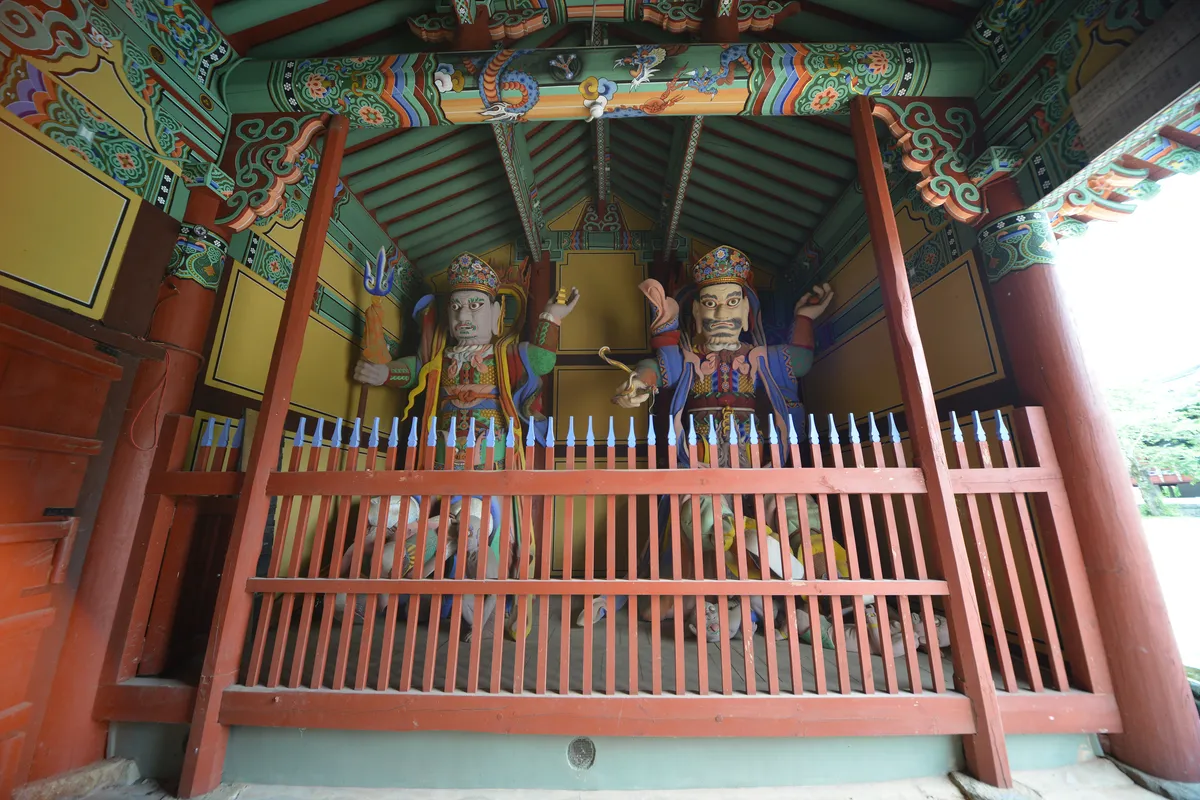
Neunggasa Mokjosacheonwangsang, Goheung
高興 楞伽寺 木造四天王像
전라남도 고흥군
Basic information
- Designation
- Treasure No.2228
- Category
- Sculpture
- Era
- 조선시대(1666년 경)
- Designated year
- 2023
- Location
- 고흥군, 전라남도— 전라남도 고흥군 팔봉길 21 (점암면, 능가사)
- Coordinates
- 34.638487, 127.413798Kakao address conversion
AI Docent
Coming soonAn AI-generated, friendly retelling of this heritage site is available in Korean. An English version is on our roadmap — for now, please see the official description below.
Description
Machine-translatedThis English description was machine-translated and may contain inaccuracies. Refer to the original Korean text for details.
The Four Heavenly Kings enshrined at the temple gate are protective deities dwelling on Mount Sumeru's slopes, safeguarding Buddhist law and Buddha lands from the four cardinal directions. Governing their respective directions, these kings bear ritual implements including treasured swords, treasured banners with pagodas, dragons and wish-granting jewels, and lutes, with most displaying consistent iconographic elements. They are characterized by widely opened eyes, gaping mouths inspiring fear, armored bodies, and supernatural beings trampled beneath their feet. Estimated to be created around 1666 based on ridge stone inscriptions, historical records, and concealed vow documents discovered during renovation of the temple gate, the Goheung Neungga-sa wooden Four Heavenly King statues represent the earliest wooden examples from the 17th century, holding significant meaning as a transitional work marking the shift in construction material from clay to wood for Four Heavenly Kings. Displaying forward-facing postures in chair-like seating positions, they feature an overall distinctive elongated and slender proportion. This unique proportion reflects not only the changing sculptural methods resulting from material transition from clay to wood, but also represents a significant artistic interpretation embedding the impoverished circumstances of commoners around the great famine period into the relatively unrestricted sculptural forms of Four Heavenly Kings, possessing considerable research value from socio-historical perspectives. These statues represent entirely different sculptural lineage compared to nearby temples like Hwaam-sa and Heunguk-sa. Distinctive features include individual body proportions, upright posture with expressionless forward-facing faces, and simple planar crowns, which represent the material-specific differences in plasticity between clay and wood, demonstrating transitional characteristics in the transformation from clay sculpture to wooden sculpture, possessing art-historical significance. Unlike the typical arrangement of Four Heavenly Kings irrespective of actual temple gate orientation, Neungga-sa consciously arranged the statues according to actual directional positioning. The Eastern and Northern Kings' sequence was reversed, as was the Southern and Western Kings' sequence, allowing directional concept understanding and research, providing sufficient scholarly value for Treasure designation and preservation.
Location
지도를 불러오는 중…
Have you visited this place?
Log in and verify your visit on-site via GPS to record a stamp in My Journey. (QR verification coming later.)
Images: KOGL (khs.go.kr) · Data source: Korea Heritage Service Open API (khs.go.kr)