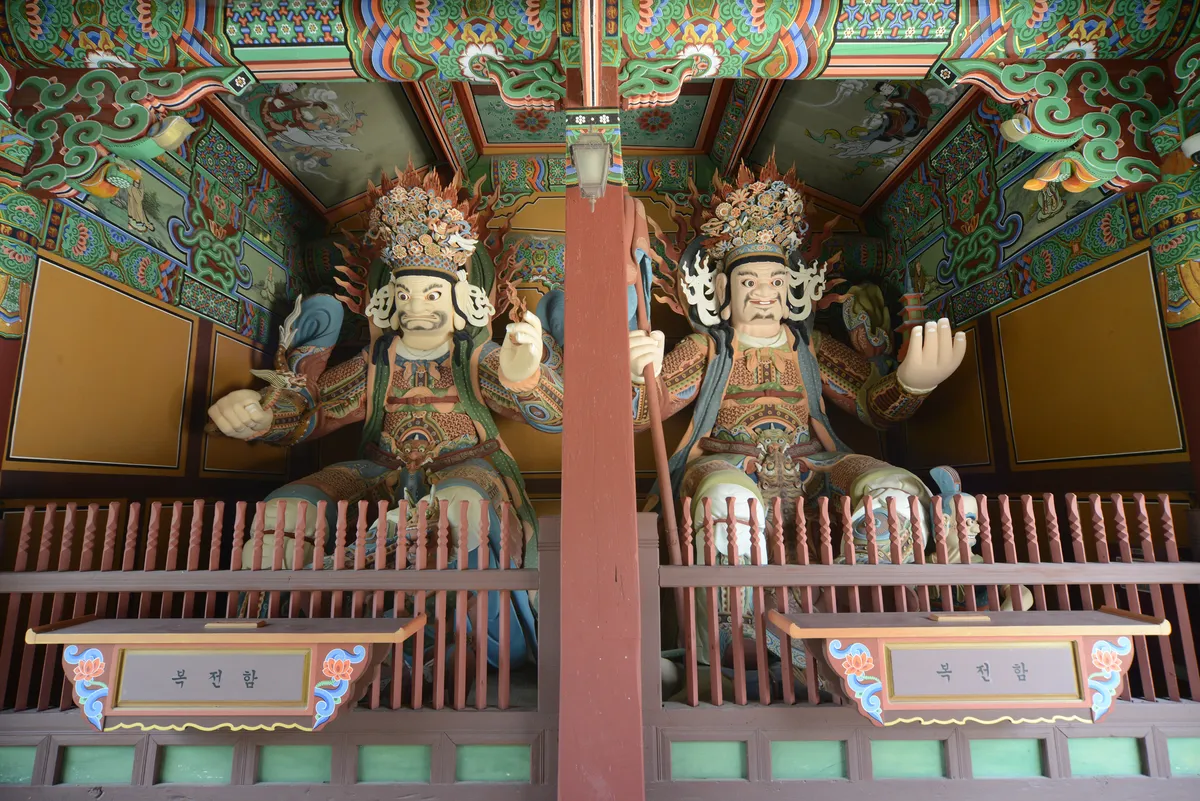
Bulgapsa Mokjosacheonwangsang Mit Reliquary Documents, Yeonggwang
靈光 佛甲寺 木造四天王像 및 腹藏典籍
전라남도 영광군
Basic information
- Designation
- Treasure No.2229
- Category
- Sculpture
- Era
- ① 사천왕상 : 조선시대(17세기 후반), ② 복장전적 : 고려시대∼조선시대
- Designated year
- 2023
- Location
- 영광군, 전라남도— 전라남도 영광군 불갑사로 450 (불갑면)
- Coordinates
- 35.200654, 126.550184Kakao address conversion
AI Docent
Coming soonAn AI-generated, friendly retelling of this heritage site is available in Korean. An English version is on our roadmap — for now, please see the official description below.
Description
Machine-translatedThis English description was machine-translated and may contain inaccuracies. Refer to the original Korean text for details.
The Four Heavenly Kings enshrined at the temple gate are protective deities dwelling on Mount Sumeru protecting Buddhist law and Buddha lands from four cardinal directions. These kings govern their respective directions with ritual implements including treasured swords, banners and pagodas, dragons and wish-granting jewels, and lutes. They are depicted with wide-open eyes, gaping mouths evoking fear, armored bodies, and demons or spirits trampled beneath their feet. The Yeonggwang Bulgap-sa wooden Four Heavenly King statues were originally located at the Yeosu-san Yeonggi-sa temple in North Jeolla Province, which later closed. They were brought to Bulgap-sa by Seoldu Seonsa (雪竇禪師, 1824-1889) of Bulgap-sa in 1876 when Yeonggi-sa ceased operations. Chronologically dated to the late 17th century, these statues carry historical significance representing the aspirations of the monastic community of Mujang County (present-day Buan) during the temple's reconstruction, and maintain important social heritage records. The Yeongggwang Bulgap-sa wooden Four Heavenly King statues, measuring over 4 meters in height, were primarily constructed from ginkgo wood through assembly of multiple wooden pieces. Simultaneously, hair, detailed ornamentation, and areas requiring volume were executed in clay, demonstrating transitional characteristics as sculptors shifted from clay statues to wooden ones, holding art-historical significance. Seated in chair-like positions, they display proportions reflecting changing sculptural sensibilities from the 17th-century early powerful physiques toward the 17th-century late refined, balanced taller forms, with narrow and high flame-form crowns reflecting late 17th-century sculptural tendencies. Possessing excellent late 17th-century sculptural and artistic characteristics without significant original damage or major deformation transmitted to the present, they warrant Treasure designation for preservation. While precise chronological dating remains difficult due to absence of creation-related documentary records, the lower chronological limit can be determined through the 'Lotus Sutra' Volume 1 (printed by Unjoo-sa, Taein, Jeolla Province in 1670) among existing concealed Buddhist scriptures already designated as Treasures. Such consecration scriptures placed within statues hold religious and historical significance, requiring comprehensive preservation and management together with the statues themselves. Therefore, the 'Yeongggwang Bulgap-sa Buddha Concealment Buddhist Scriptures' previously designated as Treasure should now be designated together with these Four Heavenly King statues and managed accordingly.
Location
지도를 불러오는 중…
Have you visited this place?
Log in and verify your visit on-site via GPS to record a stamp in My Journey. (QR verification coming later.)
Images: KOGL (khs.go.kr) · Data source: Korea Heritage Service Open API (khs.go.kr)