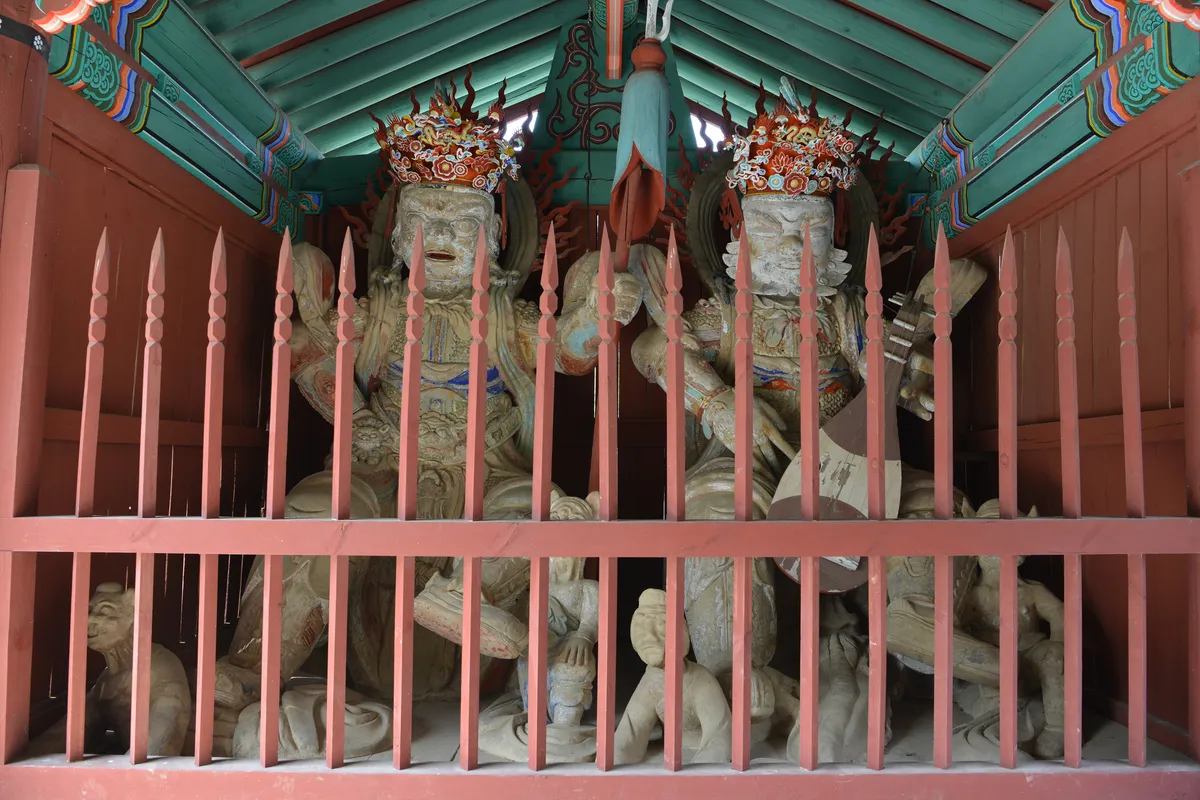
Sutasa Sojosacheonwangsang, Hongcheon
洪川 壽陀寺 塑造四天王像
강원특별자치도 홍천군
Basic information
- Designation
- Treasure No.2230
- Category
- Sculpture
- Era
- 1676년(조선 숙종 2)
- Designated year
- 2023
- Location
- 홍천군, 강원특별자치도— 강원특별자치도 홍천군 수타사로 473 (영귀미면) 대한불교조계종 수타사
- Coordinates
- 37.698669, 127.959197Kakao address conversion
AI Docent
Coming soonAn AI-generated, friendly retelling of this heritage site is available in Korean. An English version is on our roadmap — for now, please see the official description below.
Description
Machine-translatedThis English description was machine-translated and may contain inaccuracies. Refer to the original Korean text for details.
The Four Heavenly Kings enshrined at the temple gate are protective deities dwelling on Mount Sumeru, guarding Buddhist law and Buddha lands from the four cardinal directions. Governing their respective directions, these kings hold ritual implements including treasured swords, banners and pagodas, dragons and wish-granting jewels, and lutes. They are depicted with wide-open eyes, gaping mouths inspiring fear, armored bodies, and demons or spirits trampled beneath their feet. Although comparatively smaller in scale, the Hongcheon Suta-sa clay statues display stable, well-balanced postures, with faces expressing great vitality through the superior plasticity of clay as the medium. Natural movements and detailed armor ornamentation are expressed with remarkable refinement, representing supreme artistic value among Korea's extant Four Heavenly King statues through exceptional detailed expression and delicate execution. Eight yaksha demons representing supernatural beings created contemporaneously with the statues remain complete and intact. The Western King's ritual implement, a lion-form auspicious beast, appears to represent an evolution from the treasured mongoose form that emerged in early-17th century Four Heavenly King representations, providing crucial evidence for understanding the iconographic transformation and obsolescence of the mongoose in Korea, holding important sculptural value. Unlike the typical temple gate arrangement pattern where Four Heavenly Kings' positioning disregards actual temple orientation, the Suta-sa temple gate, bearing the inscription 'Phoenix Gate,' maintains west-facing orientation, affecting the statue arrangement's deviation from the standard pattern. The Phoenix Gate's right-side entrance features the Southern and Eastern Kings, while the left side features the Western and Northern Kings. Therefore, directional concept understanding and research possess scholarly value worthy of Treasure designation and preservation.
Location
지도를 불러오는 중…
Have you visited this place?
Log in and verify your visit on-site via GPS to record a stamp in My Journey. (QR verification coming later.)
Images: KOGL (khs.go.kr) · Data source: Korea Heritage Service Open API (khs.go.kr)