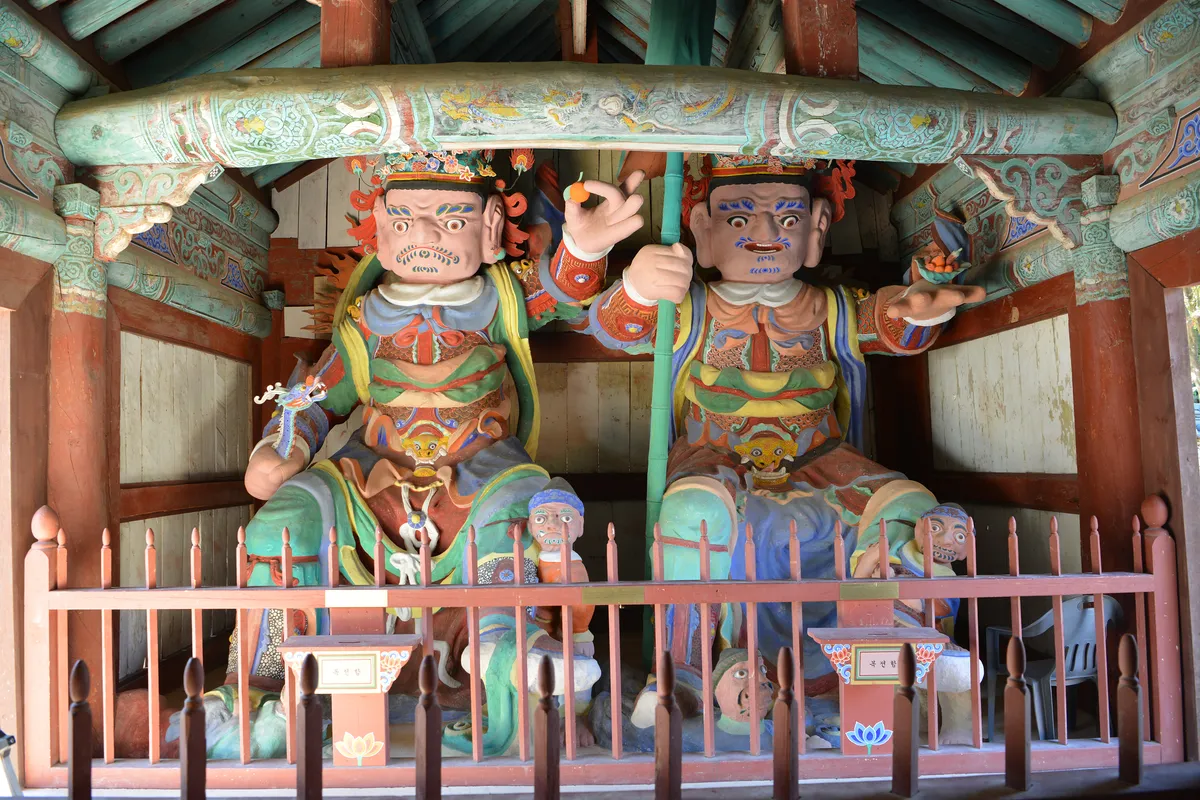
Magoksa Sojosacheonwangsang, Gongju
公州 麻谷寺 塑造四天王像
충청남도 공주시
Basic information
- Designation
- Treasure No.2231
- Category
- Sculpture
- Era
- 1683년(조선 숙종 9)
- Designated year
- 2023
- Location
- 공주시, 충청남도— 충청남도 공주시 마곡사로 966 (사곡면, 마곡사)
- Coordinates
- 36.543200, 126.910800Museum-based location
AI Docent
Coming soonAn AI-generated, friendly retelling of this heritage site is available in Korean. An English version is on our roadmap — for now, please see the official description below.
Description
Machine-translatedThis English description was machine-translated and may contain inaccuracies. Refer to the original Korean text for details.
The Four Heavenly Kings enshrined at the temple gate are protective deities dwelling on Mount Sumeru protecting Buddhist law and Buddha lands from four cardinal directions. These kings govern their respective directions with ritual implements including treasured swords, banners and pagodas, dragons and wish-granting jewels, and lutes. They display wide-open eyes, gaping mouths conveying fear, armored bodies, and demons or spirits trampled beneath their feet. The Gongju Magok-sa clay Four Heavenly King statues are clearly documented through an ink inscription inside the Eastern King statue as being created in 1683, serving as a chronological reference point for Four Heavenly King dating studies. While the sculptor's name remains undocumented, considering the sculptural style and the fact that the same lineage of Dan-eung created the Yeongsan Hall's past-seven-buddhas and thousand-buddha statues in 1681, two years earlier, this work is estimated to have been created by Dan-eung's lineage in 1683. Following the general late Joseon arrangement pattern, Eastern and Northern Kings are positioned right of the temple gate entrance while Southern and Western Kings are positioned left. Measuring approximately 4 meters, these statues feature wooden frames with clay overlay in chair-like seating positions. Notably, the Western King distinctively holds a treasured banner with one hand and a ritual implement with offerings on a lotus leaf with the other, differentiating it from other Four Heavenly Kings. Representing the final stage of clay-sculptured techniques in the 17th century, these statues feature elongated body proportions, distinctive eyelids, gaunt faces with prominent wrinkles, small stub noses, and lotus-leaf-inspired ritual implements reflecting the sculptor's wit and individuality, maintaining deep connection with sculptor Dan-eung (端應). These characteristics trace the sculptural lineage flow through Jikji-sa and continuing to Yongmun-sa Four Heavenly Kings, serving as evidence for understanding Dan-eung lineage stylistic variations, theological iconography and sculptural school activity ranges and trends, Buddha statue production methods and sequences, and various other aspects holding considerable scholarly value for Treasure designation and preservation.
Location
지도를 불러오는 중…
Have you visited this place?
Log in and verify your visit on-site via GPS to record a stamp in My Journey. (QR verification coming later.)
Images: KOGL (khs.go.kr) · Data source: Korea Heritage Service Open API (khs.go.kr)