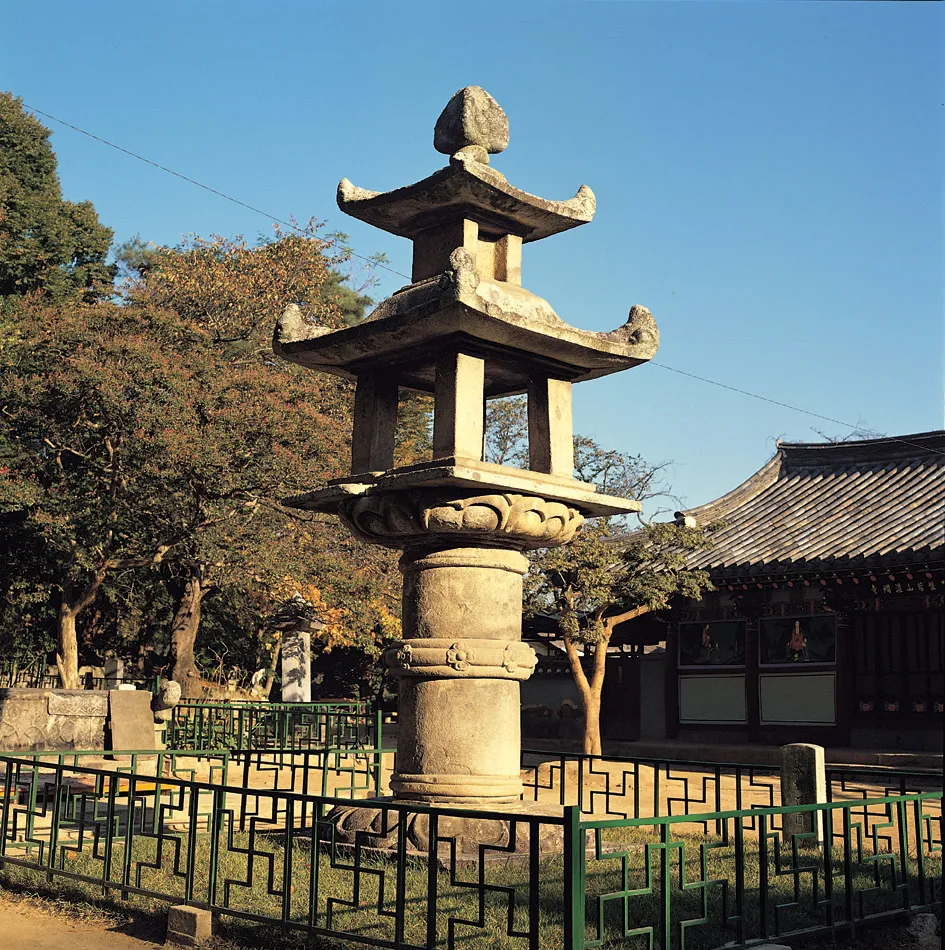
Stone Lantern of Gwanchoksa Temple, Nonsan
論山 灌燭寺 石燈
충청남도 논산시
Basic information
- Designation
- Treasure No.232
- Category
- Sites & Pagodas
- Era
- 고려시대
- Designated year
- 1963
- Location
- 논산시, 충청남도— 충남 논산시 관촉로1번길 25 (관촉동)
- Coordinates
- 36.188211, 127.112944
AI Docent
Coming soonAn AI-generated, friendly retelling of this heritage site is available in Korean. An English version is on our roadmap — for now, please see the official description below.
Description
This stone lantern is placed in front of the stone image of Buddha in the precinct of the Gwanchoksa Temple. Built by Hyemyeong in 968, this temple has been rebuilt many times. The lantern consists of a three-tiered pedestal, a light chamber, a roof stone and a finial. As a typical square stone lantern of the Goryeo Dynasty, the lotus pattern is roughly carved around the upper and lower parts of the pedestal. The middle part of the pedestal, which is round, has seven stripes carved horizontally, three in the middle and two for the top and two for the bottom. The stripe in the center, which is thicker than the others, is beautifully decorated with the pattern of eight blossoms. The two-storied light chamber has disproportionately big 'windows' and four pillars, which are too slim, to support the capstone. The roof stones are decorated with floral patterns at the edges, and the eaves are gently curved upward at the corners. The flame-shaped ornament at the top looks rather heavy because of too much decoration. It looks as powerful as the stone Buddha statue standing behind it, but the general impression from the whole structure is that of unbalance and instability. This stone lantern is believed to have been made in 968 (13th year of the reign of King Gwangjong of Goryeo), around the time the Stone Standing Maitreya Bodhisattva (Treasure No. 218) was made. This is the second largest stone lantern after the Stone Lantern at Gakhwangjeon Hall of Hwaeomsa Temple (National Treasure No. 12).
Location
지도를 불러오는 중…
Have you visited this place?
Log in and verify your visit on-site via GPS to record a stamp in My Journey. (QR verification coming later.)
Images: KOGL (khs.go.kr) · Data source: Korea Heritage Service Open API (khs.go.kr)