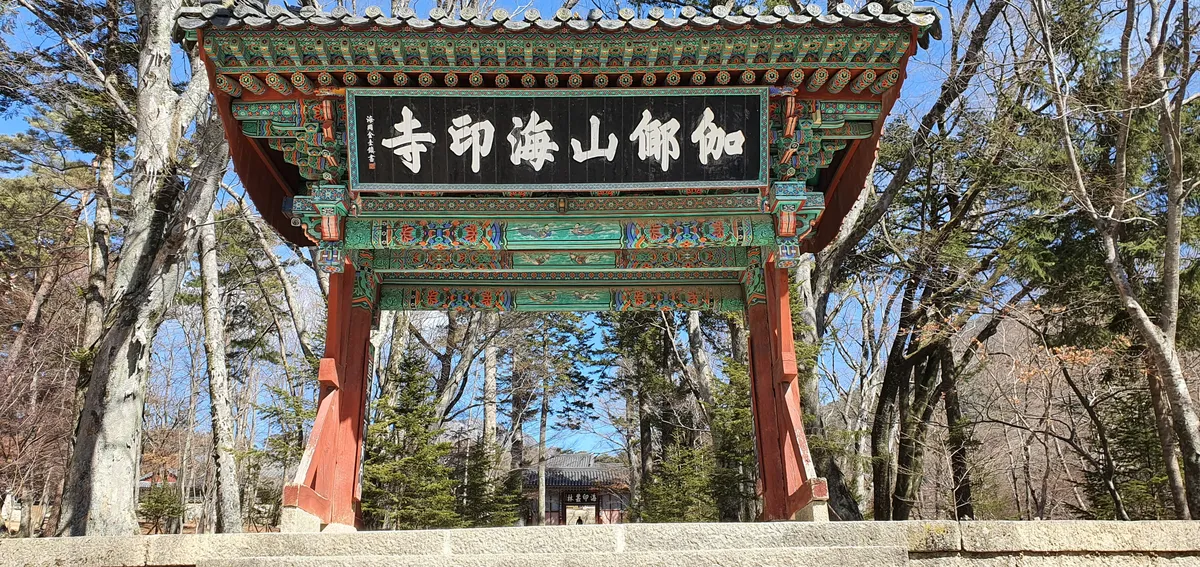
Haeinsa Hongha Gate, Hapcheon
陜川 海印寺 紅霞門
경상남도 합천군
Basic information
- Designation
- Treasure No.2232
- Category
- Architecture
- Era
- 조선시대
- Designated year
- 2023
- Location
- 합천군, 경상남도— 경상남도 합천군 해인사길 122 (가야면, 사찰)
- Coordinates
- 35.801200, 128.102200Museum-based location
AI Docent
Coming soonAn AI-generated, friendly retelling of this heritage site is available in Korean. An English version is on our roadmap — for now, please see the official description below.
Description
Machine-translatedThis English description was machine-translated and may contain inaccuracies. Refer to the original Korean text for details.
Hagjin Haein Temple's Hongha Gate (Red Wave Gate) lacks precise documentation of creation date, yet historical records transmit accounts of five repair cycles conducted since the 1457 (Sejo 3rd year) renovation, suggesting the gate's establishment during Haein Temple's expansion phase under royal patronage during King Sejo's reign. Historical accounts including Yuk Cheuk-gi's "Travel Record of Mount Gaya" (Yuga-san-gi, 1691-1767) and paintings such as Jeong Seon's (1676-1759) fan-painted "Haein Temple Landscape" and Kim Yun-gyeom's (1711-1775) "Haein Temple Landscape" confirm that by the eighteenth century, a sequential arrangement of gates including the single-pillar gate Hongha-mun, followed by the Phoenix Gate (Bongwhang-mun) and Liberation Gate (Haetal-mun) existed. The frontal facade displays a plaque reading "Mount Gaya Haein Temple" (Gaya-san Haein-sa), with an interior central plaque inscribed "Hongha Gate," while the rear facade displays "Premier Dharma-Teaching Hall of the Eastern Seas" (Haedong Jeil Doyangung). Hagjin Haein Temple's Hongha Gate comprises a single-bay gable-roof structure. The frontal curved-beam configuration supports six bracket members, with the overall composition incorporating fourteen bracket members utilizing multiple-bracket system designs. Roof construction employs overlapping curved and secondary rafters in double-eave configurations. The column design incorporates diagonally-crossed reinforcement materials flanking the primary pillars to provide roofing support. Typically, single-pillar-gate gable-roof structures employ approximately five bracket members, whereas this gate incorporates six bracket members, presenting a comparatively majestic appearance. Additionally, the bracket assembly configuration and integration methods retain the robust characteristics of early-Joseon architecture, conferring significant historical and scholarly value.
Location
지도를 불러오는 중…
Have you visited this place?
Log in and verify your visit on-site via GPS to record a stamp in My Journey. (QR verification coming later.)
Images: KOGL (khs.go.kr) · Data source: Korea Heritage Service Open API (khs.go.kr)