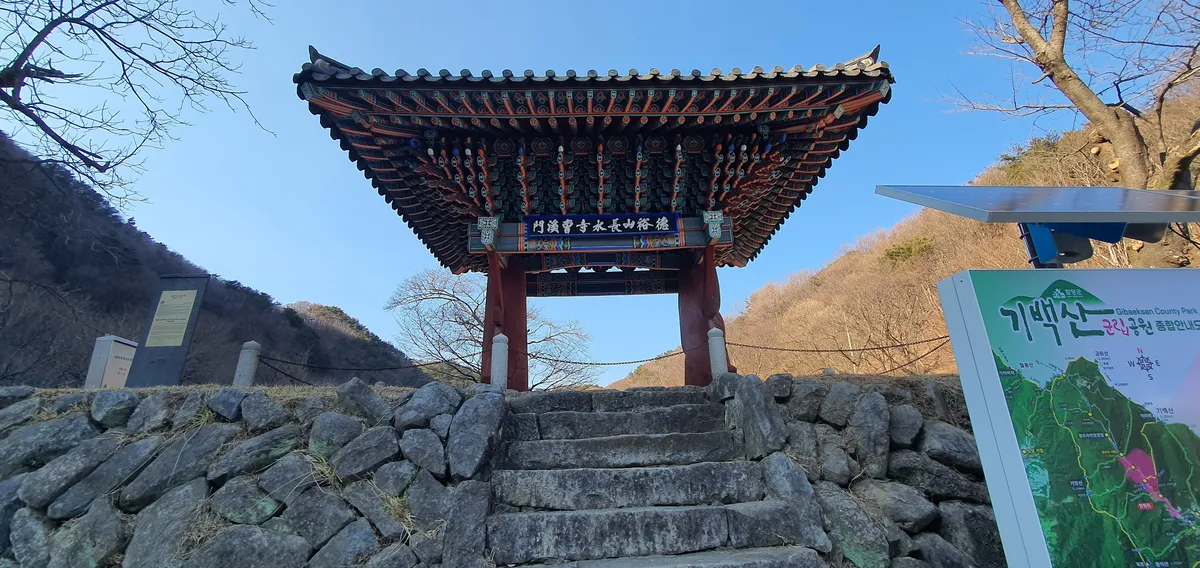
Yongchusa Iljumun Gate, Hamyang
咸陽 龍湫寺 一柱門
경상남도 함양군
Basic information
- Designation
- Treasure No.2233
- Category
- Architecture
- Era
- 조선시대
- Designated year
- 2023
- Location
- 함양군, 경상남도— 경상남도 함양군 안의면 상원리 960
- Coordinates
- 35.684187, 127.765638Kakao address conversion
AI Docent
Coming soonAn AI-generated, friendly retelling of this heritage site is available in Korean. An English version is on our roadmap — for now, please see the official description below.
Description
Machine-translatedThis English description was machine-translated and may contain inaccuracies. Refer to the original Korean text for details.
Hamyang Yongchu Temple's Single-Pillar Gate (Iljumun), also known as the Jogye Gate (Jogye-mun), occupies the sole surviving architectural structure of the ancient Jangsu Temple settlement within the Yongchu Valley region. The gate was constructed in 1711 (Sukjong 37th year). During the Korean War, Jangsu Temple was entirely destroyed by fire, with only this single-pillar gate and Neungpa Hall (Neungpa-gak) surviving the conflagration. The frontal curved-beam plaque inscription reads "Mount Deogyuu Jangsu Temple Jogye Gate" (Deogyusan Jangsu-sa Jogye-mun). Jangsu Temple originally occupied a location north of the single-pillar gate, whereas the present Yongchu Temple (Yongchu-sa) was reconstructed approximately 400 meters northward near Yongchu Waterfall at the former Yongchu Hermitage location in 1959. Hamyang Yongchu Temple's Single-Pillar Gate comprises a single-bay hip-and-gable-roof structure featuring overlapping curved and secondary rafters in double-eave configuration. The frontal curved-beam configuration supports seven bracket members, with the overall structure incorporating twenty bracket members utilizing multiple-bracket system designs. The column design employs diagonally-crossed reinforcement materials flanking the primary pillars for roofing support. Yongchu Temple's single-pillar gate benefits from clearly documented 1711 construction dating and bracket-system configuration reflecting original-period mid-Joseon architectural style preservation. The gate architecture demonstrates a comparatively majestic appearance through its seven-bracket composition, contrasting with the standard five-bracket single-bay hip-and-gable-roof configuration typical elsewhere, conferring high historical and scholarly value.
Location
지도를 불러오는 중…
Have you visited this place?
Log in and verify your visit on-site via GPS to record a stamp in My Journey. (QR verification coming later.)
Images: KOGL (khs.go.kr) · Data source: Korea Heritage Service Open API (khs.go.kr)